A good demo.
Then what?
- 01A task worth changing
- 02Evidence they can inspect
- 03An owner, action, and date
Check whether the prospect has an urgent problem, whether the demo proves their specific task, and whether someone can approve a next step. Separate a weak demonstration from a deal blocked by fit, timing, budget, or procurement.
A good demo.
Then what?
A prospect likes your product, asks thoughtful questions, and disappears after the demo. The missing piece may be a better demonstration. It may also be an absent budget owner, a workflow that is expensive to change, or a problem nobody needs to solve this quarter. Investigate the decision before producing another product tour.
This guide is for founders selling a working B2B product. The decision map, scripts, and fictional example below are original editorial tools. They are not results from a sales experiment.
Review a small set of recent opportunities, including losses and deals still waiting. Keep no-shows separate from attended demos. For each account, record what the buyer needed to decide and the last action they actually completed. A compliment is feedback; it is not a buying commitment.
| Observed behavior | Question to investigate | Evidence to seek |
|---|---|---|
| Prospect attends but has no current project | Is there a reason to change now? | A recent incident, deadline, recurring cost, or active evaluation |
| Prospect cannot connect the screens to their work | Did we demonstrate their task? | Their own explanation of the input, output, and remaining work |
| User wants it but cannot approve spending | Who owns the purchase? | A named decision maker and an agreed route to them |
| Pilot begins but nobody supplies data | Is setup blocked or the project unowned? | An input owner, access requirement, and scheduled task |
| Pilot works but the purchase waits | What approval or risk remains? | Buyer-confirmed security, integration, commercial, or procurement steps |
Label your explanation as a hypothesis until the buyer confirms it. Silence does not prove that price was the objection. Lost, disqualified, deferred, and pending deals belong in different rows.
Close's demo-discovery guide recommends learning a prospect's needs so the demonstration can focus on relevant capabilities. It is vendor-authored sales advice, not independent proof of a particular close rate. Our addition is a written decision record: task, proof needed, unresolved risk, next owner, and date.
For a low-cost, self-service product, do not turn these questions into an obligatory interview. A short public preview can help people decide whether a conversation is worthwhile. A public r/SaaS discussion describes frustration at having to book a call just to understand a product. That is an anecdotal usability signal, not a survey of all software buyers.
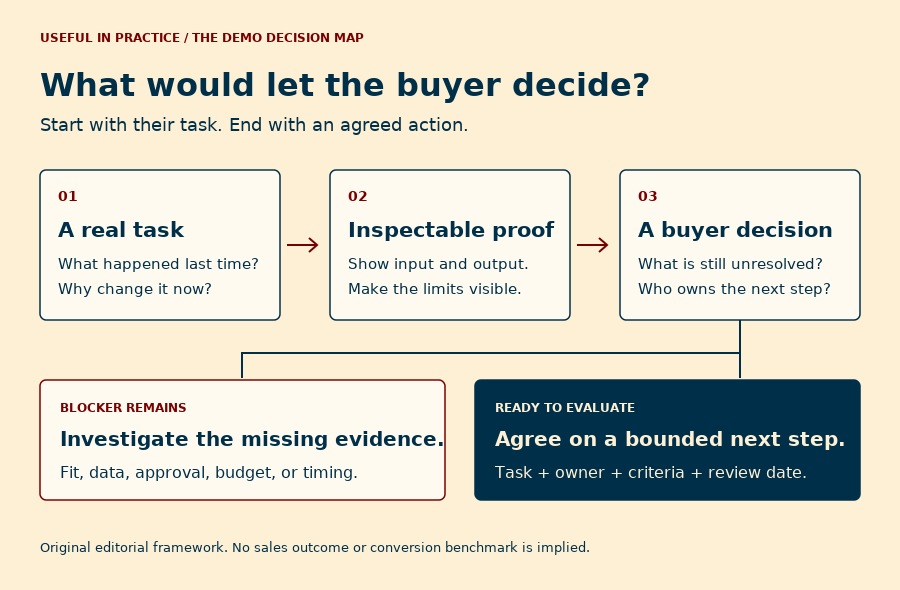
Replace “show the platform” with a decision such as: “Can the operations lead use our supported export to prepare next week's review, without copying confidential records into an unapproved service?” That sentence tells you what to demonstrate and what to leave out.
Show the input, the decisive interaction, the resulting output, and the human work left afterward. Make limitations visible. If the buyer needs a feature that does not exist, say so. A promised roadmap item cannot serve as evidence of today's product.
Fictional example: Loopback groups customer feedback for a product-review meeting. An operations lead is interested, but their manager controls the budget. The upcoming meeting provides a reason to evaluate it. None of this describes a real customer or reported sale.
| Demonstrate | Ask the buyer | Record |
|---|---|---|
| Import a synthetic file in the supported format | Could your team produce this input? | Input owner and format mismatch |
| Group requests and inspect the original wording | Which category would you change? | Required judgment and handling of exceptions |
| Save the reviewed output | Could you use this in the meeting? | Output requirement and missing integration |
| Explain current limits and trial terms | Who needs to approve a limited evaluation? | Approver, unresolved questions, next action |
Suppose the output is useful but the input requires a security review. The next job is to resolve data handling with the buyer's responsible team. Another animation or extra dashboard screen does not answer that objection. If synthetic data is acceptable for an initial evaluation, agree on what that evaluation can and cannot establish.
A pilot is appropriate when there is a real uncertainty to resolve and both sides can commit the required effort. It is not a default prize for every positive conversation. Define the commercial terms openly, including whether the evaluation costs anything and whether it creates any purchase obligation.
Copyable evaluation brief
Decision: [what the buyer will decide].
Scope: [one workflow, users, and permitted inputs].
Evidence: [observable output and acceptance criteria agreed before starting].
Owners: [buyer task owner], [approver], [founder contact].
Dependencies: [access, data, security, integration].
Terms: [price or free status, support, limits, end date, obligations].
Review: [date and participants].
Possible outcomes: proceed, revise a specific gap, or stop.
For a regulated fintech or healthtech buyer, ask who can authorize the proposed data use and what evidence their review requires. Do not improvise compliance claims or promise that a successful demo bypasses procurement. NYC enterprise teams, SF developer-tool buyers, and YC founders may use different purchasing processes; confirm the actual account's process.
Replace a generic recap with the problem discussed, the evidence inspected, the remaining gap, and the proposed next action. Here is a template to adapt only after the buyer has agreed to that action.
Subject: [Task] evaluation: next step for [date]
Thanks for showing me how your team handles [task]. We checked [specific workflow] and saw [actual output, without an invented benefit].
The open question is [blocker]. [Owner] will [agreed action] by [date]; I will provide [agreed material].
On [review date], we can decide whether to proceed, adjust the scope, or stop. Please correct anything I have misunderstood.
If no action was agreed, ask whether there is a useful next step instead of writing as if a pilot is booked. If the buyer says the problem is not urgent, record that and respect the timing. A tidy pipeline is more useful than a long list of imaginary opportunities.
Track attended demos, agreed evaluations, started evaluations, completed reviews, and paid outcomes for a defined account cohort. Record days elapsed and keep open deals visible. Do not divide this month's payments by this month's demos when those payments came from earlier conversations.
Start with counts and buyer explanations. With a small sample, “three prospects could not get an approved input file” is a more actionable finding than a sweeping close-rate claim. A larger sample still needs comparable sources, buying motions, and enough elapsed time before you interpret a change.
Download the demo decision worksheet and review one recent opportunity. Use the free SaaS demo script to plan what the buyer needs to see. If people try the product but stall during setup, continue with the signup-to-activation guide.
For help producing the demonstration itself, inspect Stephen's existing product demo services and describe your audience, workflow, and available access. Scope and availability require agreement. If your task is organizing reusable campaign copy, the optional Product Content Engine provides editable frameworks and exports. It does not record demos, run your sales process, or guarantee customers.
Sources checked October 31, 2026. This is independent editorial analysis with original templates, a labeled fictional example, a vendor-authored reference, and an unverified community account. Links here are ordinary source links. Paid services and products are offered by this publication; their inclusion does not establish sales results. See editorial standards.
A two-week plan for finding your audience, diagnosing missing clicks, and testing one useful offer.
A seven-piece content map, sample copy, and a practical reason for readers to click through.
A reusable test packet and scorecard for writing that preserves your facts and examples.
A conversion diagnostic, clear positioning examples, and a worksheet for deciding what to fix first.
Check technical access, build useful evidence, and keep a repeatable AI visibility log without a paid subscription.
A first-value map, cohort example, user interview script, and a seven-day onboarding investigation.