How to launch a SaaS product with no marketing budget
Choose one reachable audience, show one problem your product can solve, and give interested people a small next step. Use conversations, useful content, and relevant communities to test that offer.
A useful reason
to visit.
- 01People with the problem
- 02Something they can use
- 03One clear next step
You launched the site, published the announcement, and watched the view count barely move. The next job is to find people with the problem your product solves and give them a reason to visit a specific page.
This guide assumes you have a working product or an honest demonstration of what exists. “No marketing budget” means no additional spend on promotion. Your time, hosting, product development, and any existing software still have a cost.
Why is my new SaaS website getting no traffic?
Start by separating discovery, clicks, and useful action. Low traffic can have several causes, and each needs a different response.
| What you can observe | First thing to investigate | A useful next move |
|---|---|---|
| The page is not indexed | Whether Google can access and index the preferred URL | Check URL Inspection in Search Console, the canonical, and indexing restrictions |
| Indexed, but few search impressions | Whether the page answers a specific question and reaches a relevant audience | Improve one useful answer and link to it from a related page |
| Impressions, but few clicks | Query relevance and whether the title describes a useful result | Compare the query with the page's actual answer before rewriting the title |
| Social views, but few site visits | Whether the post gives people a reason to leave and the link works | Send readers to a worked example, template, or tool tied to the post |
| Visits, but no meaningful next action | Whether the page delivers what brought people there | Offer a relevant sample, trial, or next step and check for friction |
A social impression, server request, page view, and unique visitor are different measures. Keep the reporting period and source with each number. A visit to a crawler file such as robots.txt is not evidence that a potential customer read your product page.
For official search guidance, use Google's SEO Starter Guide. To understand search impressions and clicks, read the Search Console Performance report documentation.
Start with a launch small enough to learn from
For a first experiment, use a statement like this:
For [specific person], our product helps with [recurring task]. This week, we want to learn whether [observable action] is worth taking.
An observable action could be agreeing to a walkthrough, trying a workflow with sample data, or paying for access. Pick one that fits the product's readiness. A waitlist signup and a paying customer answer different questions.
Here is a fictional example used throughout this guide:
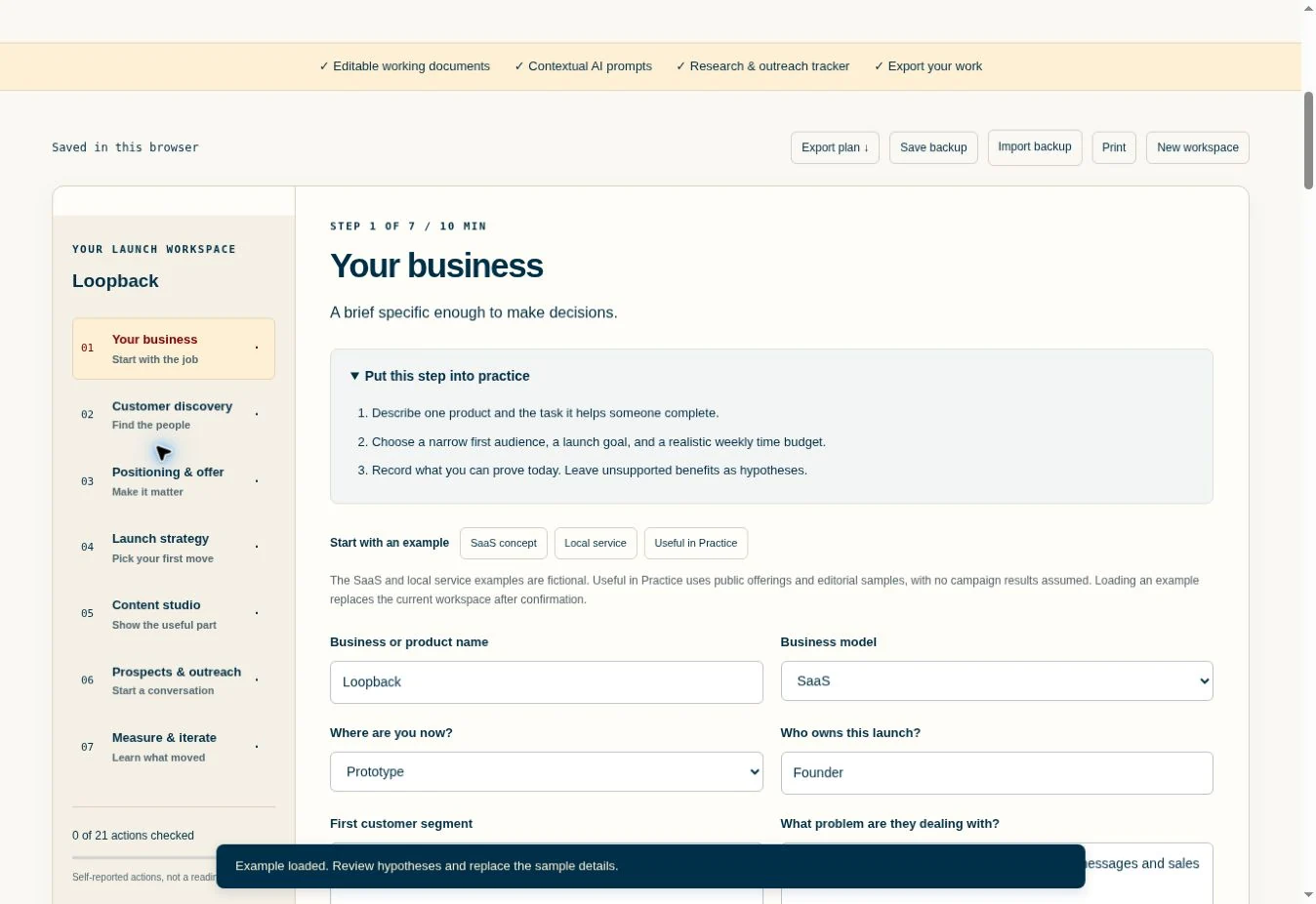
Loopback helps small SaaS teams organize feedback from support and sales. Its first audience is founders who currently copy feedback into a spreadsheet. Its initial offer is a short walkthrough using synthetic feedback. Its experiment target is three design-partner conversations within two weeks. That target is a planning choice, not a reported result or universal benchmark.
Give the product one clear page
Before asking anyone to visit, make these five things understandable:
- Who the product helps.
- The task it handles today.
- What the person needs to supply or connect.
- A screenshot or short demonstration of the real workflow.
- One action they can take next.
For Loopback, that could be: “Group feedback from support and sales before your next product review. See a sample workflow.” A dashboard image alone does not explain why someone should care.
Keep planned features separate from available features. If a human completes part of the process, describe that part accurately.
Find conversations before choosing channels
Start where your audience already discusses this task: existing professional relationships, relevant founder groups, public discussions, and organizations that serve the same people.
Record the problem, the person's role, the current workaround, and the context. Treat an expression of frustration as a research lead, not automatic permission for repeated promotion.
For Loopback, a useful question is: “How did you decide which customer requests to discuss at your last product meeting?” It invites an account of actual work. “Would you use an AI feedback platform?” mostly invites speculation.
When responding in a community, answer the question in the discussion. Disclose that you built the product and share a link only when relevant and permitted. Do not copy the same pitch across unrelated threads.
Publish something that helps before the purchase
Make one small asset someone can use independently. For the fictional feedback tool, that might be a feedback-triage spreadsheet with example categories and a worked product-review agenda.
Then demonstrate how the product supports that same workflow. Readers should be able to understand the task and inspect your reasoning without subscribing first.
The useful asset gives you something concrete to distribute: a professional contact can forward it, a community member can try it, and a potential partner can judge whether it suits their audience.
How do I turn early conversations into a first paying customer?
Choose people who already face the task and can authorize a purchase. A relevant job title is only a starting filter. Ask about the last occurrence, the current workaround, the person who owns it, and whether anyone is trying to change it now.
| Check | Useful evidence | What it does not establish |
|---|---|---|
| Recurring problem | A recent task and the next expected occurrence | A general complaint does not establish urgency |
| Cost of the workaround | The buyer's actual time, spend, delays, or errors | Your estimate is not a verified saving |
| Ability to purchase | A buyer or an agreed introduction to the approver | A user saying “I like it” is not approval |
| Willingness to commit | A specific evaluation or purchase on clear terms | Free access and compliments do not establish willingness to pay |
In a November 2022 founder account on Hacker News, Supademo's Koushik reported 340 signups and ten paid customers after a public launch, following a beta. He described community discovery, conversations, product changes, and updates. Those figures are self-reported and historical. They illustrate the distinction between signups and customers, not a repeatable two-week acquisition promise.
Conversation opener to adapt: I saw you mentioned [specific task or problem]. How did you handle it last time? I'm building [honest description] and trying to understand where the current approach breaks down. If it's relevant, I can share a small example. No need to book a call.
Use an opener only when the observation is real and contact is appropriate. In an existing conversation, describe what is available, the actual price and terms, and a proportionate next action. When an interested buyer needs evidence, use the demo decision guide. When they create an account but stop, use the activation investigation.
Run this two-week launch experiment
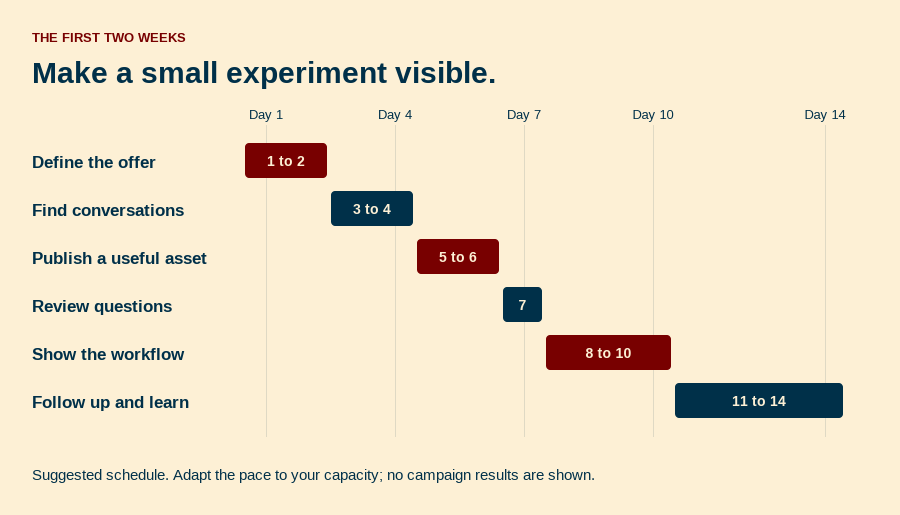
The quantities below are suggested limits to keep the work manageable.
| When | Work | Evidence to keep |
|---|---|---|
| Days 1 and 2 | Choose one audience, one offer, and one next action. Check the product page. | A short brief and a working destination |
| Days 3 and 4 | Find ten relevant people or discussions. Start appropriate individual conversations. | Actual wording about the problem and workaround |
| Days 5 and 6 | Publish a worked example and one useful resource. | The asset and links used to share it |
| Day 7 | Review replies and questions. Clarify the explanation where people misunderstand it. | Objections and unresolved questions |
| Days 8 through 10 | Demonstrate the workflow to interested people. Record where they hesitate. | Notes on fit, setup, and next actions |
| Days 11 through 14 | Follow up where invited. Review the experiment and choose one change. | A decision to refine, repeat, or change direction |
Use a simple log: source, destination, visit count if available, meaningful reply, walkthrough, activation, payment, and what you learned. Keep customer information private and collect only what you need.
Diagnose the step that failed
| What happened | What to investigate next |
|---|---|
| Few relevant people saw the offer | Audience access and where you shared it |
| People saw it but did not visit | Whether the problem and next action were clear enough |
| People visited but took no next step | Relevance, evidence, friction, and the offer itself |
| People tried it but did not complete the task | Product fit, setup requirements, and usability |
| People completed the task but did not return | Whether the problem recurs and the result remains useful |
These are diagnostic questions. Small samples cannot establish a reliable conversion benchmark or prove why an individual person left.
What about SEO?
Write a durable guide when you have a problem you can explain well and a useful example to contribute. For Loopback, a guide to running a customer-feedback review would fit the same audience as the product.
Search can be part of distribution, but a new page is not a dependable source of immediate launch traffic. Continue the direct conversations while you learn which questions deserve a fuller answer.
Build the plan with a free workspace
The Launch to Market workspace helps organize the audience, offer, research, content, outreach, and experiment review. It is free to use without an account. Work saves in your browser; export a backup if you want to keep a portable copy.
If you want expanded offline files and worked launches, you can also inspect the optional Launch to Market Toolkit. The plan above works without purchasing it.
Can I launch without an audience?
You can begin with individual conversations and small communities you can participate in appropriately. Having no audience means you need to build access and trust alongside the product explanation. It does not remove that work.
Do I need to post every day?
Use a cadence you can sustain while responding to interested people. In this experiment, the purpose of content is to support useful conversations and product use. Daily posting is not an experiment requirement.
Should I offer the product free?
Choose terms that fit the question you want to answer. Free access can test usability; it does not establish willingness to pay. State trial limits, pricing, and any obligations before someone commits.
Substantively updated October 31, 2026 with a first-customer qualification method, conversation template, historical founder source, and follow-on diagnostics. The fictional Loopback plan is teaching material. This publication sells the optional toolkit linked above; no customer acquisition result is promised.
Keep the useful work moving.
How to turn one product demo into a week of content
A seven-piece content map, sample copy, and a practical reason for readers to click through.
How to choose an AI writing tool that uses your source material
A reusable test packet and scorecard for writing that preserves your facts and examples.
Why is my SaaS website getting traffic but no signups or sales?
A conversion diagnostic, clear positioning examples, and a worksheet for deciding what to fix first.
How do I get my business recommended by ChatGPT and other AI search engines?
Check technical access, build useful evidence, and keep a repeatable AI visibility log without a paid subscription.
Why are my SaaS product demos not converting into sales?
A buyer decision map, discovery questions, pilot brief, and follow-up email for founder-led sales.
Why do people sign up for my SaaS but never use it?
A first-value map, cohort example, user interview script, and a seven-day onboarding investigation.