How do I get my business recommended by ChatGPT and other AI search engines?
Make your public pages accessible, explain the buyer problem clearly, and publish evidence that helps people evaluate your business. Track a small set of real questions and actual referrals. No setup or content tactic guarantees a recommendation.

When an AI answer recommends three businesses and yours is missing, it is tempting to search for a special ranking trick. Start with a question you can investigate: can the service retrieve accurate information about your business, and does that information help answer a real buyer’s question?
This guide focuses on public web search and citations. A model answering from stored knowledge, a search-grounded answer, and a shopping experience can behave differently. A mention is not necessarily a recommendation, and a recommendation is not a sale.
Already managing a business profile? Read the Briefing on claiming a business in ChatGPT for what Business Hub lets you update and how to test the answers buyers see.
Can I make ChatGPT recommend my business?
You can improve eligibility for discovery and publish useful evidence. You cannot guarantee a recommendation or position. OpenAI says ChatGPT Search uses several ranking factors and does not guarantee placement. Treat any guaranteed-ranking offer with skepticism.
For Google’s generative AI features, its official guidance emphasizes existing SEO foundations and distinctive, useful content. Do not assume that every search service uses identical crawlers, controls, sources, or ranking rules.
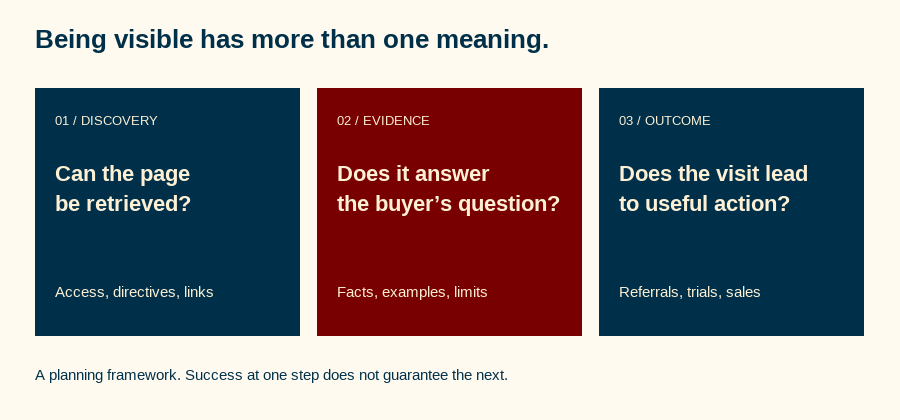
1. Check access before rewriting content
Open the exact public page without signing in. Confirm it returns the intended content, uses a sensible canonical URL, and is linked from a relevant part of your site. Inspect robots rules, indexing directives, and any CDN or firewall challenge. An accessible homepage does not prove every product page is retrievable.
For ChatGPT Search, OpenAI recommends allowing OAI-SearchBot and its published IP ranges. Its crawler documentation distinguishes search access from GPTBot, which relates to model training. Review those choices independently.
For Google, use URL Inspection in Search Console to investigate the preferred page. Check the current controls for inclusion in generative AI features too. A successful inspection, sitemap submission, or bot visit is evidence about access or discovery, not a promise of a citation.
Developer handoff: “Please check this page’s status, canonical, robots directives, indexability, internal links, and verified crawler access. Tell me what you observed and which logs or tools support it.” Asking a chatbot to read a URL once does not test every crawler route or ranking system.
2. Choose questions that reveal a buying situation
Start with customer emails, sales conversations, support questions, and relevant search queries. Keep the real words and context. “Best software” is less informative than a specific constraint such as “How can a two-person agency collect project briefs without paying for another CRM?”
| Broad topic | A useful buyer question | Evidence to publish |
|---|---|---|
| AI writing | Can this tool use my source files without inventing product claims? | A source packet, task, draft, and fact-check notes. |
| Customer intake | Can a freelancer collect different briefs for two services? | Both form paths and a completed sample brief. |
| SaaS launch | What can I do when I have a working product and no ad budget? | A bounded launch plan with examples and review criteria. |
Publish when you can supply something concrete: a workflow, supported feature, honest limitation, real screenshot, dated test, or worked example. Explain who should choose a different solution too. This is editorial judgment about usefulness, not a known ranking formula.
3. Make your business and evidence understandable
A visitor should be able to establish what you sell, who it serves, how it works, what it costs or how to request a quote, and who is responsible. Keep relevant product facts consistent across your public pages and profiles.
Place original evidence beside the claim it supports. A screenshot should show the task, not merely decorate the page. A comparison should state the input, date, product version or plan where relevant, and limits. Link sources for facts you did not establish yourself.
For example, Useful in Practice’s source-material writing guide offers a reusable test packet and answer key. A founder can apply the method without trusting a generic “best AI tool” list. That is a concrete editorial contribution; it does not establish that AI engines will cite it.
What should I avoid spending time on?
- Buying artificial mentions. Pursue legitimate coverage and partnerships because they reach relevant people and establish verifiable context.
- Publishing every question variation. Add a new page when it answers a distinct need with distinct evidence. Improve an existing guide when the intent overlaps.
- Treating llms.txt or special schema as a ranking switch. Google says it does not use llms.txt for Search and requires no special AI schema. Other services can have different uses for machine-readable files.
- Presenting one prompt result as market share. Answers can vary with wording, time, location, search behavior, and conversation context.
4. Keep a small, repeatable visibility log
Choose five buyer questions as a manageable starting sample. Use a fresh conversation for each check, record whether search was used, and keep the wording, market, service, date, answer, and citations. Repeat on a schedule you can maintain, such as weekly. This is a spot check of those questions, not a census of what buyers see.
Track mentions, cited URLs, factual accuracy, and whether the described use case fits. If the answer gets your product wrong, check the relevant public sources before assuming the model is the only cause. Improve the source, record the change, and compare later observations without claiming causation from one changed answer.
Download the AI visibility log and checklist. It includes a repeatable question template, a citation log, and a place to record actual referral outcomes.
5. Measure the visit after the mention
Separate observed mentions from referred visits, qualified inquiries, trials, and payments. Referral analytics can miss journeys, so allow a person to explain how they found you. Do not silently turn unknown traffic into AI-attributed revenue.
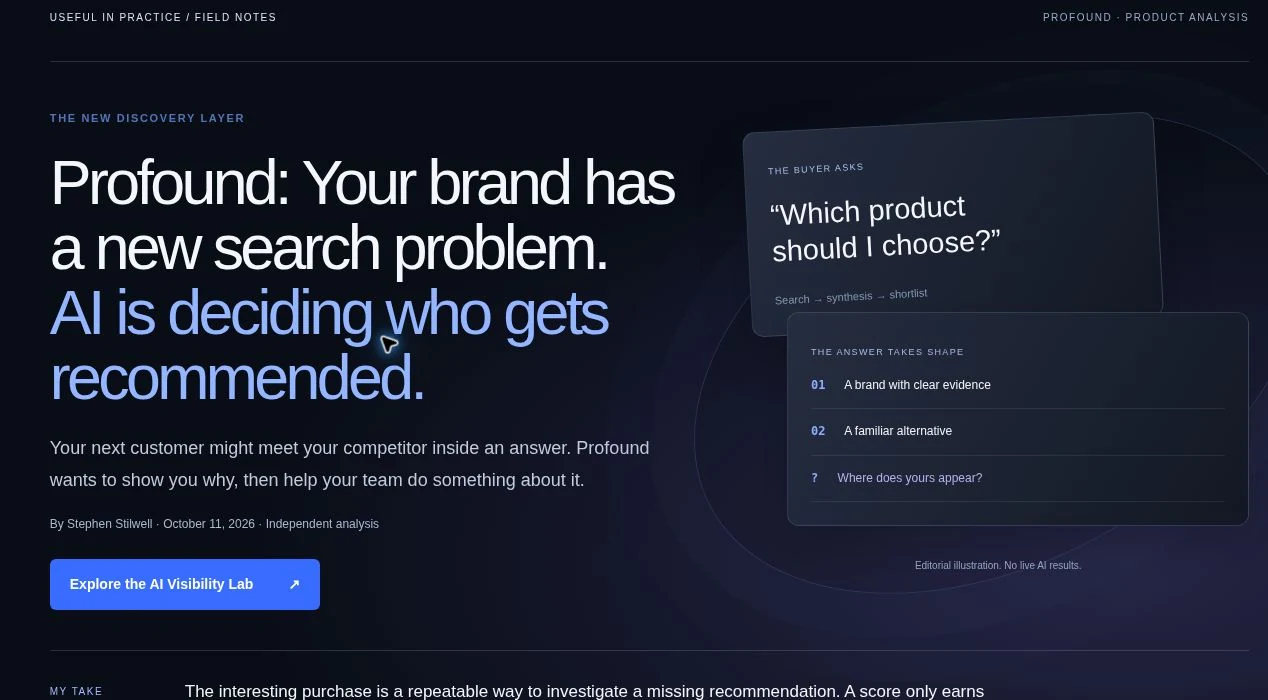
Useful in Practice’s existing public pages illustrate the distinction: the Profound Field Note explores a monitoring workflow, while the conversion troubleshooting guide helps investigate what happens after someone arrives. Monitoring software can help organize repeated checks when the workload justifies it. You can begin with a document and analytics you already use.
Your first week without a monitoring subscription
- Check one important page. Confirm public access, discovery links, canonical, and relevant crawler controls.
- Write down five real buyer questions. Preserve context and constraints.
- Record a baseline. Save the answers and cited URLs, including when you are absent.
- Improve one useful answer. Add a real example, supported facts, and a clear next action.
- Review outcomes later. Track accuracy and actual referrals alongside mentions. Keep expectations proportional to the sample.
Common questions about AI search visibility
Is GEO different from SEO?
GEO commonly refers to visibility in generated answers. Many practical tasks overlap with SEO: public access, clear information, useful content, and credible evidence. The services have different controls, and a normal search position does not guarantee an AI recommendation.
Do I need to pay for a monitoring tool?
You can start by recording a small fixed set of questions manually. Evaluate a paid tool when you need broader coverage, repeated checks, team workflows, or a way to manage enough observations to justify the cost.
How long does it take?
There is no dependable timetable for a recommendation. Separate immediate technical fixes from later discovery and answer changes. Record what changed and avoid promising a deadline for an outcome you cannot control.
Sources checked October 30, 2026: OpenAI Search guidance, OpenAI crawler documentation, and Google’s generative AI search guide. The workflow and examples are Useful in Practice’s editorial recommendations. Provider rules can change.
Keep the useful work moving.
How to launch a SaaS product with no marketing budget
A two-week plan for finding your audience, diagnosing missing clicks, and testing one useful offer.
How to turn one product demo into a week of content
A seven-piece content map, sample copy, and a practical reason for readers to click through.
How to choose an AI writing tool that uses your source material
A reusable test packet and scorecard for writing that preserves your facts and examples.
Why is my SaaS website getting traffic but no signups or sales?
A conversion diagnostic, clear positioning examples, and a worksheet for deciding what to fix first.
Why are my SaaS product demos not converting into sales?
A buyer decision map, discovery questions, pilot brief, and follow-up email for founder-led sales.
Why do people sign up for my SaaS but never use it?
A first-value map, cohort example, user interview script, and a seven-day onboarding investigation.