Why is my SaaS website getting traffic but no signups or sales?
Check that the journey works, separate relevant visitors from broad traffic, and find the first step people fail to complete. Then investigate clarity, trust, signup friction, or product value before choosing one change.

Getting visitors can feel like progress until the signup count stays at zero. Before rewriting the whole website, find the first step people are not completing. A page can attract the wrong audience, explain the right product poorly, or lose interested buyers to a broken form. Those need different fixes.
This guide separates five questions: did the right person arrive, understand the offer, believe it, start, and reach a useful result? Use the diagnostic to choose an investigation. It cannot see your analytics or establish why someone left.
Where should I look first?
Choose the earliest statement you cannot confidently say is working. Start with a technical check even if you suspect the copy.
Is the conversion problem real?
Count people reaching a defined stage, not every server request. Exclude your own testing, known bots, duplicate events, and irrelevant pages where possible. Compare the same period, source, device, and intended action. An article reader and a visitor referred by a prospective customer do not have the same intent.
Trace this sequence: product-page visitor → signup started → signup completed → first useful task completed → paid customer. Define the useful task in product terms, such as importing a feedback file and producing a review queue. An account creation is not the same as getting value.
For trials that last several days, follow the same signup cohort through its decision window. This week’s payments divided by this week’s signups mixes different groups. Google Analytics funnel exploration can help inspect sequential stages; your product database and payment records help verify completed actions.
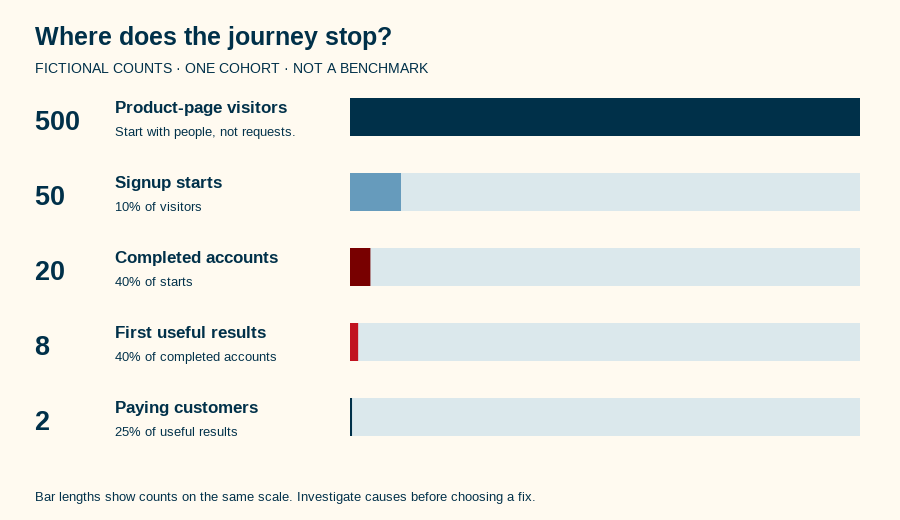
If only a few relevant people arrived, zero signups is weak evidence. For perspective, even if each visitor independently had a hypothetical 2% chance of signing up, 30 visitors would still have roughly a 55% chance of producing zero signups (0.98³⁰). That assumption is a mathematical illustration, not a forecast or an industry rate.
What does each symptom suggest?
| Observed symptom | First investigation | A useful check |
|---|---|---|
| Errors or missing confirmations | Technical path | Complete the journey and inspect the saved record, email, and error state. |
| Only page views are available | Measurement | Verify one event or record for each stage before interpreting drop-off. |
| Broad article traffic, little product interest | Audience and intent | Separate sources and landing pages. Read the query or referral that brought people. |
| Relevant visitors, few signup starts | Offer, clarity, and evidence | Ask target buyers what the product does and what makes them hesitate. |
| Started forms, few completed accounts | Signup friction | Check mobile validation, required fields, verification emails, and plan surprises. |
| Accounts without a useful result | Activation | Watch a new user attempt the first task without coaching. |
| Useful results without payment or repeat use | Value, timing, and buying process | Ask about the last real attempt, recurring need, decision maker, and current workaround. |
Which investigation fits the evidence you already have?
Write down the earliest stage that is failing before deciding to rewrite a headline or buy a tool. Use these routes to go deeper without mixing acquisition, sales, and product-use problems.
| What you can verify | Next question | Practical guide |
|---|---|---|
| Very few relevant visitors | Can you reach people with a current reason to care? | Run a small launch and first-customer experiment |
| Attended demos without an agreed next action | What decision or purchasing constraint remains? | Diagnose a demo that stalls before the sale |
| Real accounts without a completed customer task | Which input, permission, or usability step blocks first value? | Investigate signups that never activate |
For example, a founder in a public discussion about a link-management product reported roughly 240 signups and no paying customers. That self-reported account establishes neither the cause nor a representative SaaS conversion rate. It shows why “more registrations” can leave the commercial question unanswered. The missing evidence is what those accounts did and why active users declined to buy.
Choose software only after identifying a capability gap. A manual account review can precede an analytics purchase; a short, inspectable demo can precede a demo platform. If you cannot connect your counts to people completing a task, write “unknown” rather than calculating a visitor-to-customer rate from incompatible totals.
Can a visitor explain what you sell?
Show the first screen to someone who fits your audience, then hide it. Ask: who is this for, what task does it help with, and what would you do next? A small conversation can reveal misunderstandings. It is qualitative evidence, not a conversion test.
The examples below rewrite the fictional Loopback offer from our no-budget SaaS launch guide. They are editorial demonstrations, not tested winners.
Unlock the future of customer intelligence.
The all-in-one AI platform to transform your business.
A visitor cannot tell which task is handled, who it serves, or what starting requires.
Turn scattered feedback into your next product-review queue.
For small SaaS teams collecting requests in spreadsheets. Import a feedback CSV, group related requests, and keep the original customer wording beside each theme.
Show the real import and result. State supported formats and limits before signup. Only make these claims if the product actually does this.
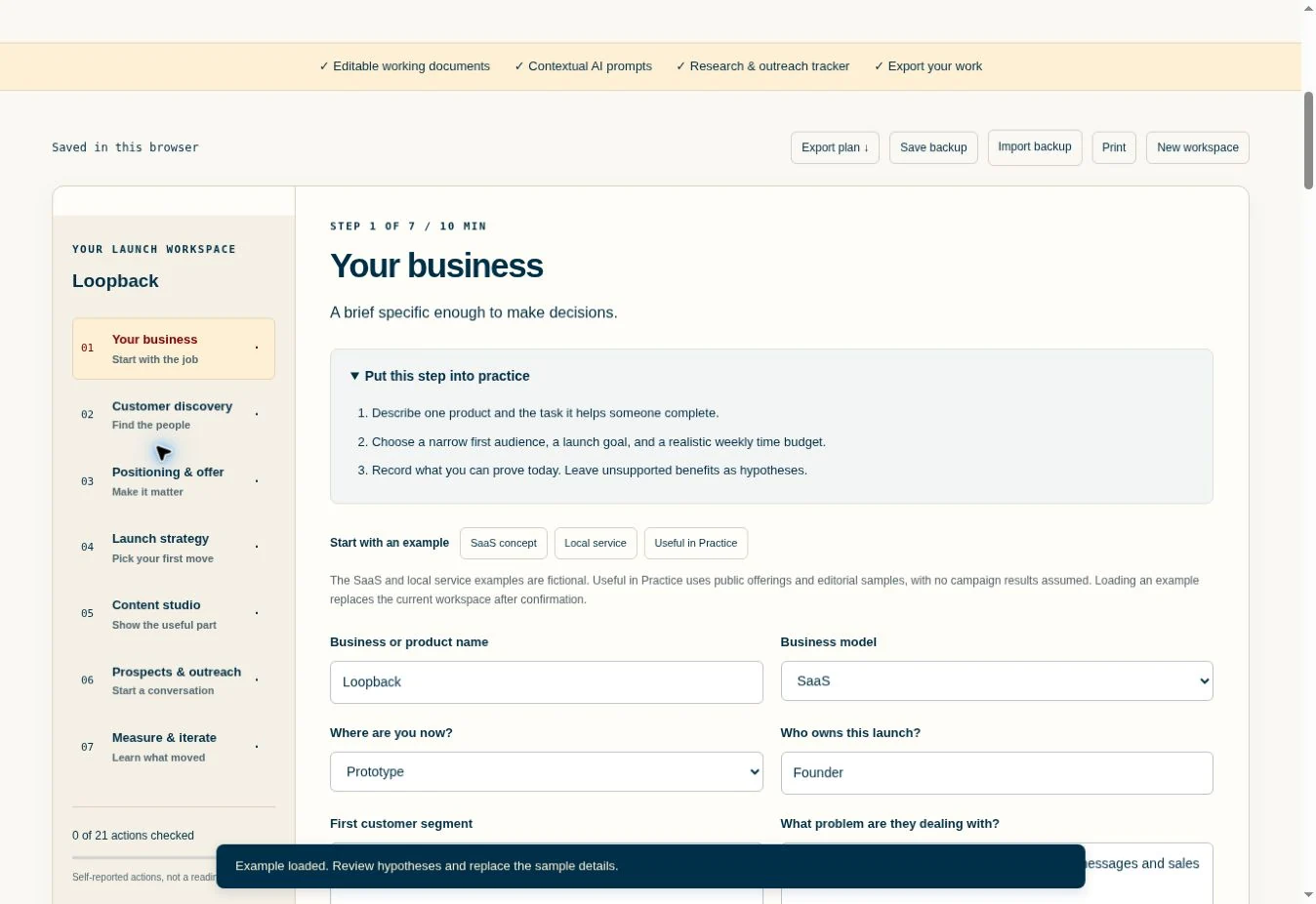
A specific headline creates an expectation the rest of the page must satisfy. Put the relevant workflow screenshot next to that explanation. Caption what went in, what came out, and what the user still needs to do. A real sample result is more useful than a decorative dashboard with invented customer numbers.
What does a cautious buyer need to believe?
List the risks the next step creates: setup time, importing sensitive data, providing a card, switching a workflow, or involving colleagues. Then answer the concern with evidence close to the decision.
- “Will it work for my input?” Show a supported sample file, the resulting output, and known limits.
- “What will it cost?” Explain the billing unit, relevant limits, and what happens after a trial.
- “Can I trust this business?” Identify the maker, support contact, terms, and privacy information.
- “How long until I see something useful?” Show the actual setup steps. Use measured timings only when you have recorded them.
If you lack testimonials, use a transparent demo and a sample project. Do not manufacture logos, customer quotes, usage counts, or performance claims to fill the space.
Does the next step match the commitment?
Match the button to its destination. “See an example” should open an example. “Start a trial” should explain the trial’s relevant conditions before someone commits. A surprise sales form or card requirement changes what the visitor thought they agreed to.
Try the flow with keyboard navigation and a narrow phone screen. Submit an invalid email, leave a required field empty, correct it, and retry. Confirm the message explains how to recover and preserves useful input. If verification is required, check delivery and the expired-link experience.
Remove a field only after understanding why it exists. A company-size question might be unnecessary for a self-service preview but essential for routing an enterprise implementation. The objective is a proportionate next step, not the shortest form in every situation.
What should I change first?
Choose one change tied to an observed problem. For low traffic, a few relevant conversations and a repaired journey are often more informative than an A/B test that will take months to learn from.
Use a hypothesis you can inspect: “Visitors from the founder newsletter cannot tell whether Loopback imports a spreadsheet. We will show the real CSV-to-queue workflow above the signup link. We will review signup starts from that same referral source and ask new users what was unclear.”
Record your baseline, change date, source, device mix, and review window. Watch a guardrail such as activation or refund requests, so you do not optimize for accounts that never get value. With a small sample, report the counts and feedback rather than declaring a percentage lift to be proof of causation.
Write your next conversion experiment
Complete the worksheet, then download your notes. Entries stay in this open page, are not submitted, and disappear on reload. The download contains the diagnostic recommendation too.
Download the blank conversion worksheet. If the investigation shows your audience, offer, and launch plan need work, the free Launch to Market workspace can organize the next step. The optional paid Launch to Market Toolkit adds reusable files and worked examples. You can use this guide and diagnostic without purchasing it.
A few common questions
Should I lower my price if nobody signs up?
First establish whether relevant visitors understand the offer and can complete signup. If people get value and still decline to pay, investigate price alongside frequency of need, alternatives, and purchasing authority. A discount cannot repair an unclear or broken journey.
What is a good SaaS conversion rate?
It depends on the audience, channel, product, commitment, and denominator. A demo request, free account, activated trial, and paid subscription are different outcomes. Begin with a reliable baseline for your own funnel and comparable visitor groups.
Should I buy more traffic?
Repair obvious errors and clarify the offer first. Then a small, relevant acquisition experiment may help test demand. More visitors from an unrelated audience will make the total larger without answering the conversion question.
Method: this is an editorial troubleshooting framework with fictional teaching examples. It does not report a controlled conversion study or audited client results. Measurement reference: Google Analytics funnel exploration, checked October 30, 2026. Updated October 31 with a stage-specific investigation table, a self-reported founder example, and routes to sales and activation guides.
Keep the useful work moving.
How to launch a SaaS product with no marketing budget
A two-week plan for finding your audience, diagnosing missing clicks, and testing one useful offer.
How to turn one product demo into a week of content
A seven-piece content map, sample copy, and a practical reason for readers to click through.
How to choose an AI writing tool that uses your source material
A reusable test packet and scorecard for writing that preserves your facts and examples.
How do I get my business recommended by ChatGPT and other AI search engines?
Check technical access, build useful evidence, and keep a repeatable AI visibility log without a paid subscription.
Why are my SaaS product demos not converting into sales?
A buyer decision map, discovery questions, pilot brief, and follow-up email for founder-led sales.
Why do people sign up for my SaaS but never use it?
A first-value map, cohort example, user interview script, and a seven-day onboarding investigation.