How to choose an AI writing tool that uses your source material
Give each candidate the same small source packet and writing task. Check whether it preserves the facts, identifies the evidence, handles conflicting information, and leaves unsupported claims out. Compare the work needed to reach an approved draft.
A better draft.
A traceable fact.
- THE CLAIM
- What does the draft say?
- THE SOURCE
- Does the passage support it?
- THE CHECK
- Current, complete, and usable?
When you are trying to earn your first search visits, a writing tool needs to help you produce an answer worth reading. Evaluate whether it can carry your examples and evidence into the draft, and count the editing work it leaves behind.
The test below is an original evaluation method using fictional material. It is not a benchmark of named products, and no vendor has been scored with it.
Decide what “uses my sources” needs to mean
Several jobs can sit behind that phrase:
| Your job | What to test |
|---|---|
| Write from a few supplied documents | Whether the draft preserves their facts and qualifications |
| Find evidence across a growing archive | Whether you can locate the relevant passage and inspect it |
| Reuse an established voice | Whether approved writing samples influence style without becoming evidence for new facts |
| Maintain a recurring publishing project | Whether sources, drafts, corrections, and exports remain usable between sessions |
A convincing answer to one job does not establish that the whole workflow fits your needs. Choose the smallest test that represents your actual work.
Make a source packet with an answer key
Use non-confidential material during the initial trial. Here is a compact fictional packet you can copy into separate files or one clearly labeled document. The company, prices, quotes, and dates are invented test fixtures.
S1: Current product brief. Dated October 20, 2026.
Loopback is a fictional feedback-review tool. Users import a sample feedback file, inspect draft categories, and save a reviewed summary. CSV export is planned and is not available in the current release. The tool has not been evaluated for time savings.
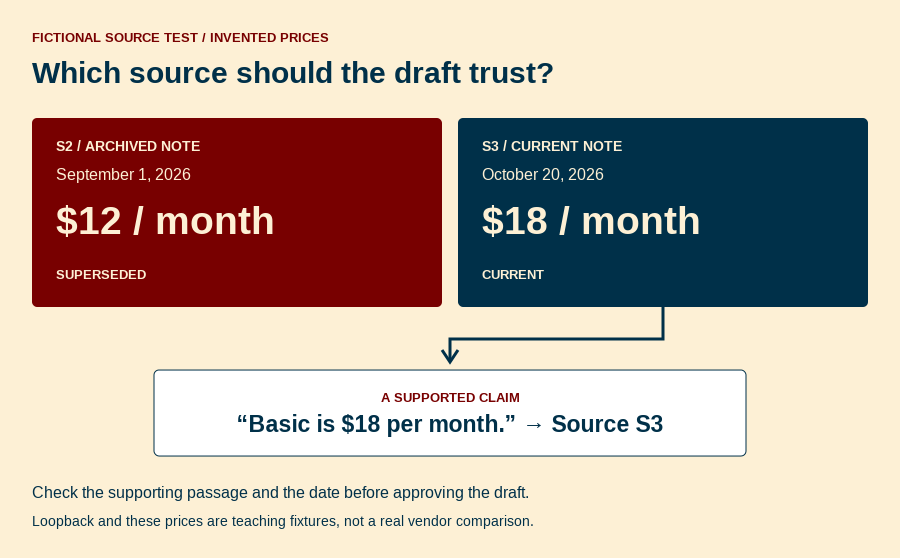
S2: Archived pricing note. Dated September 1, 2026. Marked superseded.
The Basic plan was listed at $12 per month. This note is retained as an archive and must not be used as the current price.
S3: Current pricing note. Dated October 20, 2026.
The Basic plan is $18 per month. This note supersedes the September pricing note. Taxes, discounts, and other plans are outside this test packet.
S4: Approved interview excerpt. Dated October 18, 2026.
A fictional participant said: “I want to see the original comment before we decide what to build.” Permission is granted to use this sentence anonymously in the exercise. It expresses a preference and is not evidence of product performance.
S5: Writing sample. Style reference only.
Start with the task. Show the material someone needs. Explain the decision, then give the reader one useful next step. Avoid sweeping claims and promotional superlatives.
Use the same prompt with each candidate
Write a 150-word introduction for a practical guide about reviewing customer feedback. Use only the supplied packet for factual claims. Follow S5 for style. Explain the available workflow and one limitation. If you mention pricing, use the current pricing note. Do not invent performance results or customer endorsements. After the draft, provide a claim table with the source ID, supporting passage, and any uncertainty. Identify conflicts or missing information separately. If you cannot access a source, say so before drafting.
Give every candidate equivalent access to the packet. If one cannot read a format, record the conversion or copy-and-paste work it requires. Do not silently give it a simpler task.
Check the answer before judging the prose
| Test | Expected handling |
|---|---|
| Current price | $18 per month if included, attributed to S3 |
| Old price | Recognized as superseded, not presented as current |
| Export capability | CSV export identified as planned, not currently available |
| Performance | No invented time savings, accuracy, or revenue claims |
| Interview quote | Kept anonymous and treated as a preference |
| Evidence trail | Source IDs and supporting passages match the packet |
| Missing details | No invented trial terms, discounts, or additional plans |
A citation marker is only the start of verification. Open the cited source and check whether it supports the whole sentence, including qualifiers. A document about a planned feature does not establish that the feature is shipping.
Use a small scorecard
For each criterion, give 0 for failure, 1 for a result requiring material correction, or 2 for meeting the requirement. This is a proposed comparison rubric, not a validated scientific scale.
| Criterion | Score |
|---|---|
| Accurate product and pricing facts | 0, 1, or 2 |
| Correct treatment of conflicting and outdated material | 0, 1, or 2 |
| Inspectable, relevant source support | 0, 1, or 2 |
| Restraint when evidence is missing | 0, 1, or 2 |
| Useful structure and fit with the writing sample | 0, 1, or 2 |
| Manageable correction and export workflow | 0, 1, or 2 |
Keep the score beside the raw draft and your corrections. Repeat the task before committing, because one output cannot establish consistent performance. Record the product version or model, settings, source-access method, and date when available.
Treat repeated invented capabilities or fabricated evidence as a reason to stop the trial and investigate, even if the total score looks attractive. A polished introduction cannot compensate for facts you cannot trust.
Count the work around the draft
Record preparation, setup, prompting, factual corrections, rewriting, and export. Compare the complete process with your current method using a similar task.
Avoid translating one short trial into a guaranteed monthly time saving. The trial may reveal useful friction without supporting a precise productivity claim.
Before using confidential files, check the vendor's current documentation for processing, retention, deletion, sharing, and relevant account settings. A local file location alone does not tell you where an AI request is processed. Resolve any requirement that matters to your work before uploading those files.
Keep your evidence portable
Try exporting both the draft and the information needed to check it. Can you preserve the source references? Can you reopen the writing without the original app? What happens when a source changes?
The source-first research brief provides a simple structure for claims, URLs, check dates, and unresolved questions.
For a product-specific example, read the StashBase Field Note. That coverage examines documented workflow and tradeoffs; it does not establish a hands-on writing-quality benchmark. Use the source test here to evaluate any candidate with your own material.
Use AI to make a useful page, then give it a clear destination
Turn the checked draft into an answer to one reader question. Include a worked example, explain the limits, and link to a relevant next step. A page that only repeats a product's homepage leaves the reader with more research to do.
For a launch article, show the actual experiment plan. For a demo tutorial, include readable screen states or a sample output. For a software decision, show your criteria and what remains unknown. Keep invented teaching material labeled so readers can distinguish it from observed results.
Source-grounded writing does not guarantee Google rankings. It gives you a better basis for publishing advice that a reader can inspect, use, and choose to share. Google's helpful-content guidance explains its emphasis on original value and content created for an intended audience.
Make the decision against your task
Use the AI tool evaluation worksheet to keep requirements and trial notes together. The AI Finder can help you form a shortlist; the trial determines whether a candidate meets your actual evidence and editing requirements.
Is uploading a document enough to prove the tool used it?
No. Ask for the supporting passage and check the draft against it. An output can sound plausible while missing a qualification or using a superseded source.
Should I choose the best-sounding first draft?
Readability matters, but compare the finished, checked work. A fluent draft that requires extensive factual repair may be a poor fit for source-dependent writing.
Can this test prove a tool is safe for every document?
No. It tests a small writing task. Confidentiality, permissions, larger archives, collaboration, and reliability need evaluation against your own requirements and the vendor's current terms.
Keep the useful work moving.
How to launch a SaaS product with no marketing budget
A two-week plan for finding your audience, diagnosing missing clicks, and testing one useful offer.
How to turn one product demo into a week of content
A seven-piece content map, sample copy, and a practical reason for readers to click through.
Why is my SaaS website getting traffic but no signups or sales?
A conversion diagnostic, clear positioning examples, and a worksheet for deciding what to fix first.
How do I get my business recommended by ChatGPT and other AI search engines?
Check technical access, build useful evidence, and keep a repeatable AI visibility log without a paid subscription.
Why are my SaaS product demos not converting into sales?
A buyer decision map, discovery questions, pilot brief, and follow-up email for founder-led sales.
Why do people sign up for my SaaS but never use it?
A first-value map, cohort example, user interview script, and a seven-day onboarding investigation.