An account.
Now something useful.
- 01The input is ready
- 02The user completes the task
- 03The result earns another visit
Define the first useful result in customer terms, then find what prevents new accounts from reaching it. Watch the task, separate missing inputs from usability and fit problems, and test one repair before buying more traffic.
An account.
Now something useful.
Someone creates an account, looks around, and never returns. Sending more welcome emails may bring them back to the same obstacle. Start by finding what they expected to accomplish and the first point where the real task stopped.
This guide is for an early-stage SaaS with some genuine signups and limited research time. It offers an original investigation method, a fictional cohort, and copyable questions. It is not a benchmark or a promise that changing onboarding will create demand.
Write one sentence: “A new [type of customer] gets a useful first result when they [observable task and output].” Account creation, profile completion, and a finished tutorial are setup events. They can matter without proving that the user achieved their purpose.
| Product category | Possible first useful result | What still needs checking |
|---|---|---|
| Feedback-review software | A user reviews grouped requests with the original comments available | Did the result help a real review, and is the task recurring? |
| Developer API | The developer gets a valid response for their intended test case | Can they integrate it into a real workflow reliably? |
| Content planning software | A user finishes a draft they can take into their actual publishing process | Does the output need excessive repair, and do they use it? |
These are proposed definitions. Validate yours by asking successful users what they achieved and comparing later behavior. A convenient event is a hypothesis about value. A statistical relationship with retention would still not, by itself, prove causation.
In a public discussion about software for electricians, a founder reported more than 100 registrations, two paying subscribers, and one customer completing 14 certificates. They described many users leaving before becoming active. These are self-reported figures, not audited results. They support investigating which specific workflow earns use; they do not prove which onboarding change would fix that business.
For a different buyer context, PHTI's October 2026 purchaser survey identifies weak engagement as a leading reason to switch digital-health vendors. It surveyed 321 purchasing decision makers in health plans, employers, and health systems. Patient engagement and SaaS activation are different measures, but the commercial lesson is relevant to healthtech founders: procurement interest does not remove the need for people to use the product.
Choose comparable new accounts and give them enough time to complete the task. Exclude staff tests and known duplicate accounts. For a team product, choose whether the unit is a user or a company, then keep that unit throughout the calculation.
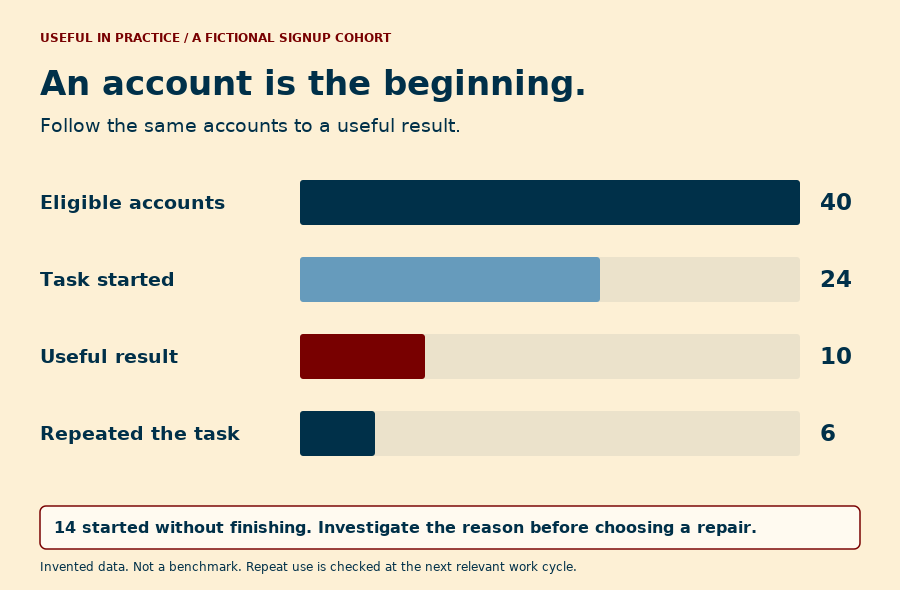
In this example, activation is 10 of 40 eligible accounts, or 25%. Task completion among starters is 10 of 24, about 42%. Those are different denominators. Fourteen accounts started without finishing, but the count does not reveal why they stopped. Start investigating that group while checking whether the 16 nonstarters understood the offer.
PostHog's funnel documentation explains sequential steps, conversion windows, and overall versus previous-step conversion. Apply those distinctions in whichever existing analytics or product records you use. You do not need a new analytics purchase to inspect a few legitimate account histories.
Record missing evidence explicitly. If your data contains only visits and completed accounts, activation is unknown. Do not rename a signup count to fill the gap. For long setup cycles, mark recent accounts as pending until their evaluation window has elapsed.
Invite a small, manageable set of people from three groups: never started, started without finishing, and completed a useful result. Three from each is a possible research workload, not a statistically representative sample. Offer asynchronous feedback when a call is inconvenient.
Interview or async observation script
What were you trying to get done when you signed up?
What did you use for that task last time?
Could you show or describe where you got to?
What did you expect the next step to do?
What input, permission, or information was missing?
Did you finish the job another way?
When does this task next need doing?
With permission, observe an attempt using non-sensitive material. Let the person explain what they expect before offering instructions. If you complete a step for them, record that assistance. A founder-operated success is not evidence of unassisted onboarding.
If people do not reply, do not fill in their reasons. Compare the invitation with their context, try a more specific question where appropriate, and retain “reason unknown.” A lack of replies can limit the investigation.
| Observed blocker | Small repair to test | Guardrail |
|---|---|---|
| No suitable input file | Provide a supported sample and show the route to importing their own data | Separate sample completion from real-data value |
| Integration needs another person's approval | Explain the access requirement before signup and give the approver a concise request | Keep required permissions and security controls |
| The empty workspace gives no next action | Put one relevant task and its expected output on the first screen | Keep existing projects and alternate workflows accessible |
| The result is confusing or needs repair | Explain the output and fix the observed failure or missing context | Check accuracy and support burden |
| The promise attracted the wrong buyer | Clarify who the product serves and what it handles today | Measure useful outcomes, not signup volume alone |
| The task is useful but occasional | Assess return at the next natural work cycle | Do not force a daily-usage target on a monthly job |
A checklist cannot supply a missing budget, permission, or urgent need. A sample project can explain value, but completing a sample is weaker evidence than solving the customer's own task. Keep those outcomes separate in your notes.
Send relevant help only through channels and preferences appropriate to that user. Base a behavioral message on an event you actually observed. Avoid implying you watched activity when you have no such record.
Template for a known import blocker
Subject: A sample file for your first feedback review
If preparing an input file is holding up your review, this sample shows the supported columns and the result to expect: [link].
You can try it without connecting a customer system. Sample completion is just a practice run; your own data may need approval or preparation.
If something else stopped you, reply with the step you reached and I can help clarify it.
Do not add a long automated sequence until one useful message and the underlying workflow make sense. A spreadsheet and a few permitted, individual conversations can be enough for this investigation. When volume justifies automation, evaluate event-triggered tools against your actual needs and data requirements.
Seven days is a work schedule, not necessarily enough time to evaluate activation or retention. Continue observing until comparable accounts have had a fair task window. Report absolute counts, assistance, input type, and limitations. Avoid claiming that a small before-and-after difference establishes lift.
Download the activation investigation worksheet. It keeps the definition, cohort, blockers, and next change in one portable text file. If prospects never reach signup, use the traffic-to-signup diagnostic. If they hesitate during evaluation, use the demo decision guide.
When the finding points to an unclear audience or offer, the free Launch to Market workspace can help organize the next experiment. The optional Launch to Market Toolkit adds portable files and worked examples. It is a planning product, not onboarding automation or a guarantee of customers.
Sources checked October 31, 2026. Original editorial method and fictional teaching data; community figures are self-reported. No named onboarding product was benchmarked for this guide. Paid products linked here are made by this publication. See editorial standards.
A two-week plan for finding your audience, diagnosing missing clicks, and testing one useful offer.
A seven-piece content map, sample copy, and a practical reason for readers to click through.
A reusable test packet and scorecard for writing that preserves your facts and examples.
A conversion diagnostic, clear positioning examples, and a worksheet for deciding what to fix first.
Check technical access, build useful evidence, and keep a repeatable AI visibility log without a paid subscription.
A buyer decision map, discovery questions, pilot brief, and follow-up email for founder-led sales.