
 StashBaseTHE WRITING WORKSPACE
Give your next draft
a better memory.
The research is in one folder. Your voice is in another. The agent is asking for context. Again.
StashBase brings your files, drafts, and AI agent into one writing workspace. Here is the product, the practical fit, and the growth strategy I would test.
Bing Wu welcomed my interest in covering StashBase. This is independent editorial coverage, with no established payment, sponsorship, affiliate agreement, or endorsement. I reviewed public product materials and source documentation; I did not run the desktop application. Workflow examples and campaign concepts below are proposals.
A workbench for
writing with agents.
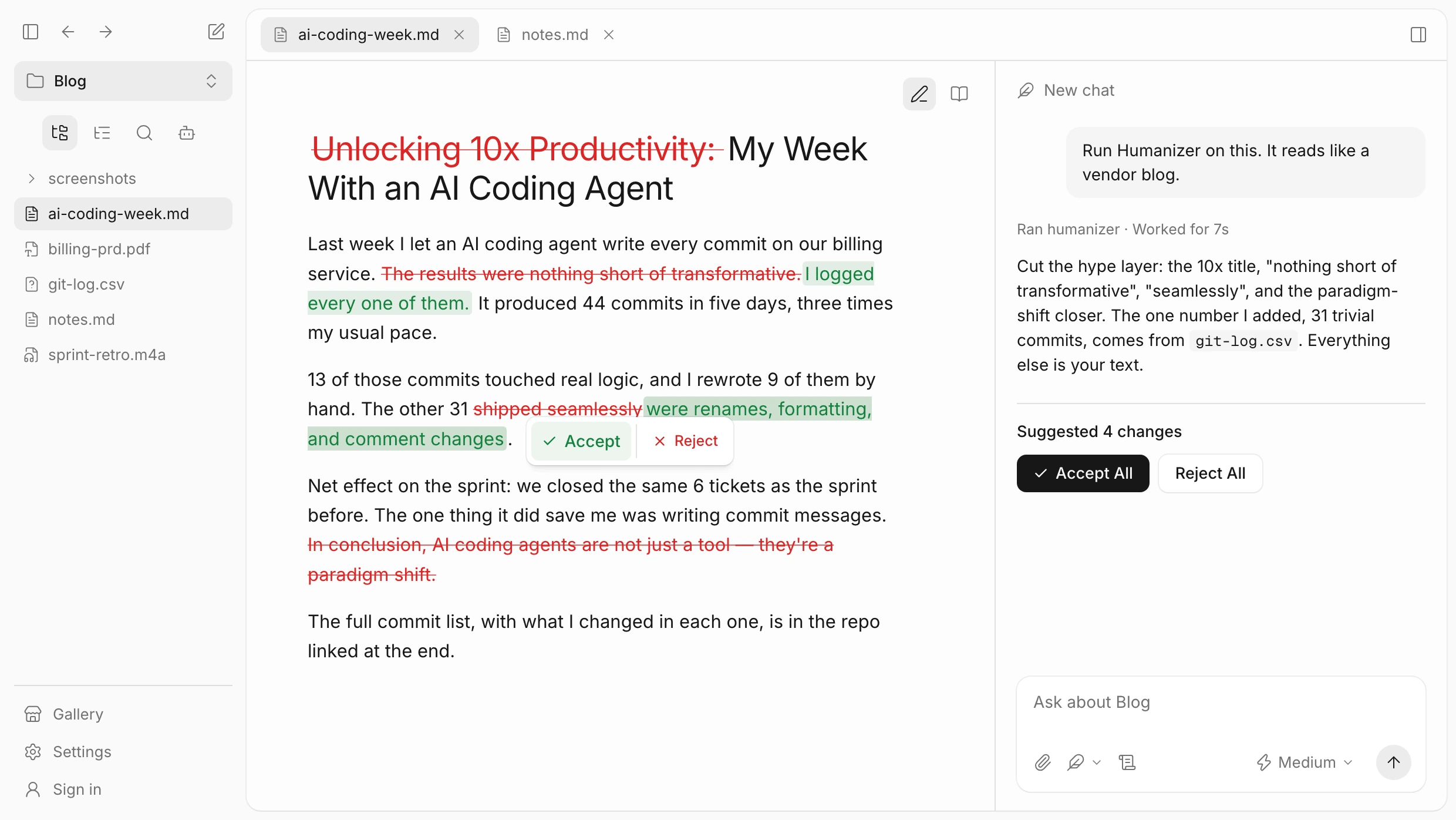
StashBase is an open-source desktop writing workspace built around files on your computer. You can work with Claude, Codex, or Antigravity beside those files, rather than repeatedly assembling a fresh bundle of context in a chat window. Product overview ↗
The interface borrows a useful idea from development environments: keep the material, the working document, and the agent close enough to inspect together. For a builder who already works in folders, that is an easy proposition to understand. For someone who only needs an occasional caption, it may be more workspace than they need.
Its creators, Bing Wu and Li Liu, describe wanting a more comfortable place to read and edit prose with the agents they already use. The company’s account identifies Bing’s previous machine learning work at Waymo and Li’s vector database work at Zilliz. Their backgrounds explain the product’s interest in agents and retrieval. They do not establish adoption or business performance.
My read: the strongest promise is continuity. A finished article can leave behind sources, editorial decisions, and reusable context for the next one. A folder full of unverified claims will still produce unverified claims. Organization helps judgment; it cannot replace it.
Read. Draft.
Question the draft.
The evidence stays in view.
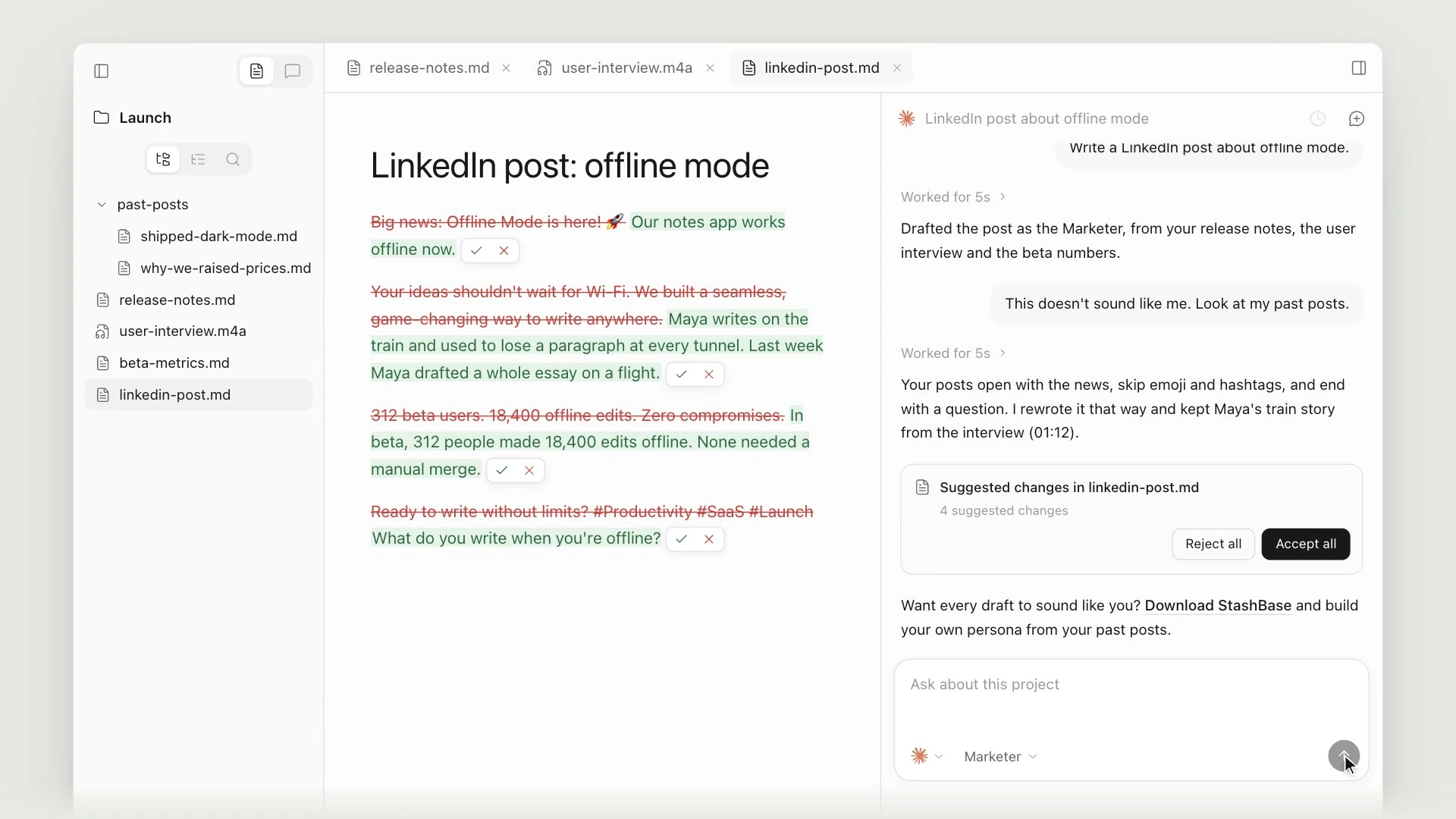
The official recording shows a launch folder with release notes, past posts, interview material, metrics, and a working LinkedIn draft. It is a useful view of the intended workflow: give the agent concrete material, then examine what it does with it.
Those demo metrics are fictional product content. They are not StashBase user numbers, and the recording’s offline feature story is not a claim that StashBase runs AI offline.
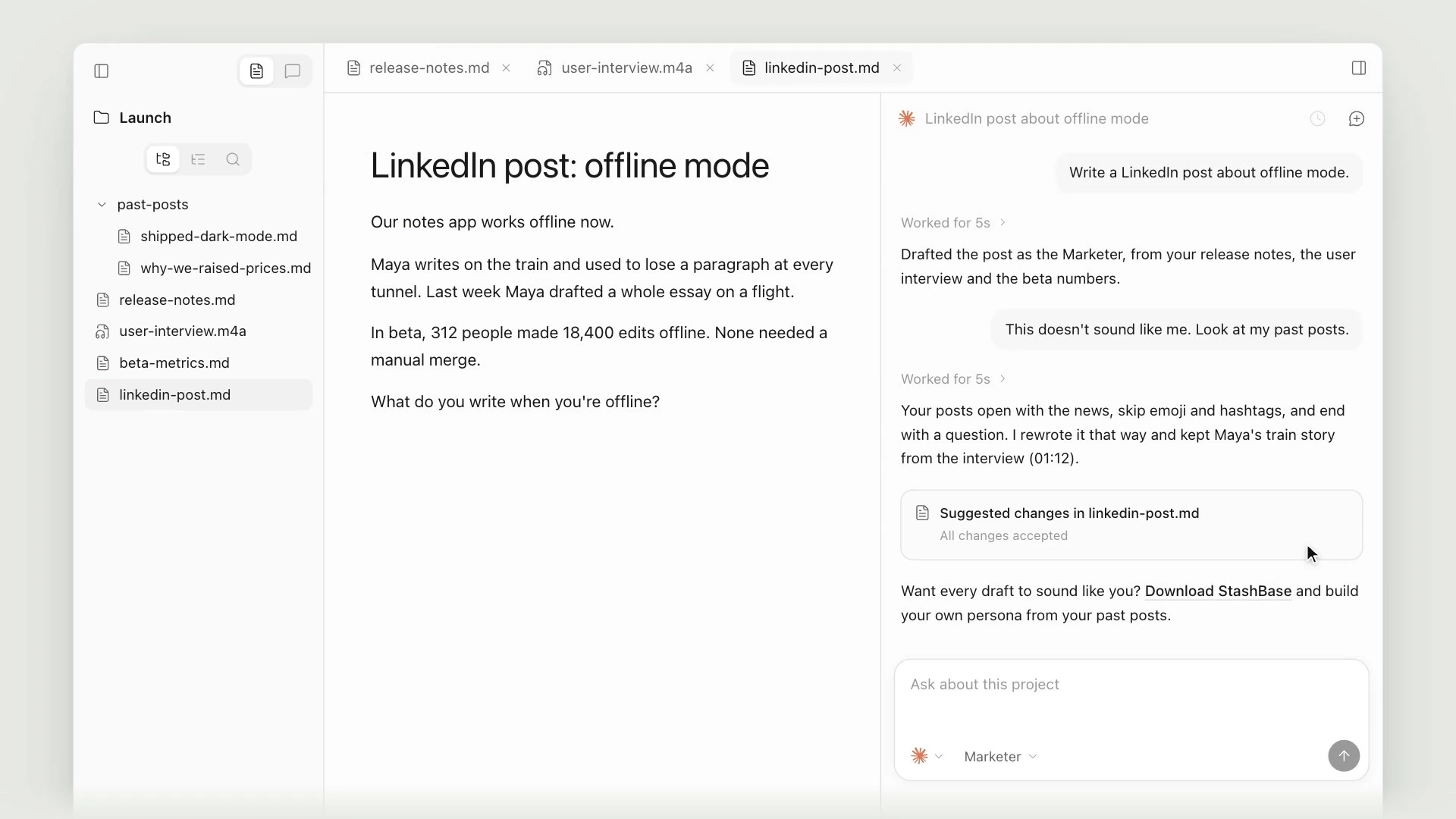
A voice needs more than a tone setting.
The recording shows a persona menu. The current usage guide describes built-in and custom personas. My recommendation is to pair one with actual writing samples and explicit editorial rules: which claims need sources, how you open a post, and what you would never say.
A persona can guide the style. It does not prove a number, make a customer quote publishable, or establish permission to disclose a founder conversation.
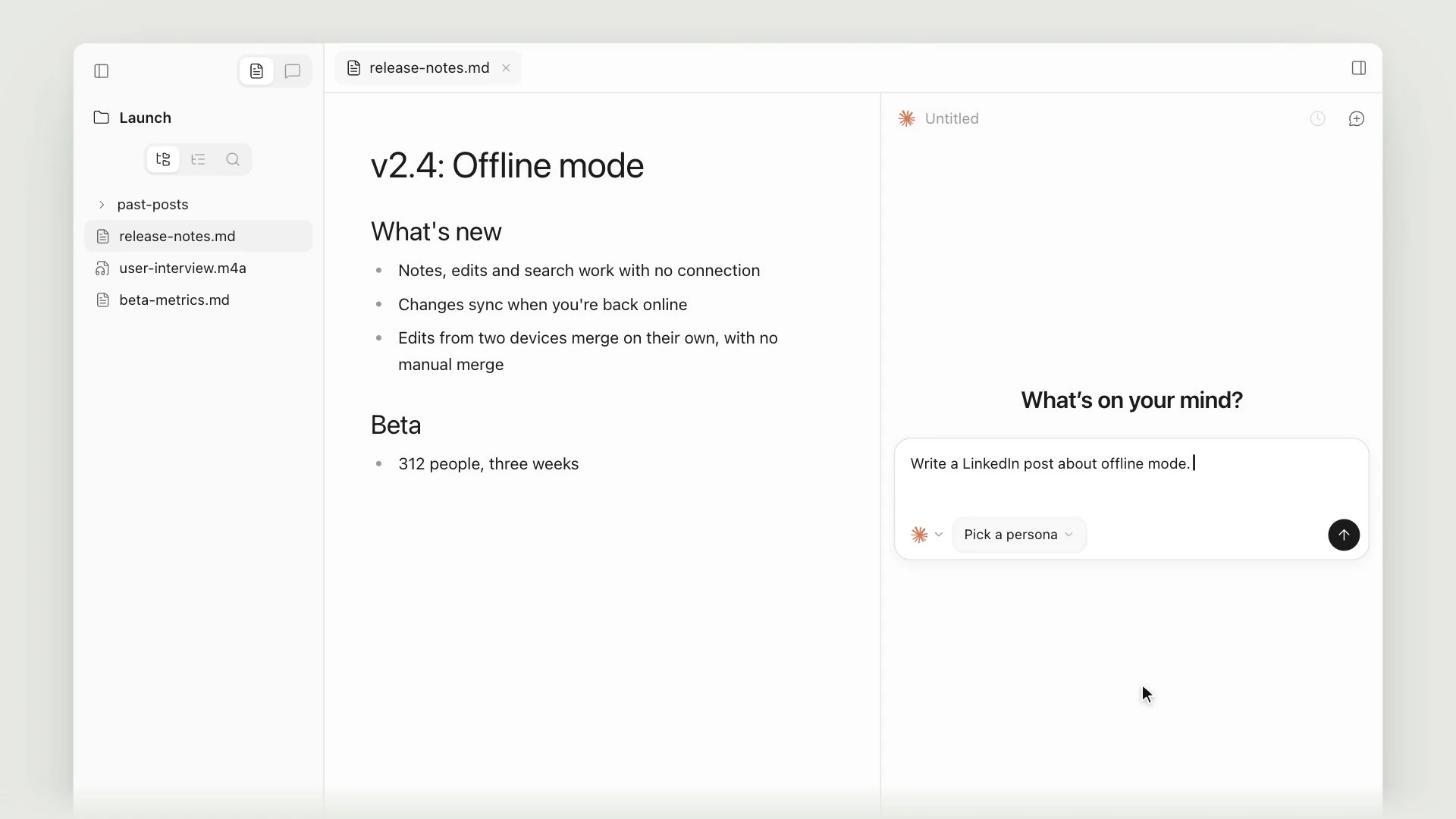
The interesting part is what gets cut.
The recording replaces vague launch language with a concrete account from the source material. You can see the revision beside the agent’s explanation. That makes a better product demonstration than another promise to write faster.
A material detail: the current usage guide says agent changes are already saved when Review opens. Keeping retains the saved edit; undoing restores earlier text. Treat review as inspection and recovery, and keep project backups.
Knowledge bases, search, and keeping sources current
The getting-started guide describes asking the agent to build linked Markdown Wiki pages from source files. A Wiki is optional. The search guide separates local keyword search from opt-in meaning-based search using your own embedding-provider key. That is useful when an old source uses different words from today’s question. Wiki guide · Search guide
Documentation changes matter here. Older web guides discuss local transcription, while the current repository guide says audio and video can be previewed but are not prepared or searchable as agent content. For a recorded founder interview, prepare and verify a transcript separately before relying on it in this workflow.
Agent setup, MCP, and the latest release
Claude and Codex setup uses their respective runtimes and provider accounts. The current README also lists Antigravity, which is missing from some older setup tables. External MCP access lets compatible clients work with an authorized project while StashBase runs. Follow the current setup instructions for your installed release. MCP configuration ↗
GitHub’s latest release checked for this feature was v2.16.15. Its release notes introduce daily project tasks and an account authentication change. The current guide says scheduled work requires the app to be open; a run missed while closed or asleep does not catch up late. A scheduled task also does not make an editorial claim true. Release notes ↗
One startup.
A reusable
research trail.
The workflow I would build for my own publishing.
A Field Note needs product facts, an editorial point of view, good visuals, and a reason for someone to care. A LinkedIn post needs a sharper cut of that material. Rebuilding the evidence for each format wastes the useful part of the first job.
This is my proposed setup, not a workflow I tested in the app. Private founder messages stay out unless there is permission to include them.
- 01_sources/
- Official pages, URLs, check dates, visual attribution
- 02_conversations/
- Approved notes and publishable quotes only
- 03_editorial/
- Audience, writing samples, disclosure rules
- 04_startup-name/
- Brief, claim ledger, draft, review notes
- 05_distribution/
- LinkedIn post, X draft, update checklist
- wiki/
- Optional cross-links to earlier research
- Research the startup
Save official sources and dates. Keep a claim ledger: what is supported, what is vendor-reported, and what remains unknown.
- Build the brief
Choose the reader, their decision, the strongest product example, and the drawbacks the article must address.
- Draft beside evidence
Ask the agent to cite the supplied sources and mark gaps. Keep opinions distinct from product facts.
- Review the work
Check each claim, image caption, link, and edit. Remove invented familiarity, results, and partnership language.
- Produce the social cuts
Use the approved article to draft LinkedIn and X copy. Give each its own hook, example, and reason to visit.
- Keep the research useful
Record the published URL and review date. Recheck pricing and capabilities before the next update.
StashBase’s LinkedIn Ghostwriter gallery project is a relevant starting point for the social portion. The folder structure and claim ledger above are my own proposal.
Try a better brief.
Then challenge the output.
Choose a job and move from source material to a publishable direction. Edit the brief, review a sample revision, and copy a workflow you can adapt.
EDITORIAL SIMULATION / Preset fictional examples and browser-side logic. No StashBase connection, live AI generation, uploads, or automatic publishing. Your edits stay in this tab and are lost on reload.
Free workspace.
Real operating costs.
| Option | Public offering | What I would check |
|---|---|---|
| Desktop app | Free, Apache 2.0 open source. | Platform support and the release you install. |
| Bring your agent | No extra StashBase fee for Claude, Codex, or Antigravity. | Your provider’s account eligibility, usage limits, and model costs still apply. |
| Default Agent | Free allowance; Plus and Pro add capacity. Current pricing describes monthly allowances, with Pro at ten times Plus. | Paid dollar amounts and exact credit quantities were not exposed in the public pricing view I inspected. Check the live plans before purchase. |
| Search by meaning | Opt-in using an OpenAI or OpenRouter key. | Separate embedding charges and provider data terms; hosted-agent credits do not cover it. |
Current pricing and renewal terms ↗. The site describes a first-month Plus offer with a card and automatic renewal. I would confirm the renewal price before using it. Older agent docs mention weekly refreshes; the current pricing page describes monthly periods. This article follows current pricing for that distinction and does not invent a dollar price.
Where local-first helps
Keeping editable files in place makes an exit easier to imagine: the documents remain usable outside the workspace. That matters for a research archive you expect to keep longer than your enthusiasm for this month’s AI tool.
The documented local operations include browsing, editing, file preparation, and keyword search. The app has no built-in folder sync or real-time collaboration according to its local-first guide. Plan backups and multi-device work separately. Local-first boundaries ↗
Where the text travels
Local files do not mean local AI. Using an agent sends prompts and relevant context to its provider. Meaning-based search sends text and queries to an embedding provider. Official builds also enable basic usage statistics by default, with an opt-out. Privacy details ↗
The README now describes Default Agent routing through OpenRouter to Claude Haiku 5.5; the privacy page still names DeepSeek. That disagreement prevents a firm statement about the current hosted processing route. Confirm it with StashBase before using confidential material.
Platforms and product maturity
Official downloads list macOS 12+ on Apple Silicon or Intel, Windows 10+ x64, and Linux Debian 12+ / Ubuntu 22.04+ x64. Linux is described as community-supported in the README. On Intel Macs, local search and PDF/image extraction require macOS 15+. The checked release notes say the Windows installer is unsigned. Download requirements · v2.16.15 release
The terms describe early software. I would evaluate it on a backed-up sample project before moving an important publishing workflow. This review has not measured app reliability, retrieval quality, setup time, or writing quality. Native desktop interaction was unavailable in this environment, so no installation or hands-on performance test is claimed.
Worth evaluating if your writing already has a research folder.
Start with one repeatable job: a launch post, technical tutorial, or source-backed review. Compare setup time, factual corrections, and time to an approved draft against your current method. If the benefit only appears after a complicated reorganization, count that work too.
Choose the workflow
you actually need.
| Tool | Reason to consider it | Question before switching |
|---|---|---|
| StashBase | Local source files and prose editing with an existing agent account. | Does the integrated writing workflow justify another app and its setup? |
| Obsidian | Local Markdown vaults and an established personal notes workflow. | Would keeping your vault and adding an appropriate AI integration be enough? |
| Notion | Pages, databases, workspace context, and connected AI tools. | Is shared team context more important than ordinary local project files? |
| Google Docs | Shared editing, suggestions, comments, and version history. | Is stakeholder review the main bottleneck rather than source retrieval? |
| Cursor | An agent that searches and edits a working code project. | If your work already lives in the repository, does prose-focused editing improve enough? |
| Jasper / dedicated AI writing platforms | Marketing-specific context, brand voice, and production workflows. | Do you need managed campaign operations more than a file-based writing workbench? |
A chat assistant may still be sufficient for a short, isolated job. The switching argument becomes stronger when the same source library supports several outputs over time. None of these tools guarantees factual accuracy or a useful editorial point of view.
Sell the second draft.
Earn the second project.
My positioning proposal: a writing workbench for people who already trust an agent with real work and want to keep their evidence close.
From a product and business development perspective, I would resist a broad promise of better AI writing. That market is crowded, and it invites a model-quality comparison the workspace does not fully control.
I would show a more specific sequence: open a known source, draft from it, catch a weak claim, revise in context, and reuse the material next week. That makes the benefit inspectable and gives onboarding a concrete finish line.
Technical founders & developer-creators
They already understand folders and agent accounts. Their trigger is turning shipped work into an accurate launch story. Their objection: “My coding editor already does this.” Demonstrate the prose review and source workflow with the same files, rather than asking them to migrate everything.
Independent analysts & research-heavy writers
Their asset is an accumulated source library. Their pain is rediscovering evidence for each article. A useful activation project has one claim ledger, one reviewed draft, and a later update that reuses earlier research.
Agencies, GTM teams & content marketers
Campaign reuse is attractive, but shared approvals, client boundaries, and collaboration may dominate the decision. Start with one operator’s approved source pack. Do not promise a team operating system before validating those requirements.
The public distribution pattern
StashBase already publishes task-focused educational content, a public repository, and reusable gallery projects. Bing’s founder-led SEO article describes using the product in its own publishing. That creates a credible teaching format: show the process behind the article. It does not establish that the channel converts or that the company has product-market fit.
I would connect that existing material into a shorter path: an exact reader problem → a three-minute demonstration → a sample project → one completed writing task → a second project. GitHub stars, downloads, and social impressions are useful signals at different stages. None is a substitute for someone returning to write.
The economics of bringing your own agent
Supporting an existing subscription can lower the objection to trying another tool. It also separates workspace adoption from hosted-agent revenue. A user who writes every week with Codex may love the app and never buy Default Agent credits.
My proposed measurement split is therefore deliberate: track repeated project use for product value, and track hosted activation, paid conversion, support effort, and gross margin for the commercial model. More hosted consumption is only attractive when revenue covers inference and service costs. No revenue, margins, acquisition costs, funding, or accelerator participation were verified for this review.
Ship one clear path.
Hypothesis: existing agent users need a concrete first task more than another feature tour.
Experiment: publish a “release notes to reviewed launch post” project, a three-minute screen demo, and provider-specific setup paths. Recruit a small opt-in cohort from founder content and relevant developer communities.
Measure: project-open to first reviewed document, setup failures by platform/provider, median completion time, and a second session within seven days.
Decision: document the initial baseline. Fix the largest setup drop-off before increasing acquisition. Any small-cohort comparison is directional.
Follow the strongest job.
Hypothesis: a tutorial tied to a recognizable job attracts better-fit users than a broad AI-writing pitch.
Experiment: test a founder launch tutorial against a research-to-article tutorial. Give each a matching gallery project and separate tagged links. Invite two relevant creators to demonstrate the same task under disclosed terms.
Measure: qualified tutorial visits, sample-project starts, completed drafts, seven-day return, and support time by cohort.
Decision: back the job with better repeated use and manageable support, rather than the clip with the most views. Define qualification before inspecting results.
Prove the next project.
Hypothesis: keeping a useful archive improves the next writing session enough to create a habit.
Experiment: invite activated users to update last month’s post with a new source. Interview returners and dropouts. Offer hosted plans where they address a real account/setup gap.
Measure: second-project completion, four-week return, claims corrected before publication, hosted paid conversion, contribution margin, and support load.
Decision: expand the channel only if the selected cohort repeats the workflow and the commercial path covers its service costs. Set numeric targets after observing the baseline.
Proposed experiments, not StashBase’s internal roadmap. Use consent-based, content-free measurement where possible. Never collect source documents or drafts merely to count activation.
Show the sentence
that changed.
My proposed creative direction is an evidence-first writing desk: quiet typography, actual documents, and visible editorial decisions. Show the input, the weak line, the source that changes it, and the final edit. The human has something to say, and the product helps carry it through.
Search intent, without imaginary volumes
The search review found official coverage for StashBase, local knowledge bases, writing with agents, and comparisons with notes tools. I would map branded evaluation intent to “StashBase review,” task intent to “Codex for writing” and “Claude Code writing workflow,” and switching intent to “StashBase vs Obsidian.” “AI writing IDE” is a descriptive category test, not a proven high-volume keyword. No volume or ranking forecast is claimed.
A useful content cluster would pair the review with a verified setup tutorial, a source-backed launch-post walkthrough, and a candid comparison of keeping an existing notes workflow. Each needs a distinct reader decision, original evidence, and an update date. Publishing five versions of the same feature list would add very little.
A collaboration
worth proposing.
I did not find a confirmed public creator affiliate program, commission schedule, ambassador application, or referral agreement in the official pages and targeted search reviewed for this feature. The pricing page mentions promotion codes; that does not establish a creator program. Every StashBase link here is an ordinary official link.
The first offer I would make
A disclosed, creator-led walkthrough: take one approved startup source pack through a brief, an article revision, and a LinkedIn post. Deliver an edited product demonstration, a practical tutorial, and social cuts with agreed usage rights. Keep editorial coverage and any commissioned promotion clearly identified.
The success measure should be completed first projects and returning writers where StashBase can measure those responsibly. A paid video can demonstrate a task without promising that every viewer will adopt the app.
Then earn the next arrangement
A joint tutorial or a customer-approved case study could follow if the first workflow works. An affiliate pilot would need written commission terms, qualifying events, refunds, attribution windows, and disclosure before any referral links appear.
Bing’s invitation creates a conversation, not a commercial contract. The public company contact page provides a verified route to discuss the proposal. No outreach, application, or agreement was submitted for this article.
Bring one folder.
Ask one better question.
Choose a small, backed-up project with material you can share with your chosen provider. Try drafting from the evidence, inspect the changes, and compare the finished work with your current method. That is a better evaluation than asking any agent to “write something engaging.”
Evidence, credits,
and open questions.
This is a documented product analysis, not a hands-on desktop review. Official product screenshots are locally optimized copies of the repository preview and frames from its product recording. Images © StashBase and their respective owners. Examples within those assets are demonstration content.
- Product overview and official branding · Creators and founding story
- Current README, source, license, and product recording
- Original full product preview · Original recording (frames at 00:08, 00:32, 00:40)
- Current usage guide: personas, saved edits, search, media, and scheduled tasks
- Getting started and optional Wiki · Web search guide · Web agent guide
- Pricing and renewal conditions · Platforms · Checked release notes
- Local-first boundaries · Privacy policy · Early-software terms
- Gallery · LinkedIn Ghostwriter · Founder-led SEO · Official YouTube channel

Unresolved: hosted-agent model routing differs between README and privacy copy; older docs describe weekly credits and transcription while newer material changes those behaviors. Exact paid dollar prices were not available in the inspected public plan view. Verify those details against the installed version and current commercial terms.