UFO.AI / THE RECURRING WORK
The chat ends.
The work
shouldn’t.
UFO is an AI teammate for work across connected tools, with scheduled tasks and an open source runtime. Its interesting promise: giving the job somewhere to continue.
01 / THE TAKE
A teammate needs
a place to work.
A meeting ends with three promises. Someone needs a recap. A customer is waiting for an answer. A product decision belongs in the tracker. The hard part is remembering to move all three forward tomorrow.
UFO’s proposition is a shared place to delegate that follow-through. Its public product presents recurring work through chat, with a web workspace and Slack. The company’s website identifies it as backed by Y Combinator. Its open source repository exposes the runtime behind the hosted service. [1] [2]
My take: this is worth a focused trial for a small team whose work repeatedly crosses conversations, files, and systems. The buying test is whether you can inspect a finished result and account for a missed one. An agent that says it will check tomorrow has made a promise, not delivered an operating process.
02 / LOOK AT THE PRODUCT
From a question
to the next run.
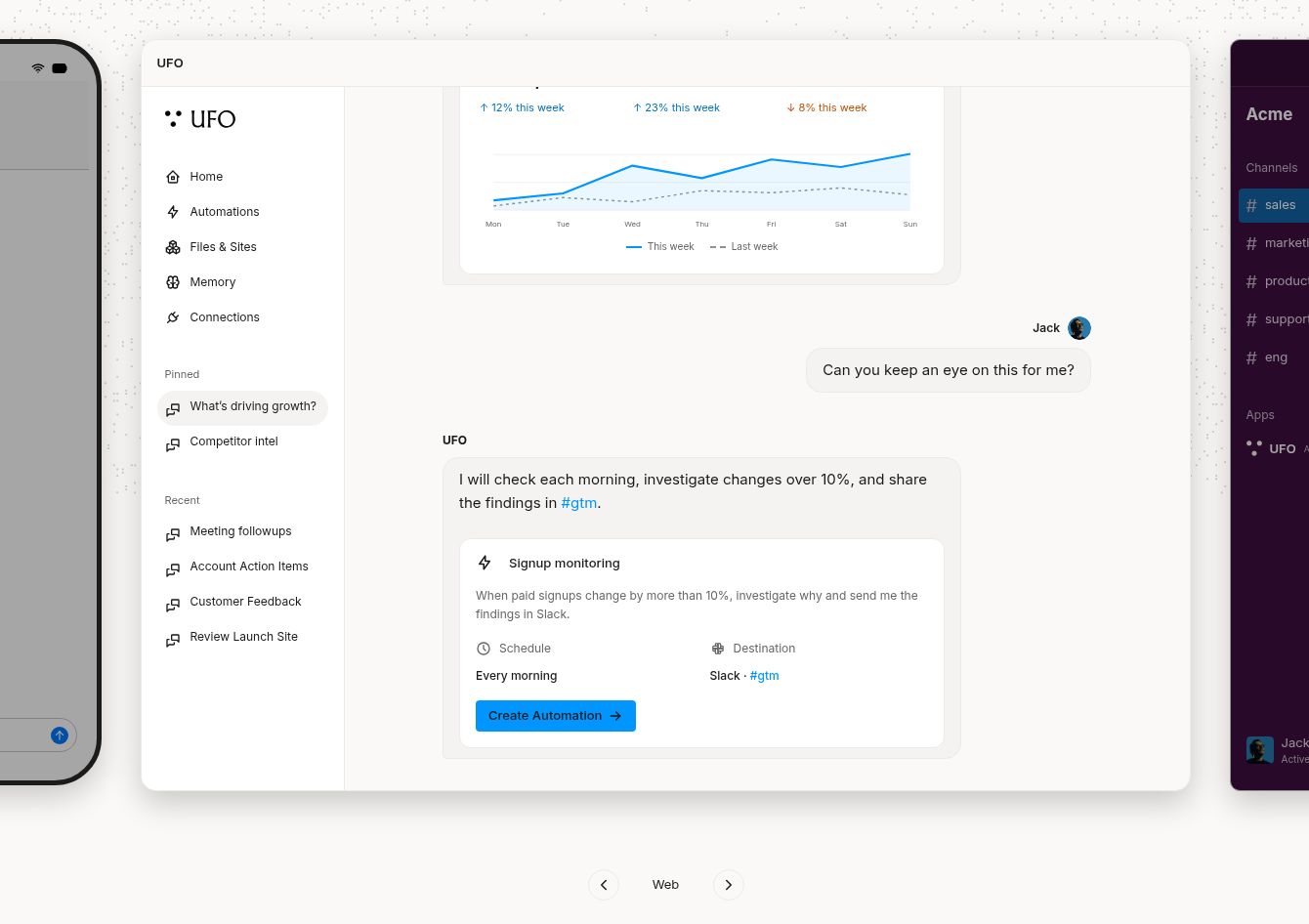
The official preview puts the handoff in view.
That is the part to interrogate.
Start with the question.
In UFO’s example, the user asks why signups changed. The visible conversation turns an answer into a proposal to keep watching.
Make the next step explicit.
Its task card gives the monitoring request a schedule and destination. Those details make the commitment easier to examine than an informal “I’ll handle it.”
Look beyond the card.
A convincing preview does not establish that the next run started, used the right sources, or reached Slack. Ask to see the run and its actual output.
The scheduled-work guide calls for the action, cadence, time zone, sources, and destination. Each run has its own conversation; the Runs view makes those records inspectable. The guide also says a run with nothing to report sends no message. That distinction matters: silence can be expected, but it is not proof that a task ran. [3]
03 / THE OPEN SOURCE LAYER
Same conversation.
Different execution boundary.
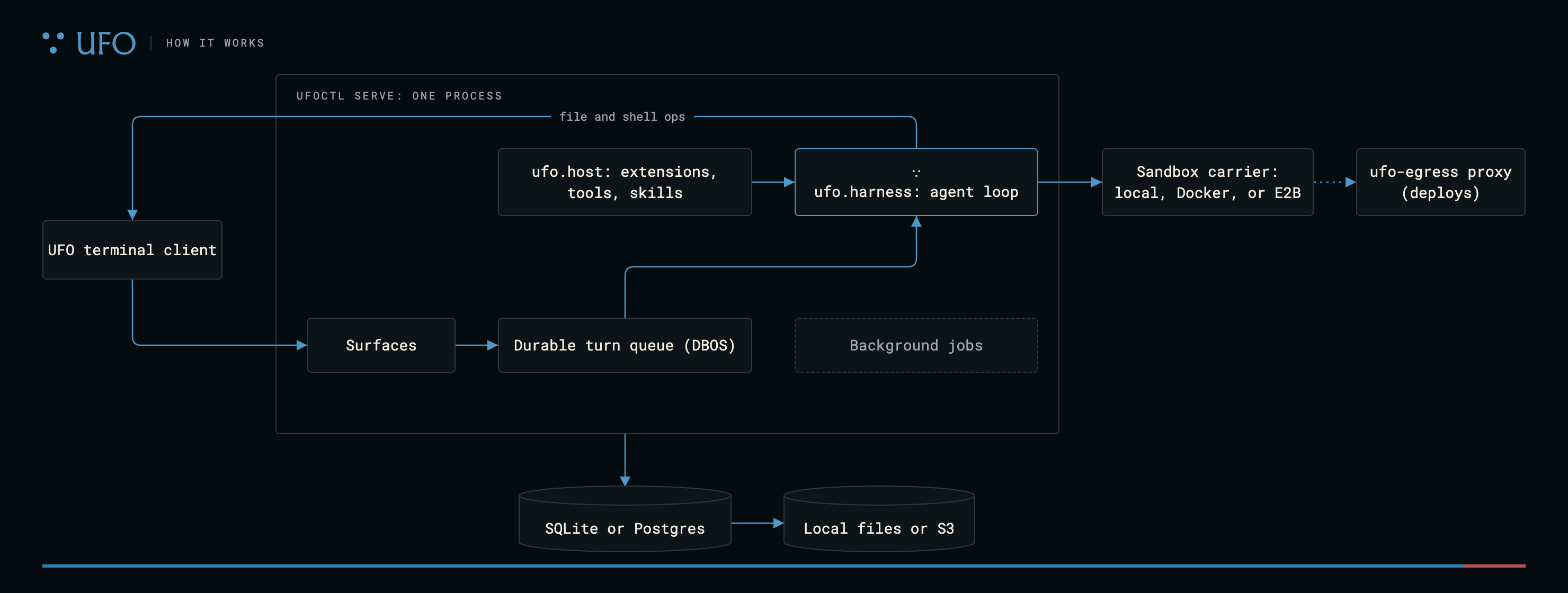
UFO’s repository is unusually useful reading before a trial. It explains where the commands actually run.
| Choice | Where the work happens | What I would verify |
|---|---|---|
| Hosted workspace | UFO operates the service; a team can use its web app or Slack. | Which accounts are granted, what is retained, and how usage is charged. |
| Terminal, default mode | File operations and commands run on the connected user’s machine. | Working directory, available files, and what stops if the client disconnects. |
| Terminal, remote mode | Those operations run in the configured workspace sandbox. | The actual sandbox carrier and its read, write, and network boundaries. |
| Self-hosted runtime | Your infrastructure runs the server with your model keys. | Patch ownership, backups, recovery, isolation, and provider costs. |
The README describes durable turns implemented as DBOS workflows, a local SQLite setup, and a path to Postgres, S3, and Redis. Those are useful architectural choices; they do not, by themselves, prove that a business action can never be duplicated after a failure. My trial would include interrupting one safe task and checking the resulting records. [2]
The important caveat: the documented default local carrier restricts writes but can read the host, and its egress is not kernel-enforced. The README recommends Docker or E2B for untrusted input or multiple workspaces. “Remote” describes a location, not an automatic guarantee of isolation. Do not confuse this project with Microsoft’s separate UFO repository. [2]
04 / TASK BRIEF STUDIO
Give the agent
a finish line.
Build a concrete first trial.
Keep the scope small enough to inspect.
This is a local editorial planning tool, not a UFO integration. It generates an authored trial brief in your browser. Nothing is sent to UFO, and no schedule is created.
On weekdays at 4 p.m. Eastern, read only the approved sample meeting notes. Draft promised follow-ups with owners and dates in one private document. Do not send emails. Link claims to sources, flag missing access, and return the document URL. Trial: five weekdays; stop after the fifth run.
05 / THE REALITY CHECK
The runtime
is only part of the cost.
Price the work you can trust,
including the work of checking it.
Hosted convenience, metered work
UFO’s billing documentation describes a prepaid workspace balance rather than a per-member fee. Task costs draw from it, and a reserve can prevent work starting even when some balance remains. Automatic refill is an ongoing rule; the documentation says a one-time credit purchase is not available. No universal per-task dollar price was established in this review. [4]
A scheduled task without sufficient credit waits for its next scheduled opportunity; the billing guide distinguishes that from a held member message. For a deadline-sensitive job, I would want a separate way to notice a missed run. A cheap successful run and a cheap missed run have very different value.
Self-hosting moves responsibility
Apache-2.0 makes the runtime available to inspect and use under its license. It does not pay for model inference or operate the machine. The practical question is who will keep the deployment healthy when the person who installed it is away.
For a solo founder seeking one weekly report, that maintenance may outweigh the control gained. For a technical team with a clear need for its own execution environment, inspectability may be the reason to trial the open source route. The architecture is an option, not a requirement to build infrastructure.
Connected data still has a destination
UFO’s privacy policy says relevant Slack and connected Google content can be sent to model providers for task processing. It distinguishes Google sign-in from separately authorized Workspace access and describes retention while the related workspace is active, with longer retention where required by law. Self-hosting the runtime does not establish local-only inference. Review the actual providers and connections chosen for your deployment. [5]
I would begin with synthetic or non-sensitive records, one narrow connection, and a private destination. Before moving to client information, I would verify access revocation, export/deletion behavior, workspace permissions, and what the selected providers retain. Those checks remain untested here.
06 / THE TRIAL I WOULD RUN
Five runs.
Five inspectable receipts.
A proposed evaluation, not a reported product test. Use a small set of sample meeting notes containing an explicit promise, an ambiguous request, and a later correction.
- Run once manually. Ask for a draft with source links. Check whether a tentative suggestion becomes a false commitment.
- Change one source. Correct a date in a later note. The next draft should use the current date and show where it came from.
- Remove one input. Make a sample record unavailable. A useful failure names the gap instead of filling it with an invented answer.
- Inspect the boundary. Check the actual result destination and execution mode. Confirm no email was sent when the task only allowed drafts.
- Review the run history. Match each expected run to its conversation and artifact. Record failures, correction effort, and the total cost of the trial.
My acceptance criterion would be that every promised output is traceable, every missing output is explainable, and the review work feels proportionate to the job delegated. Do not infer a time-saving percentage from a polished first result.
Shortlist it for follow-through.
Evaluate it on receipts.
UFO brings a readable open source execution layer to a familiar team-chat surface. That combination deserves attention. I would keep the first assignment narrow and judge the system by its sources, boundaries, and run records. The goal is a dependable next step, not a larger pile of confident messages.
07 / RESEARCH DESK
Follow the evidence.
Public sources checked November 2, 2026. This is a study of the current offering, not a claim that today is its original launch date. Runtime details describe the repository’s current main branch and may change.
- UFO official website: positioning, public web/Slack previews, example tasks and YC backing statement.
- Official ufo-ai/ufo-core repository and README: hosted/self-hosted modes, execution locations, durability, isolation caveats and Apache-2.0 license. Diagram reproduced with attribution and license/notice.
- Scheduled work: task setup, run conversations, suppression of empty reports and credit-related starts.
- Balance and billing: prepaid balance, reserve, refill rules, scheduled-task behavior and provider-key billing.
- Privacy policy, effective September 25, 2026: connected information, model processing and retention.
Official media © Metalcraft Inc. The homepage preview contains illustrative company data. The task studio, evaluation method and verdict are Useful in Practice’s analysis. No customer outcomes, reliability figures, or savings were independently measured.