COSMIC ROBOTICS / COSMIC-1
Heavy lifting.
Human judgment.
Cosmic builds mobile robots that lift and place solar panels. The interesting part is the work they leave for the crew.
By Stephen Stilwell · November 7, 2026
Independent analysis of primary sources. No field test.
01 / A VERY PHYSICAL PROBLEM
Put the panel
where it belongs.
A useful unit of progress:
a correctly installed module.
Solar construction has a deceptively simple repeated task: move a large, fragile panel from its supply position onto the structure that will hold it. Repeat across a field. The shape makes the load awkward; the repetition makes the job tiring. A robot that can absorb that handling work has a concrete reason to exist.
Cosmic-1 is construction equipment with autonomy. It brings a mobile base, a robot arm and panel-handling hardware to the installation row. Cosmic’s current focus includes solar and data-center construction; this note examines its solar application, where the public evidence is more specific. [1]
The relevant reader is a utility-scale solar contractor or project team evaluating how a machine fits into an existing installation method. For founders and software builders, Cosmic is also a useful look at AI beyond a chat window: the output has weight, a location and a next person who depends on it.
KUKA’s August field interview describes Sunstall using the Cosmic-1A, with computer vision for panel detection and an arm that lifts and places the modules. The crew still prepares the supporting structure and fastens the modules. [3] That is the distinction worth holding onto: automated handling is a meaningful part of construction, rather than proof of an unattended jobsite. [4]
Naming note: Cosmic uses Cosmic-1. KUKA names its solar machine Cosmic-1A. Confirm the offered configuration.
02 / LOOK CLOSELY
Not a render.
A real jobsite.
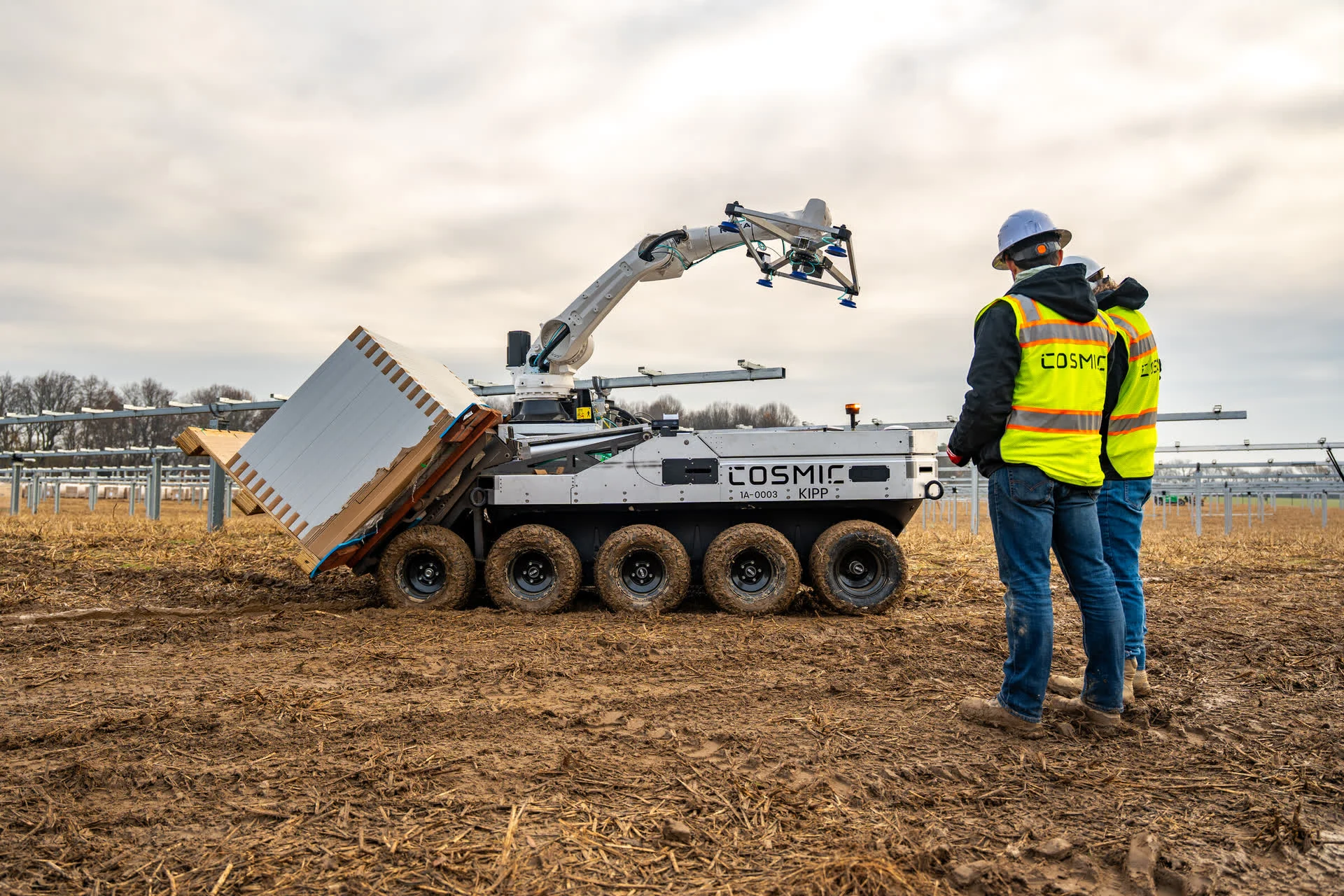
The company’s photographs make the proposition tangible. Explore the visible parts of the machine, then separate what the photo shows from what needs a demonstration.
OFFICIAL PHOTOGRAPH / EDITORIAL ANNOTATIONS
Equipment meets a crew.
The official image shows a mobile robot beside workers and tracker rows. It establishes the physical setting, not a measured installation rate or proof of safe operation under every condition.
Remove a repeated strain.
The useful promise is moving heavy material into position consistently enough that people can concentrate on the next job.
Work between two crews.
The robot needs a ready supply and a prepared row. Downstream workers need a panel they can finish installing without a new workaround.
A photo is a starting point.
Ask to see the operating envelope, intervention process and whole-shift results on a representative site.
03 / FOLLOW ONE MODULE
The handoff
is the product.
Four stages in an editorial map of the solar workflow. Select a stage to inspect its responsibility and the question it leaves open. This is an explanation, not a robot controller or an operating procedure.
A robot cannot place a panel that is not ready.
KUKA describes workers preparing racking before the robot travels along it. My demo question starts upstream of the lift.
What supply arrangement, rack preparation and access conditions does this configuration require?
Basis: KUKA field case study [3]. Question: Useful in Practice analysis.My reading: the value is less about replacing a person-shaped set of abilities and more about taking responsibility for a tightly bounded physical transfer. The machine receives a panel in one state and leaves it in a state another worker can use. Reliability at that boundary may be more valuable than a spectacular isolated motion.
That changes the demo I would ask for. Show an ordinary row, a shift change, a delayed material supply and the approved recovery process for a placement that needs attention. Have the people who will actually use the equipment explain the handoff. A smooth company film cannot answer those site-specific questions.
04 / THE BOTTLENECK LAB
Faster at lifting.
Faster at what?
Try a simplified pipeline. If fastening or supply is slower than placement, making the robot faster may not increase the finished output.
Illustrative assumptions, not Cosmic performance data. All times below are invented teaching inputs. This local calculator has no product connection and is not a site forecast.
Enter 5 to 300 seconds for each stage. These are effective stage cycles, not a claim about individual worker speed.
ILLUSTRATIVE STAGE CYCLES / SECONDS PER MODULE
Supply limits this example. Halving placement from 35 to 17.5 seconds leaves the ideal rate unchanged.
Model: stages run in parallel, one effective station each, after pipeline fill. Ideal rate = 3,600 ÷ the longest stage cycle. Assumes unlimited buffers and perfect uptime; excludes transport, charging, setup, inspection, rework and shared workers. A real jobsite needs a richer model.
Measure accepted installations per crew-hour, alongside safety, damage and rework. A faster intermediate step is useful only if the rest of the system can absorb it.
05 / WHAT IS HERE, WHAT IS NEXT
Today’s row.
Tomorrow’s ambition.
Cosmic’s August 19 roadmap reaches well beyond solar. Its present evidence and its intended future deserve different labels.
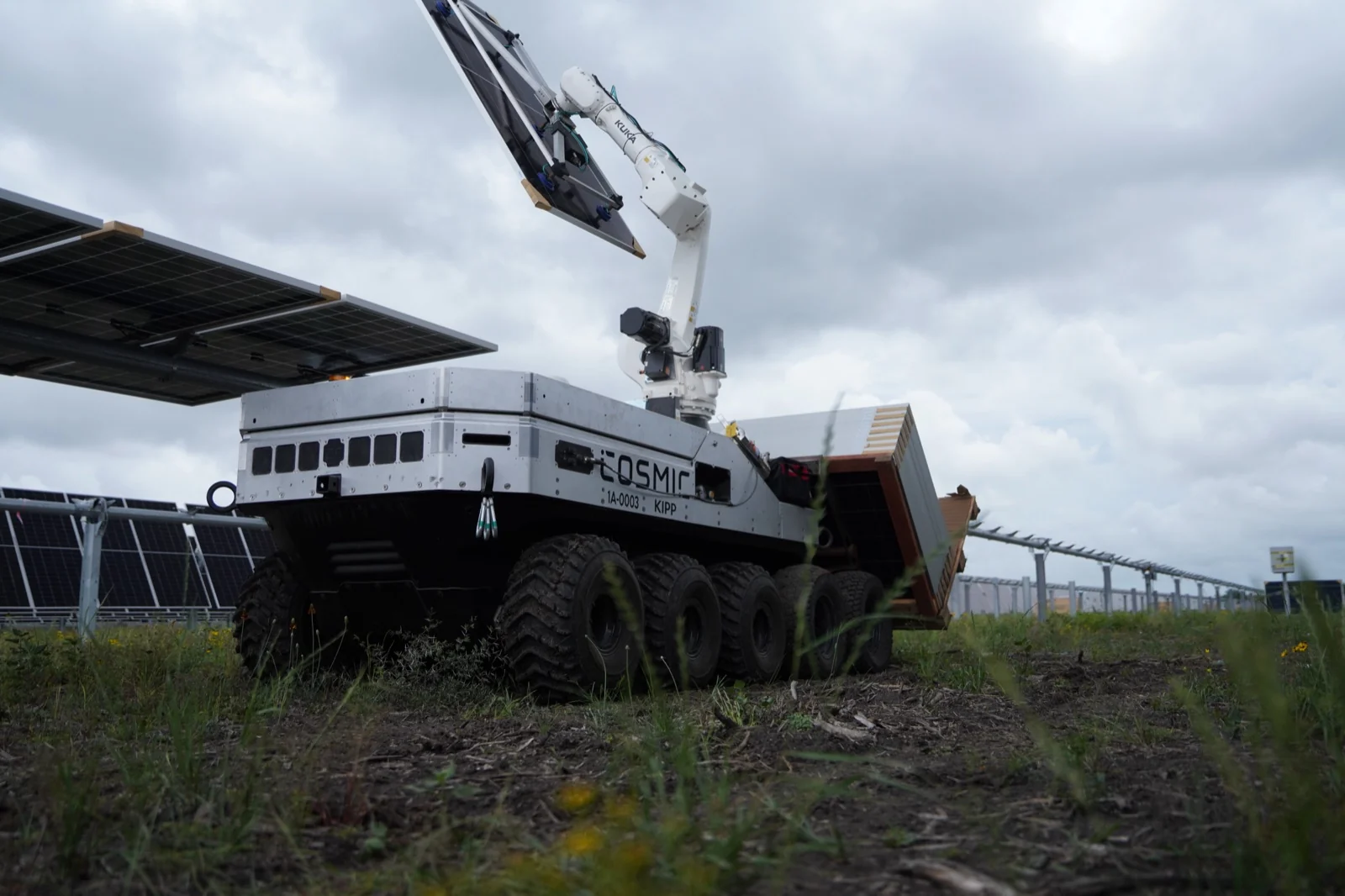
Supervised construction work.
The company says its work so far has centered on hardware and controllers for supervised autonomy. The supplier account gives a concrete solar workflow. Neither establishes general-purpose autonomy across an entire construction project. [2] [3]
Reasoning above the motion.
Cosmic describes developing an edge AI operator and higher-level coordination, with Constellation as its jobsite planning and mission-control software. The eventual Mars-city ambition is a research and business direction, not a capability demonstrated by these photos. [2]
The more revealing part of the roadmap is its restraint about the controller. Cosmic says it is prioritizing tasks it can solve with model predictive control and optimization while gathering data for more general policies. In other words, a startup can pursue advanced AI without putting a generative model in charge of every physical motion. [2]
That is a sensible distinction to examine in any physical-AI product. Planning a task and safely executing a motion are separate engineering problems. Ask which component makes which decision, what constrains it and how a human can intervene. A fluent explanation from a reasoning model is not evidence that a robot can handle an unfamiliar site condition.
KUKA describes automated fastening as future work. [3] My question for a buyer: does the quoted version stop at placement or complete the connection? That boundary changes who must verify the work.
06 / THE BUYING QUESTION
Price the whole
working day.
Cosmic is worth a contractor’s closer look when repeated module handling is a real constraint and the site can support a coordinated machine-and-crew workflow.
The strongest idea is a narrow one done well.
Move an awkward load repeatedly. Put it where the next person needs it. Keep the crew’s skilled work connected to the machine’s output. That is a useful proposition without requiring a story about an entirely autonomous future.
I would shortlist Cosmic for a representative, supervised contractor evaluation. I would wait if compatible equipment, site conditions, support or the recovery process remain unclear. It is not a rooftop DIY tool or a drop-in replacement for a construction method.
There is no price estimate in this note. Cosmic’s public site directs buyers to request a quote. A useful comparison needs the offered scope, support and full operating costs, not a guessed robot price. [1]
Explore the official product ↗Direct link. No affiliate relationship with Cosmic Robotics.
TAKE THESE QUESTIONS TO THE SUPPLIER
One representative row. A complete record.
- Fit. Which module sizes, tracker configurations, ground conditions and weather limits are supported by the offered version?
- People. Who supplies, supervises, fastens, inspects and recovers a stopped cycle? What training and site controls are required?
- Time. Record mobilization, setup, charging, waiting, interventions and demobilization, alongside productive operation.
- Quality. Count accepted modules, damage and rework with agreed inspection criteria. Keep rejected work out of the headline output.
- Economics. Compare all crew-hours and operating costs on matched conditions. Separate supplier claims from the results of your own evaluation.
Editorial evaluation questions, not instructions for operating industrial equipment. Agree the demonstration and site safety plan with qualified personnel.
Can the handoff stay reliable when the site stops looking like the demo?
A polished autonomous action is only the middle of the story. The work before it and the acceptance after it decide whether a team gains anything. For Cosmic, the next useful evidence is a fuller account of compatibility, interventions and whole-shift output under stated conditions. That is more decision-helping than another sweeping autonomy claim.
The same lens runs through our notes on RightNow’s decision boundary and Momentic’s reviewable QA findings. Different products, same question: what exactly has the system taken responsibility for, and what evidence reaches the person who acts next?
SOURCES / RESEARCH & VISUAL PROVENANCE
What this note
rests on.
Primary sources reviewed November 7, 2026. This is documentation-led analysis, not a firsthand deployment, safety assessment or independent productivity benchmark. No original launch date is asserted.
- Cosmic Robotics, current company website ↗
Product focus, quote path and official field photography. Undated page, checked November 7.
- Cosmic Robotics, Technology Roadmap ↗
Lewis Jones and James Emerick, August 19, 2026. Current focus, future architecture and official Cosmic-1 field photo. Roadmap statements remain company plans and claims.
- KUKA, The Power of Automation ↗
Supplier case study on Sunstall and Cosmic-1A. The URL has a December 2025 path; no publication date was visible in the retrieved article. Checked November 7, 2026. Supplier testimony is not independent validation.
- KUKA iiMagazine, solar-field automation interview ↗
Carolin Hort, August 10, 2026. Additional field context on Sunstall, human alignment, fastening and quality assurance. English article on KUKA’s French-region route.
- Y Combinator, Cosmic Robotics company profile ↗
YC Summer 2026 affiliation, checked November 7. This is Cosmic Robotics, not the unrelated Cosmic content-management company.
Both photographs are official Cosmic Robotics media reproduced for independent product analysis and optimized locally. The inspector uses editorial crops; the workflow and bottleneck lab are original explanatory work. No generated imagery, fabricated interface or company performance chart is used. Numerical examples are explicitly illustrative.