THE DECISION BEFORE THE RESPONSE
Before the agent acts,
make the call.
RightNow’s System Zero turns incoming information into structured decisions with probabilities. The opportunity is faster routing. The hard part is knowing when an answer is safe to use.


Rank.
Hold.A consequential choice.
01 / WHAT IT DOES
A model for
the fork in the road.
The interesting unit is a named decision, not a paragraph.
A customer says a parcel has not arrived. A moment later they correct themselves: it arrived, but the contents are damaged. An agent can write a sympathetic response to either message. A useful system also needs to change which workflow handles the case.
System Zero is RightNow’s API for named questions about supplied state. It returns structured answers and probabilities. The interface supports boolean, choice and ordered-score questions, rather than asking an application to interpret an essay.
For founders building support tools, developer platforms or internal operations, that narrower interface is the appeal. You can ask which queue should receive a case, whether a required fact is present, or how an item fits an explicit rating scale. You still define what those questions mean and what happens afterward.
RightNow appears in YC’s Fall 2026 directory. Its release notes date the text-decision launch to October 15, 2026, followed by an October 27 SDK and price-card update. Current docs, updated November 4, describe server WebSocket streaming. This is a look at that current decision layer, not a claim that it launched today.
Reviewed: public product pages, the recorded company example and current docs. We did not run an authenticated API call or independently measure accuracy or latency. The interactive explanations on this page run locally and never send data to RightNow.
GIVE THE QUESTION A SHAPE
Three ways to ask.
Three different jobs.
A precise output type helps software consume an answer. It does not make a poorly defined task precise.
“Does the message report damage?”
A boolean is useful for one explicit condition. It cannot, by itself, tell you whether the customer wants a replacement, is eligible for one, or has already received it.
damage_reported → true / false“Reports damage” describes the message. “Approve a refund” applies a business rule. Combining them hides the distinction between understanding a request and being authorized to act.
A forced choice can look definitive even when none of the options fits. Include a review path in your application and test missing context, contradictions and unfamiliar language.
A score is useful only if the levels mean something consistent. A vague urgency rating invites disagreements that a longer numeric scale will not solve.
02 / THE PUBLIC EVIDENCE
Small answer.
Large responsibility.
RightNow’s public announcement shows a recorded damaged-blender example. This is a screenshot of the company’s page, not our API session.
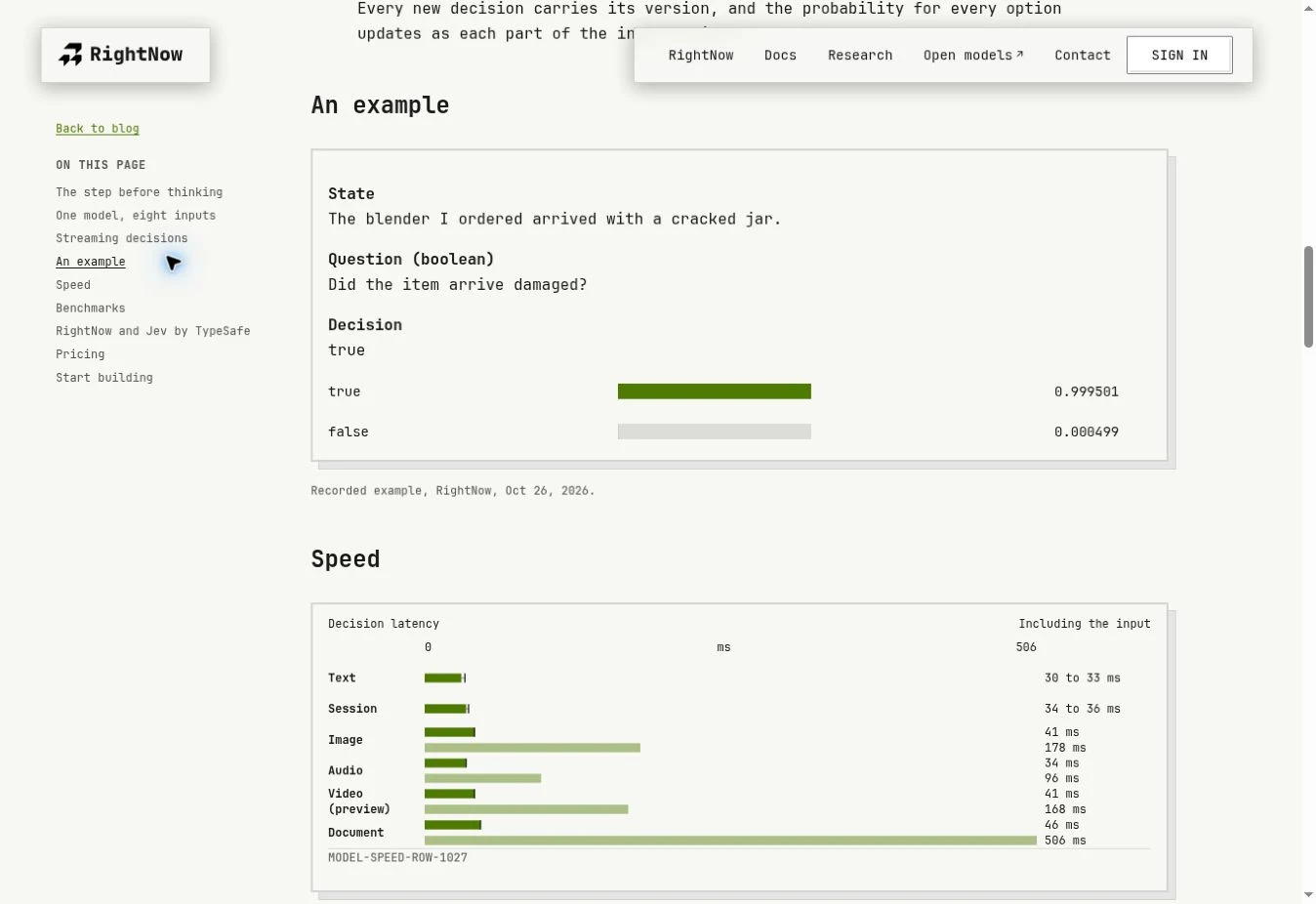
The number is not a warranty.
The decision docs say calibrated is false in this release. A calibration-version identifier does not establish calibration. They also distinguish the selected outcome’s confidence from the expected level of a score question.
That matters in practice: a high displayed probability is not evidence that equally confident predictions will be right that often on your tickets. Establish the relationship on labelled examples from the actual task. A threshold copied from a demo is not a validation result.
Read the benchmark’s footnotes.
RightNow’s launch page separates its own Decision Index measurement from Artificial Analysis’s evaluation and leaves its workflow-comparison results pending. Those qualifications prevent a clean claim that one ranking establishes broad production superiority.
The sensible trial compares incorrect routing, review workload and response freshness on your own cases. Measure end-to-end time including input preparation, network transit and application checks. A fast model result does not guarantee a fast, correct workflow.
03 / EXPLORE THE APPLICATION POLICY
A confident answer
can still be stale.
This authored scenario explains a decision gate. It is not an AI simulation or a RightNow integration. All outcomes and the 0.94 confidence below are illustrative assumptions.
“Correction: the parcel arrived. The contents are damaged. Please help me replace them.”
The answer covers the current state and meets the illustrative threshold. This permits routing only, not a refund or replacement.
The gate shows your application’s rule. It does not test whether the answer itself is correct.
Try the version 1 answer. Then turn off the freshness check. The confidence is unchanged, but the application can now route using evidence the customer has corrected.
04 / FROM PROTOTYPE TO A USEFUL HANDOFF
Stream the evidence.
Own the consequences.
The streaming interface is the distinctive development here: a decision can be associated with a particular accepted state as the input changes.
Define a small decision.
Start with one queue choice and examples a person can label consistently. Keep refund eligibility, identity checks and permission to send a message outside this initial classification.
Track the state it saw.
Streaming docs describe accepted mutations advancing state_version. Check the returned version before consuming the answer. An acknowledgement of new state is not itself a decision.
Keep a review lane.
Inspect each named answer for errors, even when HTTP succeeds. Route an unanswered, contradictory or insufficiently supported case to review instead of treating absence as a negative decision.
Audit the wrong turns.
Log the question definition, version and resulting route. Compare against human labels, then inspect why the system failed. Keep evaluation cases separate from the examples used to tune your rules.
The stream is not a durable job queue.
The streaming guide specifies server-to-server use and no durable stream resume. It distinguishes accepting state from producing an answer. Reconnect guidance includes replay and an unknown-outcome signal, possibly_decided.
For a small team, that means the integration includes storage, timeouts and reconciliation. Keep API keys on your server. If a connection disappears, do not infer either that no decision happened or that an external action should run again. Your application needs its own record of completed work.
Start in observation mode.
Run the model alongside the existing queue process first. Review the difficult cases: a correction after an initial answer, an incomplete message, a sarcastic complaint, a refusal, and two issues in one ticket. Inspect both the selected label and how the application handles it.
In our Mirrors Field Note, the question was how to scope a correction without changing unrelated agent behavior. RightNow addresses an earlier boundary: selecting a structured answer from current evidence. Neither removes the need to check downstream actions.
Can this make a narrow workflow more reliable, after we count the cases it sends to review?
That is a more useful acceptance test than whether it returns a neat answer to a clean example.
THE ECONOMICS
Short output.
More than one fee.
RightNow’s October 27 card lists text input, answered-question and answered-call charges; output is not charged. Recheck current prices before using them in a budget.
The launch card lists USD $0.19 per million uncached text tokens, $0.00013 per answered question and $0.000055 per answered call. Media and other paths have additional rules. “Output is free” does not mean a decision is free.
1,000 answered calls × (1,000 uncached tokens × $0.19 / 1,000,000 + 3 answered questions × $0.00013 + $0.000055).
This is arithmetic using the published base rates, not a bill estimate from a live workload. It excludes media, retries and other routing or billing conditions. Evaluation and human review can dominate the cost of a small pilot even when inference is inexpensive.
Published price card and conditions ↗05 / THE TAKE
Make the decision
easy to inspect.
Read the product docs ↗Independent coverage. No affiliate link.
RightNow is worth evaluating when a product repeatedly makes a narrow, well-defined choice. Typed questions and versioned streaming give that choice a useful software boundary. A team can inspect the question, associate an answer with evidence, and apply its own policy before acting.
It is less compelling when the real problem is an undefined process. A decision API will not decide what your refund policy should be, settle conflicting stakeholder expectations, or establish that your examples are representative. Those problems become harder to see when a precise-looking number arrives quickly.
My preferred first use is low-consequence routing with a visible review queue. Keep generation elsewhere if you also need a response drafted. Keep consequential actions behind explicit rules and appropriate review. Treat latency and accuracy claims as hypotheses to test on the actual workload.
The promise is a smaller, more inspectable decision layer. The test is whether the complete workflow makes fewer wrong turns. Until that is measured, a clean interface is a reason to investigate, not a reason to remove oversight.
PRIMARY SOURCE DESK / ACCESSED NOVEMBER 5, 2026
Follow the evidence.
Visual provenance: official RightNow launch artwork and our capture of its public announcement. No authenticated product screenshot was obtained. Local diagrams are original editorial explanations; they are not generated product interfaces or measured performance charts.