CUSTOMER CONTEXT, WITH SOMEWHERE TO GO
The brief is
only half
the job.
ChatGPT for Sales brings account research, customer conversations and CRM work into one conversation. Its most useful output may be a next step that still carries the reason behind it.
already talking to?
Identity · owner · open deal
buyer actually ask?
Commitment · condition · date
this matter now?
Source · timing · relevance
With its evidence attached.
An action, an owner and a reason a teammate can inspect.
WHAT OPENAI LAUNCHED
A sales workflow
around the chat.
On November 17, OpenAI introduced ChatGPT for Sales: a Sales plugin with seller-specific skills, alongside more than 30 new or enhanced partner plugins. It is aimed at work from choosing accounts to preparing meetings and following up.
The useful audience is a seller, founder or small revenue team whose customer context lives in several tools. A convincing brief can still leave that team with a second job: copying the conclusion back into the system the next person will read.
My question is whether this launch can shorten that whole handoff. The test is a customer record that explains what to do next, where the recommendation came from and what remains unresolved.
Read a polished account brief.
Reconstruct the action later.
Inspect the reason.
Leave a durable next step.
The new part needs a careful date.
This is a new packaged sales experience, not the first time ChatGPT could reach a CRM. HubSpot’s February 26 changelog already documented creating and updating records and logging activities from chat. Calling all of that new in November would erase the earlier capability.
There are meaningful partner changes, too. Clay’s November 17 relaunch moves beyond running prebuilt functions to building audiences and editing workflows, with artifacts shown in the conversation. That is a vendor-described expansion; I have not run it. Our earlier Clay note asked for a reason behind each prospect. This release raises a different question: can the reasoning survive when research becomes an operational step?
THE PRODUCT, IN CONTEXT
Several tools.
One customer story.
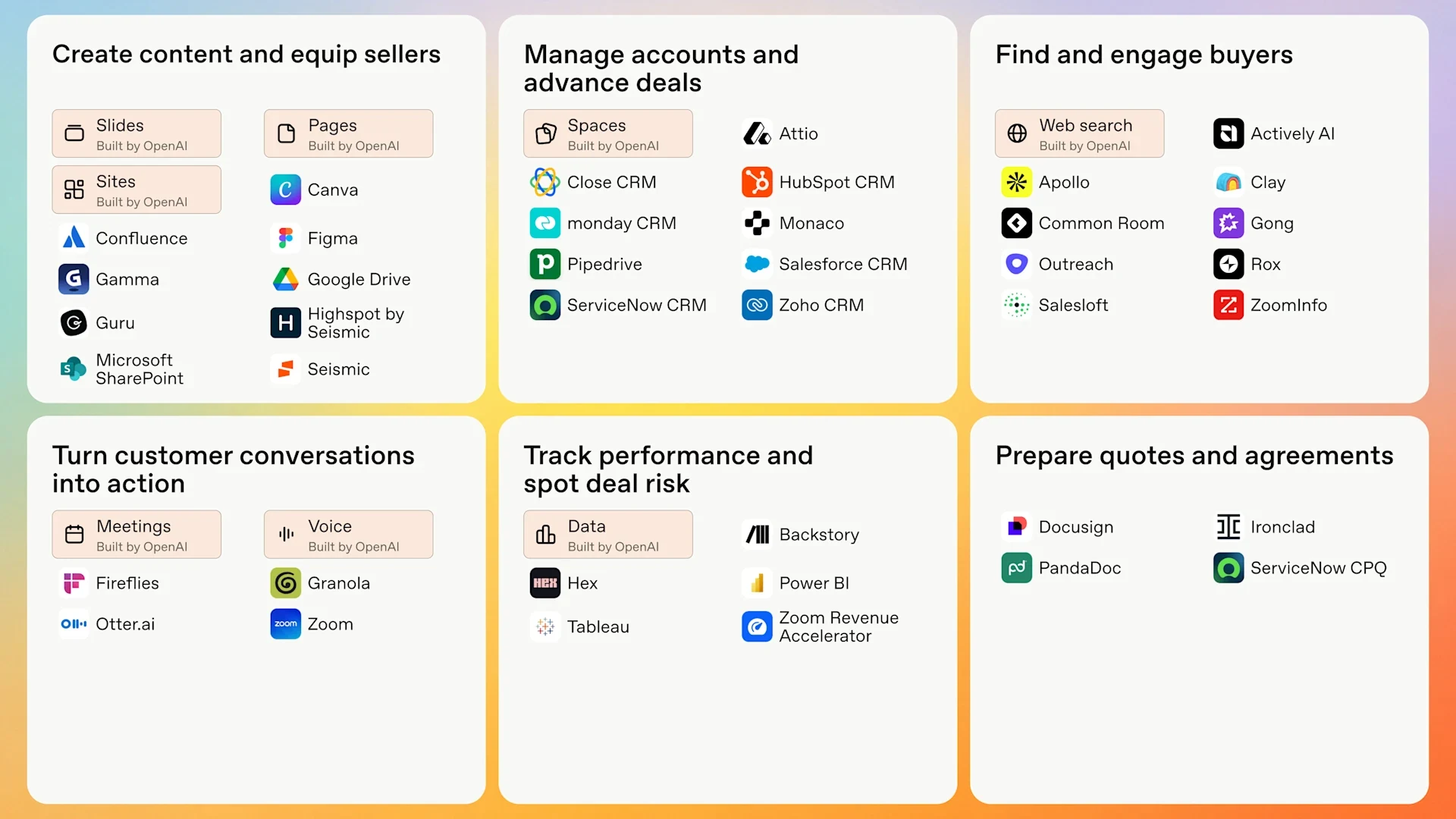
OpenAI’s official launch graphic groups tools by the work they support. The diagram is a useful picture of scope, not proof that every connected account exposes the same information or actions.
For an initial trial, choose the few connections needed to answer one customer question. More sources help only if you can tell which account, conversation and period they describe.
FOLLOW ONE THREAD
Where does the
evidence come from?
Choose a part of the handoff. These are editorial checks to bring to the connected product.
A company name is a weak join.
Match the company domain and the specific CRM account. A parent company’s expansion does not establish that your existing buyer owns the new budget. Keep that distinction in the brief.
Proposed check: include two similarly named accounts and ask which record supports the recommendation.
AN INTERACTIVE EDITORIAL EXAMPLE
Would you leave
that next step?
Imagine selling onboarding software to the fictional Alder Studio. An expansion announcement makes the account look timely. A recent call adds a less convenient detail: the buyer wants a security answer before another demo.
Use the evidence switches below to see how the recommendation should change. This is an original teaching model with fixed examples. It reads no CRM, calls no AI service and sends nothing.
Fictional company, people and events. The model deliberately distinguishes a public signal from a buyer commitment.
Answer security before booking.
Maya: prepare a response to the buyer’s security question, then ask whether a follow-up demo is useful.
- Reason
- The latest buyer conversation makes the next demo conditional on a security answer.
- What the signal adds
- The office expansion is useful context. It does not establish budget or an agreed purchase date.
- Still unknown
- The security question’s exact wording and who can approve the response.
The action follows the buyer’s condition. The announcement stays context.
Good personalization explains why you reached out.
Good follow-through remembers why you stopped.
The signal is not the commitment.
An office opening can justify investigating an account. It cannot justify a CRM note saying the buyer is ready to purchase. When those two claims collapse into a fluent summary, the next rep inherits false certainty.
In this example, the most commercially useful result is smaller than a campaign: an answer to the blocker, assigned to the right person. The expansion may matter later. The buyer’s condition matters now.
A saved note has to stand alone.
The conversation contains reasoning that a short task title may omit. “Follow up with Alder” is easy to save and hard to use. Include the condition, its source and the unresolved question in the saved record.
This extends the issue in our Granola discovery note: preserving uncertainty in a meeting summary is valuable, but the downstream action must preserve it too. A new interface does not remove that editorial responsibility.
A FIRST TRIAL YOU CAN ASSESS
One account.
One finished handoff.
Try an account you already understand, with sample or appropriately authorized data. Keep a manual version of the same task. Compare the complete result: finding evidence, checking identity, correcting the recommendation and leaving a usable record.
Do not infer success from how quickly the brief appears. Read the saved record as a colleague arriving tomorrow. Can you tell what to do, why it matters and what needs an answer?
For this account, prepare a meeting brief from the connected CRM, latest customer conversation and current public sources. Show the account domain and record, source dates, buyer commitments and unresolved questions. Separate public signals from buyer-stated intent. Propose one next step with an owner and supporting evidence. Show the exact customer-record update for review before saving it.
Remove the latest call.
The result should acknowledge the missing conversation. A confident recommendation that stays identical deserves inspection.
Open the saved record.
Check the account, owner, condition and evidence. A plausible sentence in chat does not establish that the right record was updated.
Count the cleanup.
Compare accepted handoffs, including corrections and re-entry. Keep the product if the work falls without losing the reason.
THE USEFUL IN PRACTICE TAKE
A promising place
to join the work.
ChatGPT for Sales is worth a bounded trial when your team already has useful customer information in connected tools and spends time reconstructing it. Its appeal is continuity: fewer handoffs between research, preparation and the next operational step.
The tradeoff is that a unified conversation can hide differences between sources. A current public announcement, a stale CRM field and a buyer’s recent condition deserve different weight. Ask for that distinction explicitly, then inspect whether it survives in the saved output.
Connections also have practical limits. HubSpot documents that accounts with sensitive data enabled do not expose engagement data through this connector. Clay says its relaunched MCP requires Editor or Admin access and consumes the same credits and actions as its app. Neither a plugin listing nor a successful connection establishes that your exact task is available.
OpenAI says availability varies by plan, region and workspace settings. For Business and Enterprise, administrators choose the Sales and partner plugins available to members. Its admin documentation separates installation, underlying app access and action controls. Confirm those before promising a workflow to the team.
If you only need occasional account research, the setup may outweigh the benefit. If your CRM is unreliable, adding a conversational layer may make its errors easier to repeat. Start where the inputs are understood and the saved outcome can be checked.
Explore ChatGPT for Sales · Official Sales plugin
No paid trial, performance measurement or authenticated CRM run was conducted. Official media and documentation inform the product description; the workflow judgments and interactive examples are editorial analysis. Direct links, no affiliate relationship.
PRIMARY SOURCES / READING NOTES
The evidence,
dated.
Published November 19, 2026. Sources accessed on that date. Official launch artwork was obtained and optimized locally. Embedded launch videos did not load in this research session; no behavior is inferred from them.
Related: Clay and prospect fit · Granola and customer uncertainty · Lumo and connected actions
- OpenAI: Introducing ChatGPT for Sales — November 17, 2026. Release, partner scope, availability and official artwork.
- OpenAI: ChatGPT for sales teams — current, undated product page.
- Clay: MCP relaunch with ChatGPT for Sales — November 17, 2026. Before/after, previews, access and usage.
- HubSpot: CRM actions and engagement access — February 26, 2026. Earlier write capabilities and documented exception.
- OpenAI: Admin controls for plugins and apps — current support documentation; accessed November 19.