
SkillsizeYour method is the product.
The valuable part of consulting often lives in how an expert thinks. Skillsize wants to turn that method into an AI workflow a team can reuse, inspect, and improve.
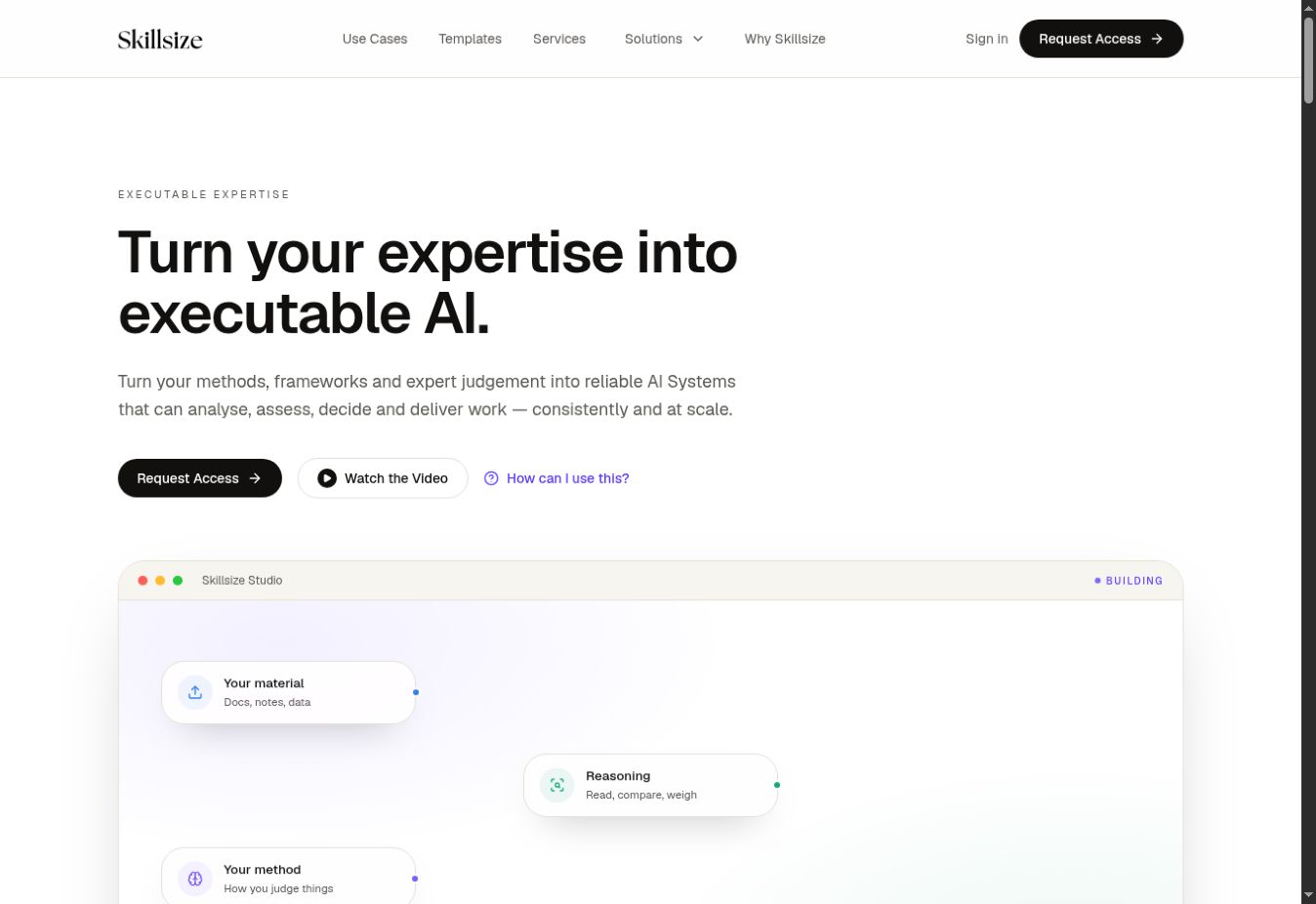
A platform for packaging expert methodology into structured, reusable AI Skills.
Consultants, advisory firms, and specialist teams with an established way of evaluating a recurring problem.
Can someone else run your process and produce work you can inspect, defend, and approve?
A consultant’s advantage is the way they reach a conclusion.
Two people can read the same customer interviews and produce very different recommendations. The difference may be which evidence they trust, how they weigh contradictions, and when they decide they do not know enough. That method is difficult to capture in a document that simply lists steps.
Skillsize describes a way to turn frameworks and judgement into AI Skills with defined inputs, sequenced reasoning, human review, and traceable outputs. It also promotes exporting methods into other AI environments. Official product overview ↗
The interesting possibility is a reusable service component: a diagnostic, a research synthesis, or an assessment that preserves a firm’s approach. My buying question would be whether the expert can inspect and correct the method, and whether those corrections survive the next engagement.
Evidence in. A method in the middle. A reviewable result.
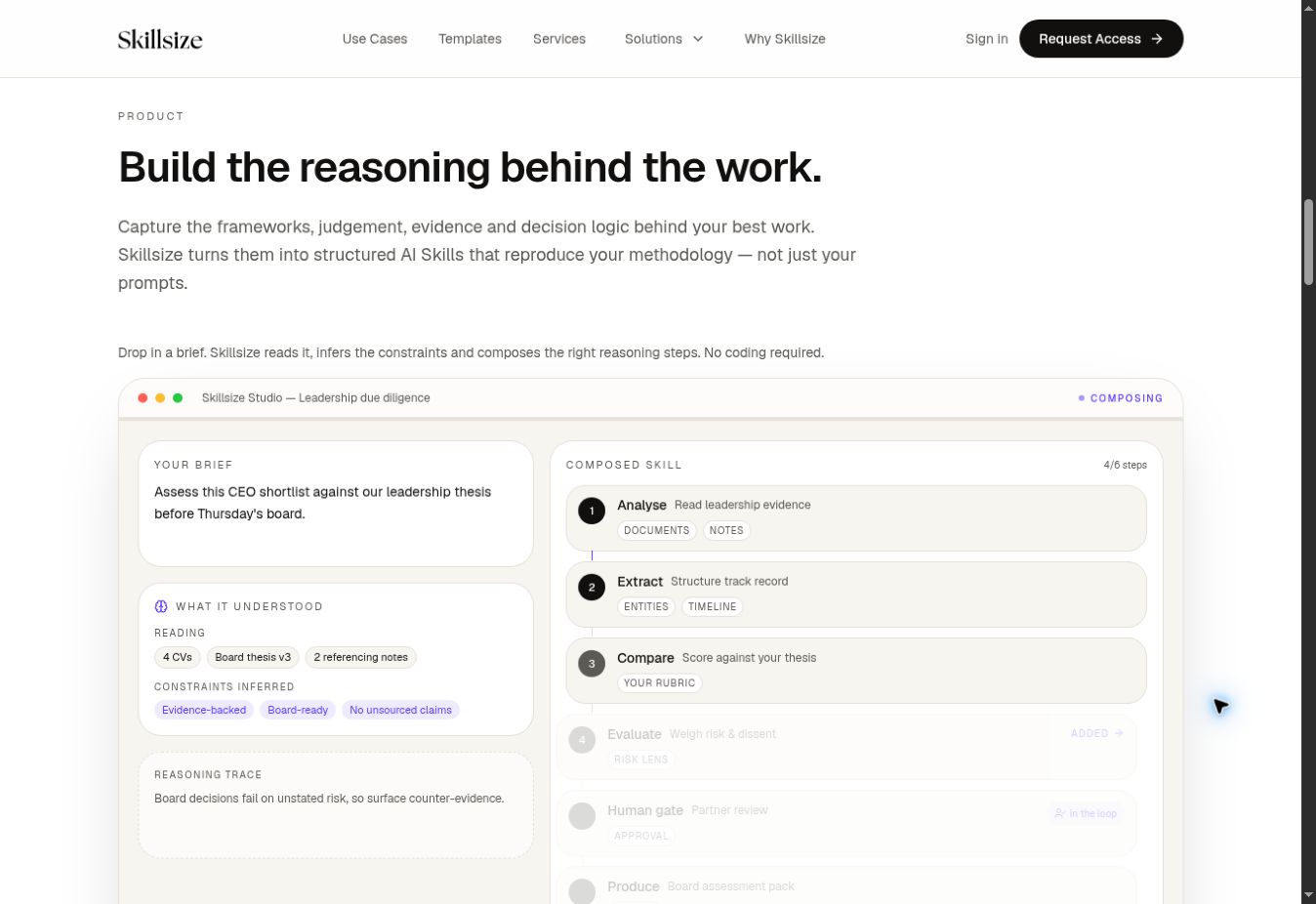
Skillsize’s public Studio demonstration shows a brief being broken into stages such as analysis, extraction, comparison, evaluation, expert approval, and a final deliverable. The screen below is a capture of that animated website demonstration, rather than evidence of an actual client engagement.
Its differentiator page emphasizes ordered reasoning, human approval points, an analysis trail, and documented methodology. Those are useful things to request in a demo because a polished final report alone reveals very little about how the work was done. Skillsize’s explanation ↗
What I would ask to see
Bring a deliberately incomplete brief. Ask the demonstrator to show where the missing evidence is noticed, what the reviewer can change, and which steps rerun after a correction. That turns an abstract promise of control into an observable interaction.
- 01 / CaptureDefine the expertiseWrite down the questions, criteria, evidence requirements, and exceptions.
- 02 / StructureSequence the workMake dependencies explicit so later conclusions rely on checked inputs.
- 03 / ReviewGive an expert controlChoose where a person must examine, challenge, or approve the work.
- 04 / ReuseRun and improveCompare outputs with your standard, revise the method, and test again.
That sequence is my evaluation framework for this category. The evidence that matters is a method behaving correctly on a difficult example, especially when it should pause or return an unresolved question.
Choose one recurring deliverable.
A positioning diagnostic
Compare a product brief, customer language, and a defined audience. Require each recommendation to name the evidence behind it and the assumption that needs testing.
A process review
Turn interviews and process notes into a map of handoffs, delays, and ownership gaps. Ask the workflow to separate an observed bottleneck from a suspected cause.
A roadmap review
Assess proposed work against the customer problem, dependencies, capacity, and success criteria. Have an expert challenge the recommendation before it becomes a client deliverable.
These are illustrative applications I would investigate, rather than customer outcomes. Each has a bounded input, a recurring decision, and a result a qualified reviewer can assess. A vague instruction to “improve the business” is much harder to evaluate.
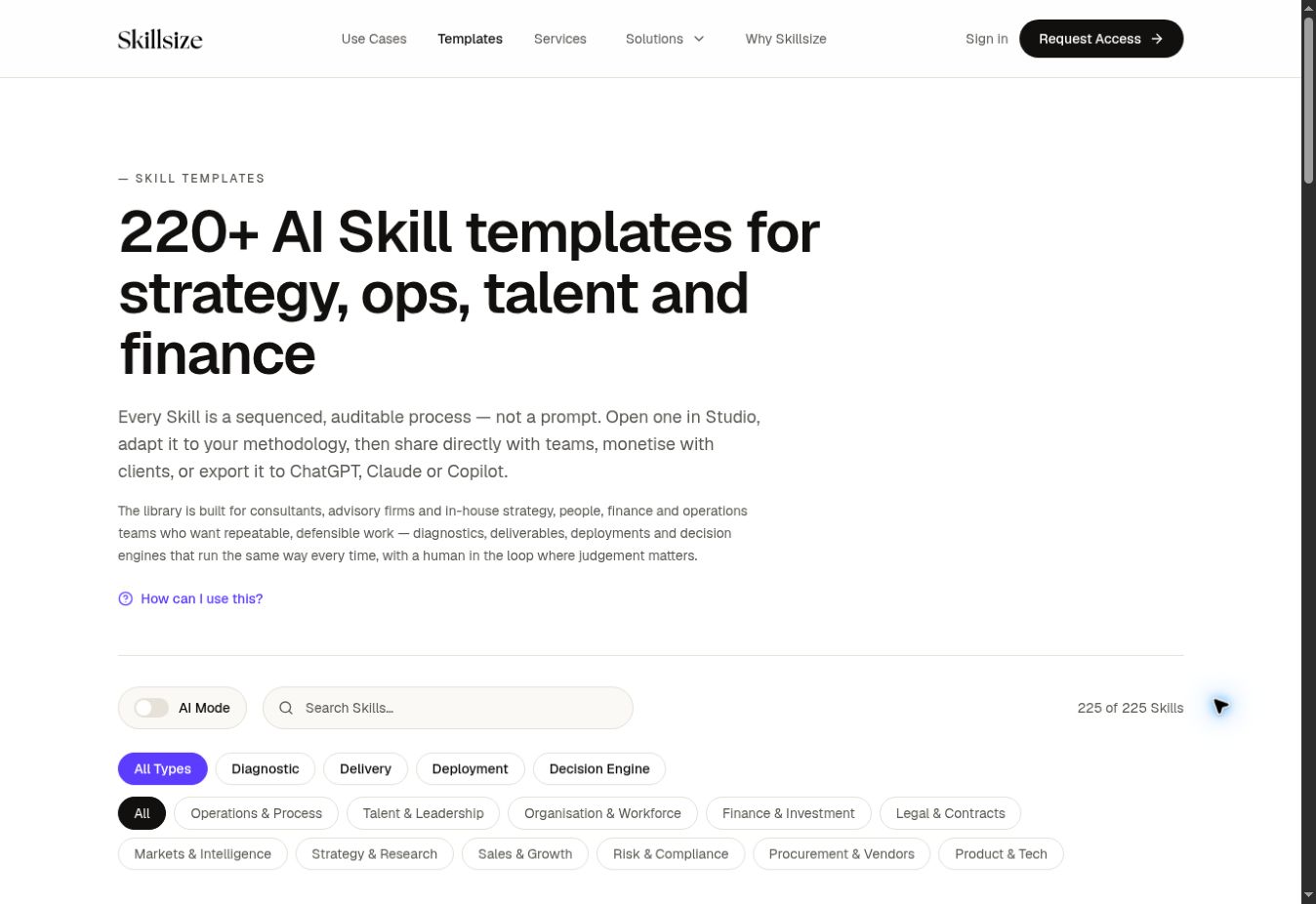
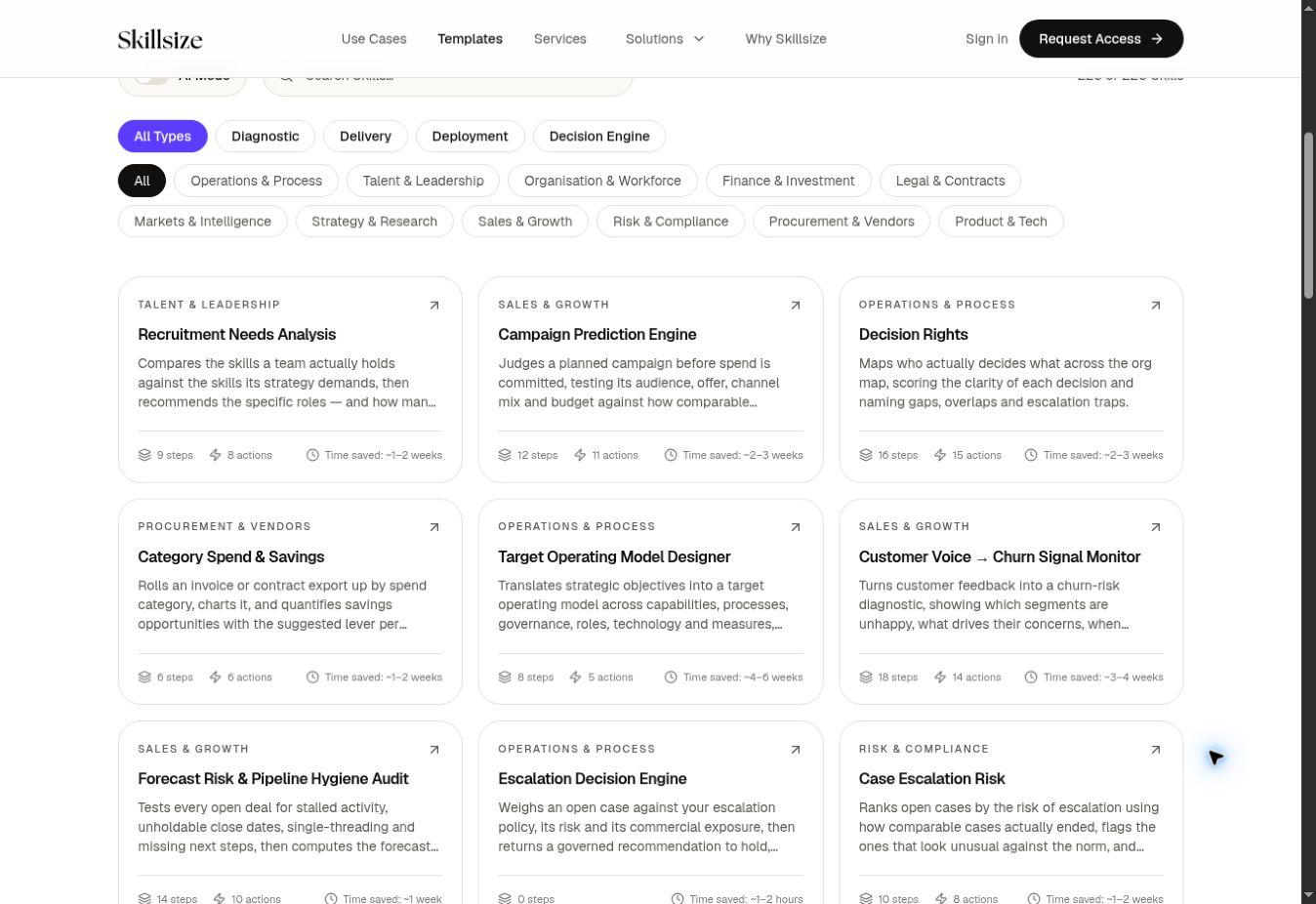
Skillsize’s directory advertises more than 220 templates across areas including strategy, operations, talent, and finance. I would use the directory to find a close starting point, then inspect the method and remove assumptions that do not fit the client. Browse the current templates ↗
Could it preserve your positioning method?
For Useful in Practice, I would trial a narrow SaaS positioning diagnostic. The input pack would contain a product brief, approved interview extracts, a landing-page capture, and my scoring rubric. The deliverable would be a short positioning memo with evidence, objections, gaps, and the next experiment.
| Stage | What the method should do | What I would inspect |
|---|---|---|
| Extract | Separate product facts, customer observations, and founder assumptions. | Does each finding retain its source and original meaning? |
| Compare | Evaluate the offer against the rubric and the chosen audience. | Does the same criterion mean the same thing across cases? |
| Challenge | Look for contradictions, missing proof, and plausible alternatives. | Does it flag a weak claim even when the brief sounds confident? |
| Approve | Let an expert revise conclusions before producing the memo. | Can the reviewer see what changed and what needs another pass? |
I would prepare three cases: a clear fit, a weak fit, and a brief with conflicting evidence. Write the expected findings before running the workflow. Then compare the output with those expectations, including how well it expresses uncertainty. Repeat a case to check whether the important conclusions remain stable.
A fast, fluent answer would not be enough. I would want supported recommendations, visible gaps, and less total review work. If the expert must reconstruct the entire analysis to trust it, the workflow has not yet earned wider use.
The first commercial win could be consistency.
My view: a repeatable first pass may be valuable even before a firm sells a standalone AI product. It can give the reviewer a common structure, help junior colleagues follow the method, and reveal where the methodology itself needs clarification.
Package a specific outcome people already buy.
My GTM recommendation
Lead with a concrete deliverable: a positioning diagnostic, a supplier review, or a roadmap assessment. Show a redacted input, an intermediate checkpoint, and an output. Buyers can assess that story more easily than a broad claim about making expertise executable.
A sensible product ladder could begin with an expert-reviewed assessment, progress to recurring monitoring, and eventually offer a client-facing workflow. Each step needs a clear scope, an owner for updates, and an explanation of when a human gets involved.
Where services could help
Skillsize also describes services for codifying expertise, automating knowledge work, and building AI solutions. Its published process includes discovery, design, building, validation, and deployment. AI Capability Services ↗
I would consider that route if the valuable method is still implicit in an expert’s habits. Ask what methodology documentation, evaluation cases, maintenance responsibilities, and deployment assets the engagement delivers.
An implementation partner could help extract the method or integrate the resulting workflow. That is a potential collaboration model, rather than a claim of an existing partnership. The important commercial question is who owns the relationship and who is accountable when the method needs to change.
The method needs to exist before it can scale.
I would shortlist Skillsize for a team that can explain its method, recognize a good output, and provide representative examples. I would slow down if every engagement is entirely bespoke or if nobody can agree on what the recommendation should be based on.
Portability is another point to demonstrate. Skillsize promotes exports across AI environments, including SKILL.md and MCP. Ask what is actually exported and which review controls, integrations, and execution behavior depend on the destination. A portable method still needs to be checked in the environment where people will use it.
For cost, request a quote using your intended users, run volume, source documents, deployment, and support needs. The homepage’s access request is not enough to calculate your cost per approved deliverable. Ask separately about implementation effort and ongoing maintenance.
Use this short checklist to prepare a useful demo.
Questions readers ask.
How is a Skill different from a saved prompt?
Skillsize positions a Skill as a structured method with stages, evidence requirements, and review points. The useful comparison is whether those elements can be inspected and tested on your examples. A longer instruction alone does not prove a more reliable workflow.
Does this remove the need for an expert?
My proposed pilot keeps the expert responsible for the rubric, difficult exceptions, and approval. The potential benefit is a stronger repeatable first pass. This Field Note does not establish that autonomous output is suitable for consequential decisions.
Can I use the same method with different AI tools?
Skillsize advertises portability across environments. Confirm the export format and destination requirements, then rerun your evaluation cases there. The same methodology may behave differently when the model, available tools, or review interface changes.
Start with expertise worth repeating.
The strongest version of Skillsize’s idea is a method you can inspect, improve, and deliver consistently. I would begin with a narrow diagnostic the team already knows how to judge, and make the difficult examples part of the demo.
My threshold for expanding the pilot would be less reconstruction by the expert, clearer evidence, and useful handling of uncertainty. If your immediate problem is organizing source material for writing, the StashBase Field Note explores that earlier stage of the work.
Sources & editorial context
Public product information checked October 26, 2026. Screenshots show Skillsize’s public website and animated demonstrations, rather than a private account or a completed customer engagement. This is independent analysis without firsthand product testing. The pilot, commercial recommendations, and acceptance criteria are proposed by Useful in Practice. No paid placement or affiliate relationship is represented here.
Turn a complex product into a clear story.
I create practical software stories, product demos, and content for AI and SaaS teams.