AI VIDEO / INDEPENDENT PRODUCT ANALYSIS
The first cut
is a conversation.
Pexo turns an idea, a webpage or your assets into a video through chat. The useful question comes next: can you change the right thing without losing the story?
By Stephen Stilwell · November 8, 2026
Documentation-led analysis. No hands-on generation test.
01 / THE PRODUCT IN PLAIN LANGUAGE
From source
to sequence.
Pexo is a conversational video-creation service for people turning a product or an idea into a finished piece of content. Its public workflow covers planning, scene creation, editing and delivery, with narration, music and graphics brought into the same project. That makes it relevant to founders and small marketing teams who need a coherent explainer but do not want to coordinate every production tool themselves. [1]
The distinction I care about is responsibility for the whole sequence. A collection of appealing clips still needs a point, a pace and a reason for the viewer to take the next step. Pexo proposes to carry that assembly work. You still need to decide what the video is allowed to say.
Its URL-to-video guide describes using a public page as source material, including brand assets and copy. It recommends a focused page and a request that specifies the audience, message and destination. [2] A feature page is therefore a more useful starting point than asking an agent to infer your entire business from a broad homepage.
For a software launch, I would give it a released feature page, approved screenshots and one viewer problem. The task is to help someone understand that feature. A lively animation of a capability the product does not have would fail, however polished the result.
Research scope: current public product and documentation, checked November 8. The public changelog’s latest listed entries are September 30, 2026. This is a first Field Note on Pexo, not a claim that the product launched this week. [5]
02 / MAKE THE PLAN VISIBLE
A finished video
has dependencies.
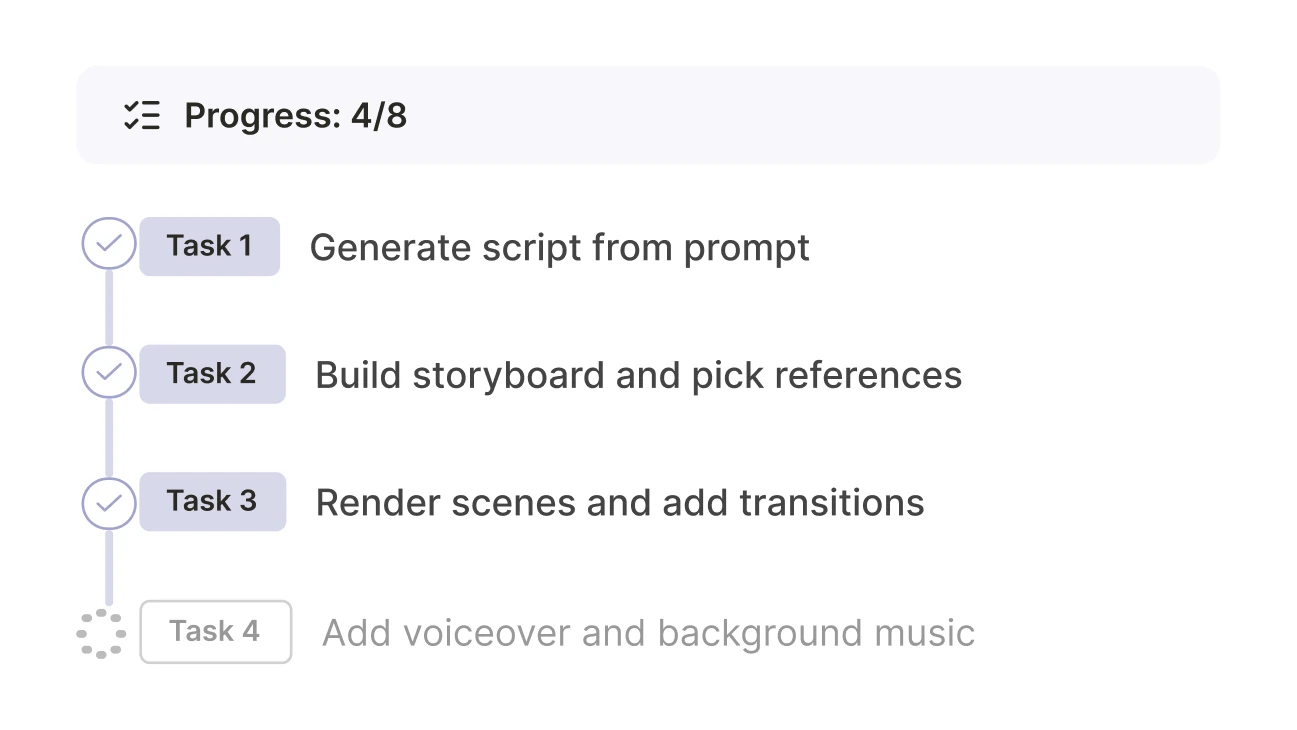
In the company’s artwork, a script leads to a storyboard, scene rendering and audio. It is a useful picture of the coordination Pexo wants to own.
My interpretation: the plan is an early review opportunity. If the wrong benefit becomes the opening premise, every later visual can reinforce the wrong story. Correct that premise before judging the transitions.
03 / THE REVISION DESK
“Make it better”
needs a location.
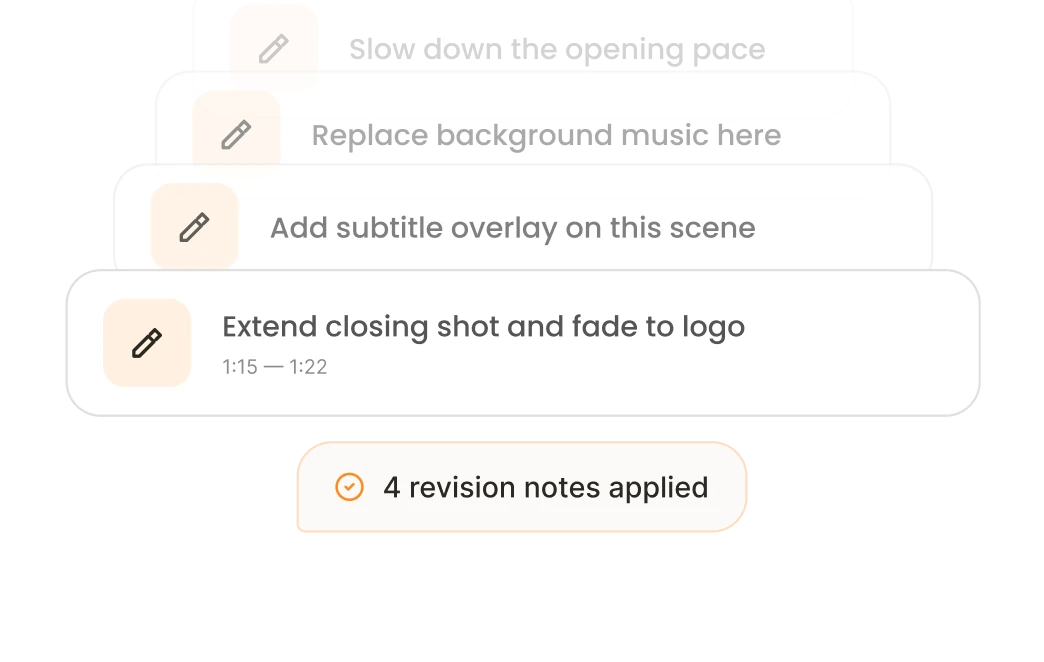
Pexo documents broad conversational changes and a more local “Mark to fix” workflow: pause, mark an area and comment. [3] That distinction is the most practical part of its proposition.
ORIGINAL EDITORIAL EXERCISE / FICTIONAL PRODUCT / NO PEXO CONNECTION OR VIDEO GENERATION
A stronger promise than the product supports.
Make the copy more accurate.
In the opening title, replace “Books every meeting automatically” with “Suggests times for your review.” Keep the calendar screenshot and the approved product name.
Recheck: watch the title, narration and captions. Correcting one layer is not enough if another still makes the old promise.
A good revision identifies the location, the intended change and the parts that should survive. This is how I would direct Pexo, not a demonstration that it obeyed these notes. The exercise produces authored feedback, not a generated edit.
The difficult case is a dependent change. Shorten a scene and a caption may need retiming. Replace a claim and the narration may need rewriting. Review the whole exported sequence after a local fix, especially the seam between the changed scene and the next one.
04 / A SPECIFIC FIRST TRIAL
One feature.
One useful correction.
Try a bounded product explainer, then ask for a change whose correctness you can actually judge. A short exercise can expose review overhead that a beautiful first result hides.
A proposed starting brief
ORIGINAL TEMPLATE / REPLACE BRACKETED DETAILS
Create a short explainer for [specific audience] about [released feature].
Use [public feature URL] and these approved screenshots.
The viewer should understand [one task] and end at [destination].
Preserve [exact product name], [approved claim] and [required wording].
Show real product assets for actual interface actions. Label any conceptual scenes.
Propose the story before the final cut. Do not invent metrics, customer quotes or capabilities.
What earns a useful result?
0 of 4 reviewed. This is a local checklist, not a product score.
Record preparation, waiting, review and correction time separately. Note credits spent and which outputs you would actually use. Checks stay on this page and reset on reload; the brief is copied only when you request it.
05 / THE COST OF A SECOND CUT
Count the version
you can use.
Pexo’s credit guide distinguishes subscription, bonus and add-on credits. Subscription credits expire at the end of their billing cycle rather than rolling over, and add-ons have their own validity. It also links watermark-free exports to subscription entitlements. [4]
Those terms matter more than a hypothetical price per video. A first draft, two discarded alternatives and an approved export are different units. Until you have repeated a representative task, converting an allowance into a promised number of usable videos would be guesswork.
Compare the complete route with your current method. If a screen recording and a few manual cuts already explain the feature clearly, the new workflow needs to earn its extra review and subscription overhead. If assembling scenes, narration and graphics is what keeps a useful idea unpublished, Pexo has a stronger reason to be on the shortlist.
No dollar comparison is included here. The pricing page returned a loading state in the research extraction; the linked credit guide was readable. Check current plans, generation charges, export requirements and usage rights before budgeting a real campaign. We did not buy a plan or generate a video for this note.
06 / WHERE I WOULD KEEP CONTROL
Direction is still
your job.
A webpage is evidence to inspect.
A source URL can contain stale copy, ambiguous wording or a claim intended for a different audience. Approve the script against current product behavior. Do not let visual polish make an unsupported statement feel settled.
Real interfaces need real assets.
Use authorized screenshots or footage when a scene claims to show a product action. Synthetic imagery can explain a concept, but it should not stand in for proof that the interface works that way.
A correction needs a rewatch.
The documentation explains how to request edits, not an independently verified guarantee that unchanged details remain identical. Inspect names, timing, captions, audio and the final call to action after each meaningful revision.
07 / THE DECISION
Shortlist it
for the whole story.
Visit Pexo ↗Direct link. No affiliate relationship or sponsorship.
Pexo is worth a bounded trial for founders and marketers who have a clear message and approved source material, but need help turning those into a complete video. Its conversational production and localized revision workflow make a concrete promise to investigate.
I would hold off when exact timeline control, reproducible frame-level changes or specific export requirements are essential and have not been demonstrated. The public materials describe a direction for working; they do not substitute for a representative test of those constraints.
We have already explored Yarn’s product-story workflow and Cardboard’s footage-led editing proposition. Pexo adds another current company to that landscape. This note’s focus is the review loop: how you point to an error, preserve the useful parts and judge the revised export. No comparative performance test is claimed.
The result I would pay attention to is simple: a viewer understands the real product, and a reviewer can correct the story without repeatedly rebuilding it. The first attractive cut gets your attention. The next accurate one earns its place in the workflow.
SOURCES / CHECKED NOVEMBER 8, 2026
Follow the evidence.
- Pexo current product website and official artwork ↗
Undated. Product scope, workflow and both artwork assets. Images are company-produced explanatory artwork, not authenticated application captures or our results.
- Pexo URL to Video guide ↗
Undated. Public-page input, focused pages and creative direction.
- Pexo How to Revise guide ↗
Undated. Broad conversation changes and localized Mark to fix instructions.
- Pexo Subscription & Credits ↗
Undated. Credit types, expiry and export entitlements. Verify terms for your account.
- Pexo changelog ↗
Latest listed entries September 30, 2026: interface languages, recent-project navigation and voice options. These are dated updates, not a November launch claim.
Research, not a hands-on review. We did not verify an accelerator affiliation and make no YC or Techstars claim. Official media was available, so no generated illustration was needed. Revision examples and trial criteria are original Useful in Practice work. No fabricated metrics, quotes or partnerships.