INTERCOM FIN / EVALS & RELEASES
Before the policy
reaches a customer.
Fin is Intercom’s AI customer-service agent. Its Evals test conversations before you change what customers experience. The interesting part is keeping that evidence attached to the change you actually ship.
By Stephen Stilwell · November 9, 2026
Independent, documentation-led analysis. No account test.
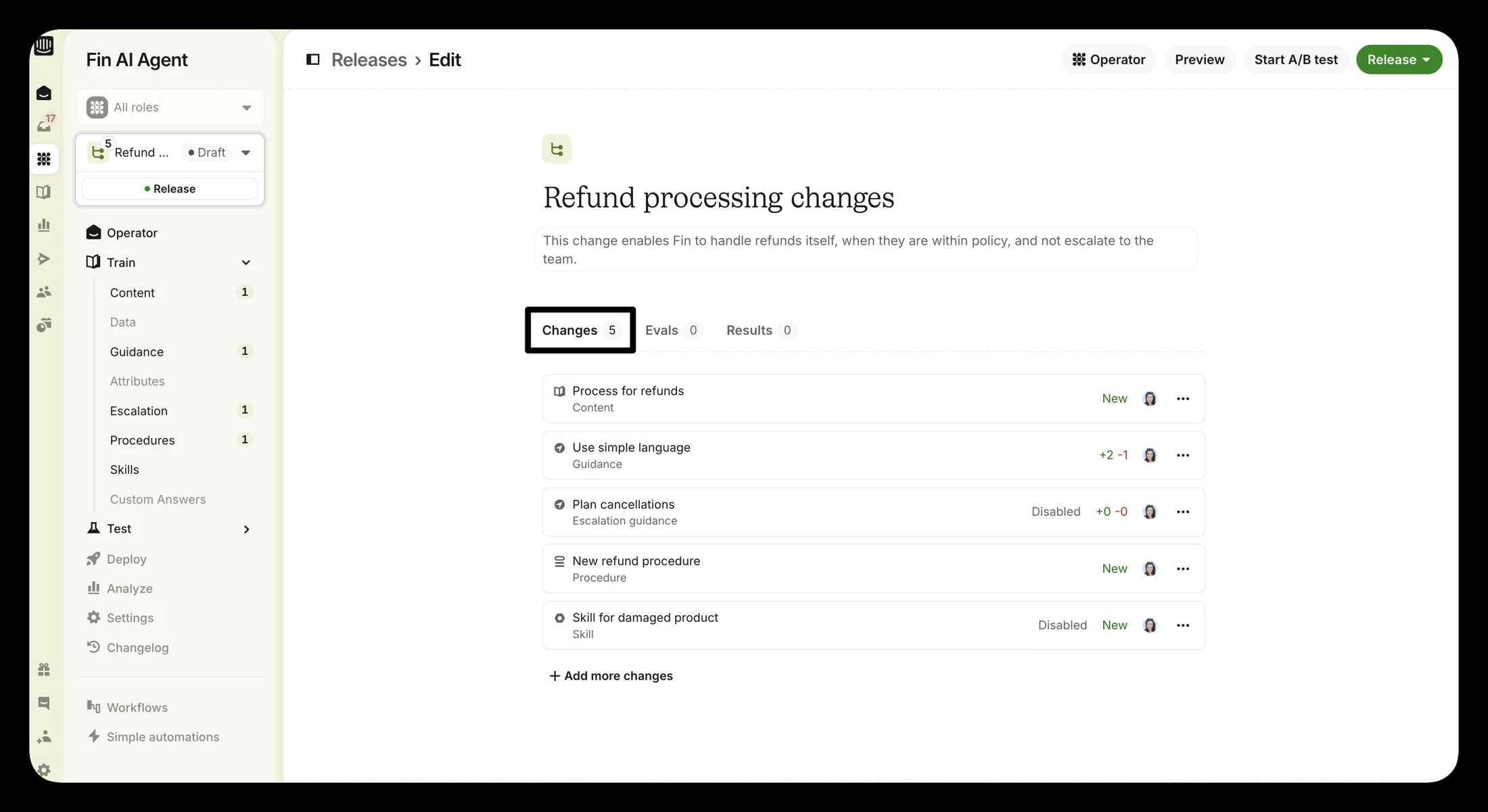
Inspect the change list
Detail crop of the same official screenshot: tabs and change names. Open the full image above for all surrounding controls and status columns.
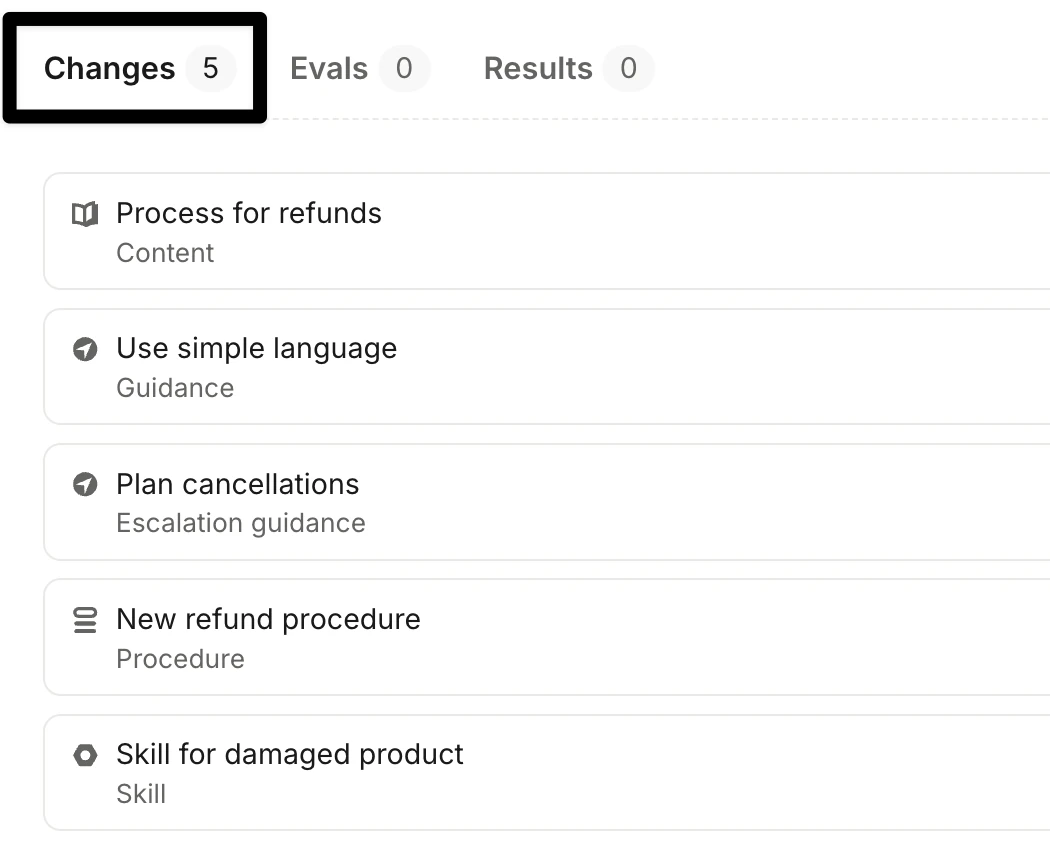
So should the review.
01 / THE PRODUCT & THE DEVELOPMENT
Support changes
are software changes.
Original Evals and Releases announcement
NOV 05Evals available to every Fin customer
For a support team, changing a help article can change the product. The next customer may receive a different answer, enter a different procedure or reach a different person. A typo fix and a refund-policy revision deserve different levels of scrutiny.
Fin brings company knowledge and configured behavior into customer-service conversations. [1] On November 5, Intercom announced that Evals was available to every Fin customer: multi-turn simulations with an AI customer and an AI judge, scored against checks the team defines. The announcement includes content, guidance, procedures, skills and data connectors in its testing scope. [2]
This is a wider-availability development, not a claim that the idea launched last week. Intercom’s original announcement was published on August 13. [3] The practical reason to revisit it now is that more teams can build repeatable checks into everyday configuration work.
Releases supplies the other half: a separate workspace for related edits, with preview, evaluation and rollout choices. Current documentation limits Releases to the Service agent and offers immediate publication, phased rollout or an A/B test against Main Fin. [4]
My read: the meaningful unit is the change package. A new article may be accurate while old guidance still tells the agent to do something else. Reviewing those ingredients together is more useful than approving each sentence in isolation.
02 / WHAT THE INTERFACE MAKES VISIBLE
A collection of tests.
A history to inspect.
An Eval groups simulations around a theme. [5] This official view makes the work concrete: scenarios have names, results and run history. A green count still needs an explanation of what was checked.
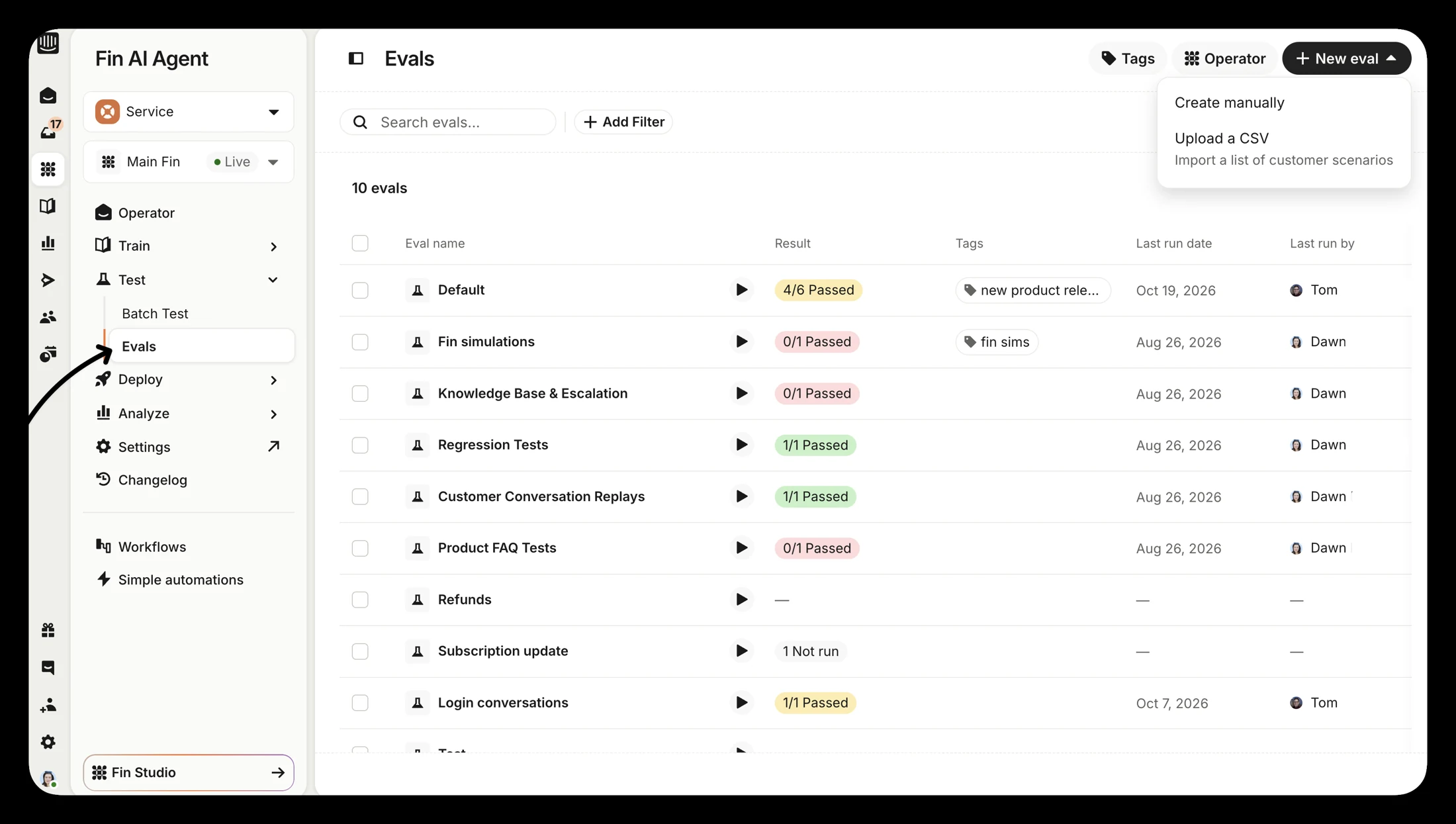
Inspect the result states
Detail crop of the vendor’s result column, including a not-run state. These sample counts are not performance data. The full interface is above.
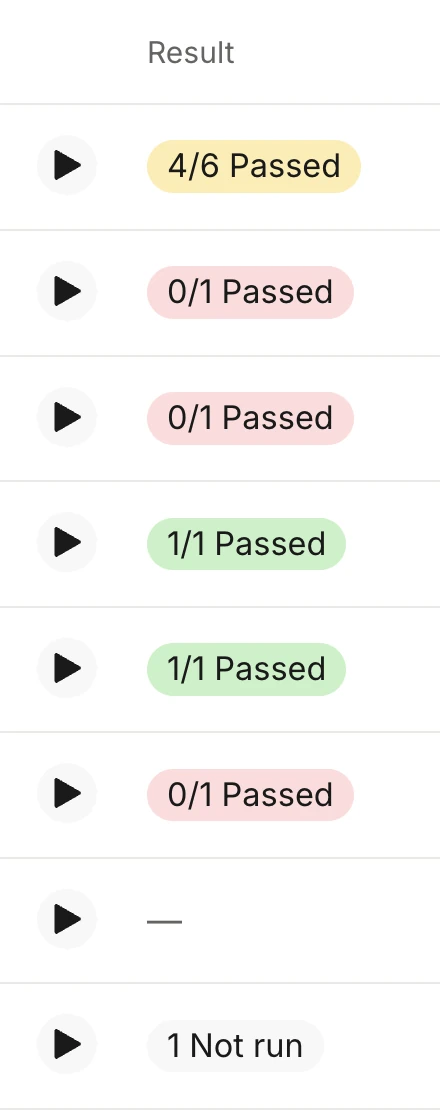
“Refund exceptions” tells a reviewer more than “Test 1.” Make the purpose recognizable after the author leaves.
A passing collection cannot answer a question its scenarios never asked. Coverage is an editorial decision before it is a score.
A new policy needs new tests. It also needs an old, unrelated case that should continue to work.
03 / THE CONVERSATION BENCH
The second message
changes the test.
A single opening question can lead to several correct outcomes. Choose a customer’s follow-up to see how I would change the acceptance criteria.
Unused items may be returned within 30 days. Damaged deliveries go to a support specialist. Check the order before promising a refund.
An ordinary return still needs verification.
- What should happen
- Verify the order and explain the eligible return process. Do not promise that a refund has already been issued.
- Handoff intent
- No specialist handoff is expected for this ordinary policy question.
- The failure to look for
- Treating “eligible to return” as “money already refunded,” or skipping the order check.
The test should distinguish explaining eligibility from completing a financial action.
These are acceptance criteria I would write, not answers Fin produced. The point is to separate a plausible reply from a correct next action. A reassuring answer can still be wrong if it promises money before the required check.
Intercom’s results guide says every simulation check and handoff check must pass. It also warns that an unset handoff expectation can default to “No handoff.” Set that intention explicitly, especially when escalation is the desired outcome. [6]
04 / THE EVIDENCE HAS A VERSION
You changed the rule.
Rerun the proof.
Intercom keeps results separately for each Release. Edit a Release after an Eval run and its results become out of date. Running Evals is recommended, but is not required to publish. [5]
That last point changes the operating model. The product supplies evidence; your team still decides what evidence is enough to ship.
Aligned: the example evidence refers to the current draft.
Try editing, then recording evidence for the revised version. This demonstrates freshness only. It does not run Fin, produce a pass or enable a release.
“Did it pass?” needs a second line:
“Against the version we plan to release?”
05 / A BOUNDED FIRST PILOT
One policy.
Several ways to be wrong.
For a team already using Fin, I would start with one meaningful support-policy edit. Keep the change narrow enough to explain and the scenarios varied enough to challenge it.
Put related edits together.
Update the policy article and the guidance that interprets it. List the intended behavior change and what must stay the same. Use authorized, appropriately minimized test fixtures.
Write the inconvenient cases.
Include an eligible request, an exception and missing information. Add an unrelated existing question. In a Release, Fin exposes both changed Evals and Evals from Main that you can run against it. [7]
Inspect the path, not just the badge.
The results view includes a transcript and event log. “Fail” means checks were unmet; “Error” means the conversation could not complete. Investigate them differently. [6] Record the specific mismatch before editing again.
Make the decision explicit.
Recheck evidence after the last change. Choose a rollout appropriate to the consequence of an error, name a reviewer and decide what live feedback would cause you to stop or revise.
Take the review brief
ORIGINAL TEMPLATE / REPLACE BRACKETS WITH YOUR TEAM’S FACTS
Change: [one policy and its related configuration]
Version reviewed: [release name and last edit]
Expected behavior: [what should now happen]
Must stay unchanged: [one existing customer journey]
Scenarios: [ordinary case], [exception], [missing information]
For each: [required checks], [explicit handoff intent]
Evidence: [run ID], [transcript review], [unresolved mismatches]
Outside this test: [workflow after handoff], [other dependencies]
Decision owner: [person] / Rollout and follow-up: [plan]
After any edit: rerun and review the relevant tests.
06 / WHERE THE CONFIDENCE STOPS
A passing simulation
has edges.
The useful promise is a repeatable way to investigate behavior. It should make the limits of your evidence easier to name.
Your checks define the target.
An AI judge can apply an incomplete criterion consistently. Manually inspect a sample of transcripts against the actual policy, including examples that passed. Agreement with a badly written test is not business correctness.
A handoff is not the whole workflow.
Evals can check a handoff to a workflow, but do not simulate what that workflow does next. [5] Test assignment, notifications and downstream records separately. A successful transfer does not establish that the customer’s issue was resolved.
Not every dependency is versioned here.
Releases currently exclude data connectors, attributes and workflows. [4] List shared dependencies in the review brief. Do not interpret a separate release workspace as a fully isolated copy of your support system.
Keep room for a second run.
Simulation allowances are monthly and workspace-wide, based on recent conversation volume. The documented allowance below 1,000 conversations is 250 simulations per month. [6] Budget for iteration and regression checks, not just the first run. This is a usage limit, not a quoted subscription price.
07 / THE DECISION
Make a change
you can defend.
Read the November 5 update ↗Direct link. No sponsorship or affiliate relationship.
For a team already operating Fin, Evals and Releases deserve a concrete place in the change process. The November availability update is an opportunity to replace an informal “looks good” with scenarios, explicit expectations and evidence tied to a release.
The best first use is a change you understand well enough to challenge: a refund exception, a new escalation rule or revised product guidance. The value is not the number of green checks. It is being able to explain why those checks address the risk of this particular edit.
For a team choosing a new support platform, this feature alone is not a buying decision. You still need to evaluate the customer experience, integrations, operations and commercial terms. This note did not test Fin’s live resolution quality or compare its performance with another agent.
Our Decagon Field Note examines what should survive a human handoff; our Sierra analysis asks what happens when a customer changes channels. Fin’s current development adds a different question: can the team reproduce the important cases before changing the system?
Keep the test and the decision close together. When the policy changes again, yesterday’s confidence needs new evidence.
PRIMARY SOURCES / CHECKED NOVEMBER 9, 2026
Open the record.
- Fin official product website ↗
Current product scope: Intercom’s AI customer-service agent. Undated page.
- Fin Evals availability update ↗
November 5, 2026. Availability to every Fin customer, conversation testing and automated checks.
- Original Evals and Releases announcement ↗
Brian Donohue, August 13, 2026. Establishes the earlier announcement date.
- Getting started with Releases ↗
Current help documentation, displaying “Updated this week.” Service scope, draft configuration, rollout choices, exclusions and official release screenshot.
- Fin Evals explained ↗
Current help documentation, displaying “Updated this week.” Eval structure, version freshness, optional testing gate, workflow boundary and official Evals screenshot.
- How to run Evals and read the results ↗
Current help documentation, displaying “Updated this week.” Checks, handoff defaults, result interpretation, transcripts and monthly simulation allowances.
- How to run and review Evals inside a Release ↗
Current help documentation, displaying “Updated this week.” Changed and existing Evals tested against release changes.
Research scope: public official materials and authentic vendor documentation images. No private product access or hands-on simulation run. Conversation examples, version exercise and review brief are original explanatory work, not product output. No accelerator affiliation, performance metric or customer outcome is claimed. Official screenshots were available; no generated imagery was needed.