WHEN A CORRECTION BECOMES SHARED CONTEXT
The first fix
is not the lesson.
Clay’s new global agent builds go-to-market work from a conversation, using the context already in your workspace. A small founder team can fix a bad prospect quickly. The harder decision is what that correction should teach the next run.

THE NOVEMBER 19 OPEN BETA
A play you can build.
A lesson you should inspect.
Clay introduced its global agent in open beta on November 19. The Agent tab plans and builds across Search, Audiences, Workflows and Sequencer. Clay says it tests a sample before volume and can suggest changes to the business context that informs later work.
This is relevant to a founder or small revenue team that understands its customers but spends too much effort translating that understanding into searches and enrichment workflows. The product’s appeal is a shorter path from an intended outcome to something inspectable inside Clay.
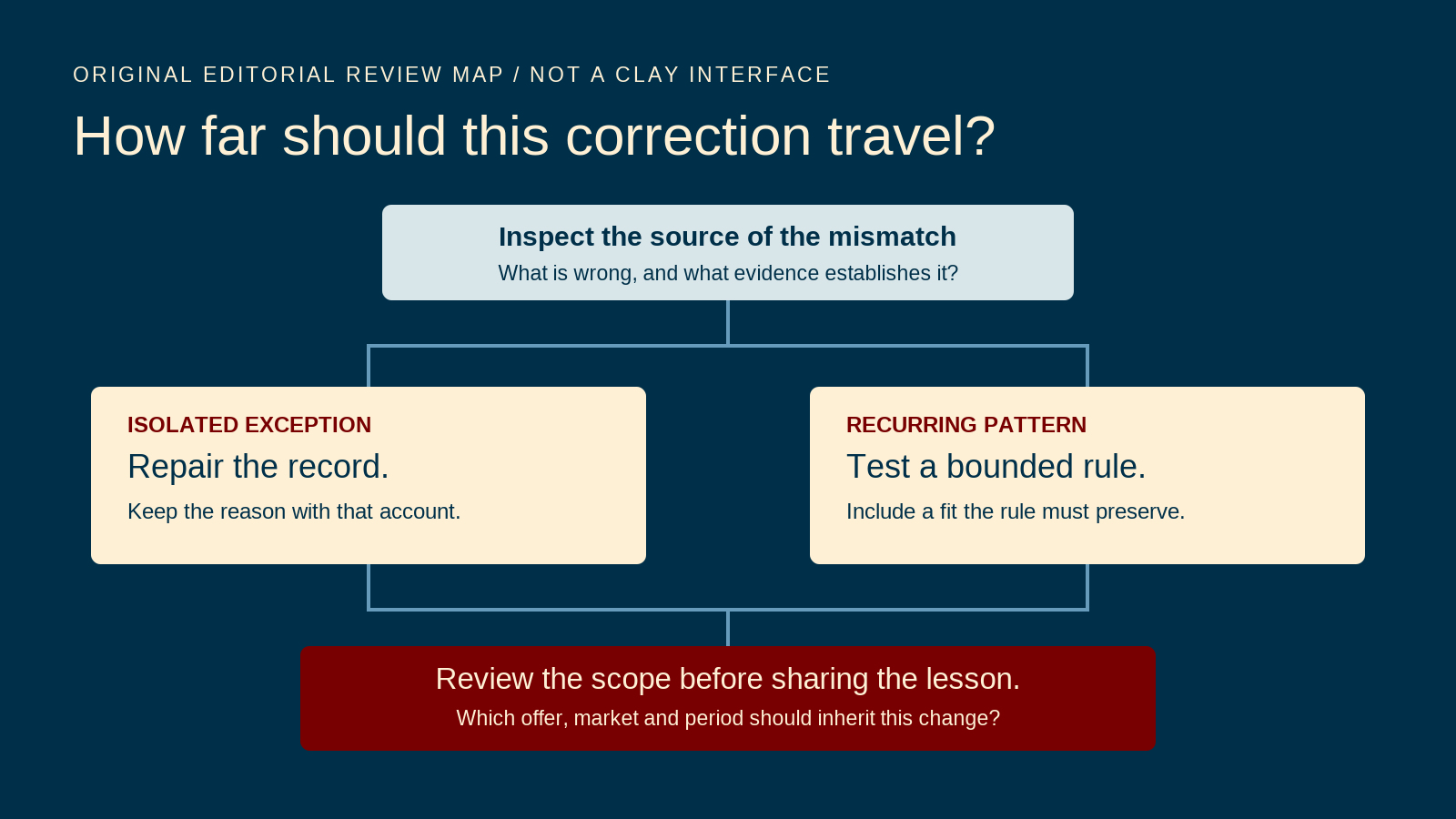
The longer-term question is more interesting than the first build. When a sample exposes the wrong account, do you repair that record, change the workflow rule or rewrite your shared view of the market? Those decisions have different reach.
DIFFERENT FROM OUR EARLIER CLAY COVERAGE
Building inside Clay
changes the unit of work.
Our earlier Clay note asked for a reason behind each prospect. The ChatGPT for Sales note discussed the November 17 MCP release and preserving evidence in a CRM next step. This November 19 development is a native agent for building across Clay. The thesis here is what a correction should change before the next play starts.
THE PRODUCT’S SHARED STARTING POINT
Context can compound
the wrong lesson, too.
Clay’s Knowledge Hub documentation describes a workspace business record, with sections including customer profiles and interest signals. The global agent starts from it. Suggested changes wait for acceptance; edits and approvals require an Admin.
That offers a useful place to preserve what a team learns. It also raises the cost of a sloppy generalization. A one-account mistake can become a broad exclusion if someone approves a convenient explanation without testing its boundary.
AN ORIGINAL EDITORIAL LAB
One wrong prospect.
Three possible changes.
Imagine a fictional founder selling onboarding software to companies that make their own subscription products. A sample includes a reseller. The company page makes clear that it sells someone else’s software, yet the draft research treated it as a product owner.
Choose where to apply a correction. These are fixed teaching examples, not a Clay interface, observed output or connected account. Nothing is researched, changed or sent by the lab.
FICTIONAL SAMPLE / RESELLER INCLUDED
The account does not own the product.
Evidence: its company page describes reselling another vendor’s software.
Local correction: mark this account outside the proposed product-owner segment.
HOW FAR SHOULD THE FIX TRAVEL?
Repair this record first.
A corrected row does not establish whether the search or enrichment rule will make the same mistake again.
Keep the source explaining the exclusion. Inspect the workflow step that inferred product ownership before changing the wider target market.
A useful rule
survives a near miss.
“Exclude any company that mentions reselling” sounds efficient. It can also remove a business that resells another tool while building its own product. The relevant question is whether the account owns software that creates the onboarding problem you solve.
My proposed test would include that mixed business alongside a service-only reseller and a straightforward product company. A rule that excludes the bad example while keeping the plausible buyer is more useful than a rule that merely makes yesterday’s list look cleaner.
A FIRST JOB WITH A CLEAR FINISH
Build a shortlist.
Hold the generalization.
Start with a small, intentionally varied sample you can assess yourself. Ask Clay to build an inspectable segment and explain each account’s fit using a dated source. Keep campaigns out of this first task. The accepted outcome is a reliable shortlist and a visible account-ownership rule.
When you find an error, record which inference failed. Was the source missing, was the account identity wrong, or did a workflow turn a weak signal into a decision? Ask for the smallest correction that addresses that failure, then rerun the affected examples.
A PROPOSED BRIEF / ADAPT TO YOUR WORKSPACE
“Build a small review segment for our onboarding-software offer. Show evidence that each company owns a software product, separate uncertainty from exclusion and leave existing customers out. Include a reseller that also owns a product as a boundary case. Propose corrections at the record, workflow and business-context levels separately. Do not launch a campaign or broaden the sample until I review the artifacts.”
Before accepting the lesson
Use this review aid on your own work. Checks stay on this page and are not an automated assessment.
0 of 4 checks reviewed.
Download the correction trial worksheet
Knowledge Hub’s documentation adds a detail worth remembering: a single suggestion can affect several sections. Inspect the full proposed change. It also says removing a source document does not undo what that document already contributed. Cleaning the inputs and correcting the business record are separate jobs.
After an accepted shared change, start a fresh task and inspect its initial assumptions. The useful evidence is that a new play uses the intended distinction. A repaired conversation alone does not demonstrate that future work has improved.
THE USEFUL IN PRACTICE TAKE
Keep the correction
smaller than the claim.
Clay’s global agent deserves a bounded trial if your team already works in Clay and the bottleneck is building a play from a clear commercial question. The new interface can make the intended workflow easier to discuss and inspect. No speed, accuracy or pipeline improvement was measured for this note.
The tradeoff is that building faster can also make a mistaken rule travel faster. Shared business context is valuable precisely because later work uses it. Approve a broad change only when its evidence supports a broad conclusion.
Current agent documentation lists Enterprise, Growth and Launch access, with temporary availability for legacy Starter, Explorer and Pro. It warns that beta results need checking. Agent work consumes data credits; downstream work has its usual usage costs. Check your workspace before planning a trial.
The documented boundaries matter: the agent can prepare a campaign, but you launch it in Sequencer; a new signal begins paused. It can analyze a table or rebuild it as a workflow, while table building and editing remain with Sculptor. The default approval mode still allows some work and credit spending without a pause. Review its scope before starting.
If you are still deciding who the offer is for, an agent may help explore the question but cannot turn a few convenient examples into market proof. Start with a shortlist you can audit. Keep a lesson when it explains the next case, not merely because it fixes the last one.
SOURCES & METHOD
The evidence,
dated.
Published November 22, 2026. All sources accessed that date. Public primary documentation supports the product description. The reseller example, correction lab and worksheet are original proposed evaluations, not observed Clay behavior.
- Clay: global agent open-beta announcement, November 19, 2026. Native Agent tab, sample-first workflow and suggested learning.
- Clay global-agent documentation, current, undated. Product surfaces, eligibility, usage and operational boundaries.
- Knowledge Hub documentation, current, undated. Reviewable business context, Admin role, cross-section suggestions and source-removal limitation.