
OPENSEO REVIEW
What happens when your AI agent becomes your SEO team?
A cheaper dashboard is interesting. A shorter path from search data to a decision is the bigger idea.
By Stephen Stilwell · October 12, 2026
Independent, documentation-based analysis.
› What should my website fix next?
Illustrative workflow. No live analysis runs here.
01 / THE PRODUCT BEHIND THE QUESTION
SEO software usually stops
at the dashboard.
You search for a keyword. Inspect a chart. Open another tab. Eventually, someone has to decide what the business should do with all that information.
OpenSEO puts an agent beside the data. Its MCP connection lets an assistant use SEO tools; its reusable Skills give that assistant a process to follow. The useful question becomes: which finding deserves work, and what would prove the work helped?
Meet OpenSEO
YC lists OpenSEO as a Boston company founded in 2026, in the Fall 2026 batch. Founder and CEO Ben Senescu previously worked as a senior software engineer at Klaviyo. The profile lists a two-person team. [1]
It covers keyword research, rankings, backlinks, competitors, audits and AI visibility, with DataForSEO supplying the main SEO data. Google Search Console adds evidence from your own property. [2]
The agent should make your next decision easier to explain. It should not make the evidence harder to inspect.
02 / LOOK INSIDE
A workspace you can inspect.
A codebase you can change.
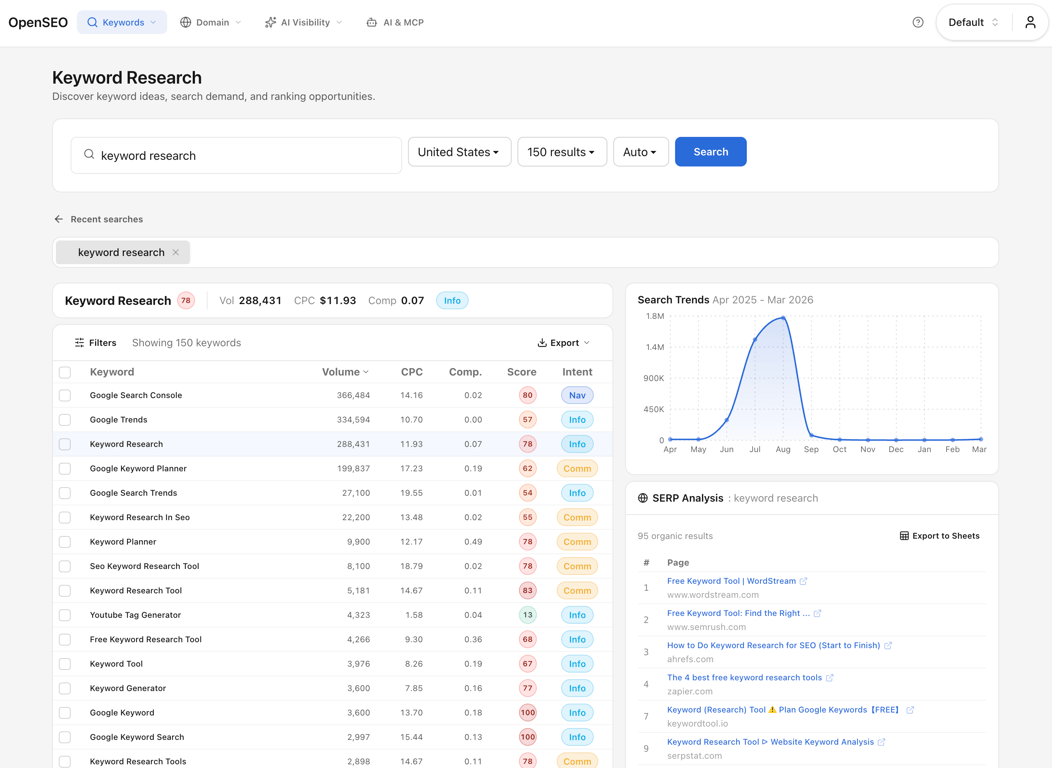
Data
Research seeds, inspect search results beside metrics, then save relevant opportunities. Volume is a clue; the pages already ranking tell you what the searcher expects.
Connection
MCP is the bridge between an assistant and external tools. A connected assistant can request data rather than guess. Skills supply the research procedure. Setup and client compatibility still matter. [4]
Ownership
The repository uses an MIT license. You can inspect and adapt the software. Open source provides an exit and a starting point for custom workflows; it does not establish data accuracy or remove maintenance. [5]
03 / INTERACTIVE SEO GROWTH LAB
What should your
website fix next?
Choose a goal. Leave with a diagnostic plan and a prompt that asks for evidence before recommending work. Your URL only personalizes the prompt; inputs stay in this page.
YOUR DIAGNOSTIC PLAN
Start with discovery evidence.
04 / CLICK THROUGH THE RESEARCH
Meet your new
SEO research assistant.
MCP supplies access. Skills supply a repeatable method. You supply the business context and approval to spend. This explorer illustrates the process, not a live tool run.
SEO audit
Compare the important page families, confirm indexing assumptions and weigh benefit against effort.
Read the official workflow ↗HUMAN CHECKPOINT
Does the issue affect an important page, or is the report simply counting warnings?
05 / A REAL SITE, A REAL CONSTRAINT
I put my own website
under the microscope.
Useful in Practice needs relevant discovery, not just more articles.
This site connects AI and software analysis with newsletter resources and SaaS creator services. Its public Field Notes include product comparisons, GTM workflows and AI-search coverage. The commercial path is already visible: useful article → relevant service or resource → inquiry or signup.
Meta VR glasses page impressions
0 clicks · average position 9.11
Ray-Ban comparison impressions
1 click · average position 6.79
“gtm studio” query impressions
0 clicks · average position 46.2
THE SAME PAGES, TWO DIFFERENT SIGNALS
Exposure is not engagement.
Page impressions show exposure; clicks show the visits that followed.
Source: owner-provided Pages(1).csv, Queries(1).csv and Filters(1).csv, exported October 11, 2026. Web search, “Last 3 months”; exact start and end dates were not included. Page and query tables are separate views. Average position is not a fixed ranking. Small counts make conclusions tentative. These are not OpenSEO audit results.
What the evidence supports
Meta hardware topics already receive impressions. That is a reason to inspect query intent and snippets, not a reason to promise more clicks. The GTM query has little exposure and a much weaker average position. It needs a relevance and competition check before another article.
The provided query rows contain no “SaaS UGC creator” or “SaaS product demo creator” terms. Absence from this export does not establish zero demand or zero visibility. Those are commercially aligned research candidates.
What I would ask OpenSEO next
- Compare the real search results for the creator-service terms with my SaaS UGC page.
- Use keyword research to check intent, location and plausible competition.
- Review the strongest related articles and their paths to the service page.
- Choose one landing-page improvement, then compare equivalent future GSC windows.
EXISTING STRUCTURE / OBSERVED
Product discoveries
Meta, Canva, AI agents and GTM Field Notes
→ Resources + newsletter + creator servicesPROPOSED STRATEGY / TO VALIDATE
Three clear discovery paths
Search growth: OpenSEO + Profound
GTM tools: practical marketing workflows
Hiring intent: SaaS demos + UGC portfolio
This is a strategy proposal, not a measured improvement. “AI tools for marketers,” “AI tools for startups” and “AI workflow automation” are further candidates, not validated opportunities. First check whether existing pages can answer the intent before adding new ones.
06 / FOLLOW THE COSTS
Open source does not
mean free SEO data.
HOSTED OPENSEO
$10 / month
Includes $10 of monthly usage. The trial includes $0.50. Paid research consumes credits; extra credits can be purchased. Included credits reset each cycle, while top-ups do not expire. An active subscription is required. GSC data does not consume the included budget. [6]
SELF-HOSTED OPENSEO
$0 app license
Docker or Cloudflare, your DataForSEO account, and your maintenance. The docs list a $50 minimum DataForSEO top-up and describe a 28% fee on hosted DataForSEO requests. Hosting and your AI assistant may add costs. Self-hosting is control, not a zero-cost promise. [7]
Set a research boundary: one property, one market, three queries and a cost estimate before calls. Continuous monitoring multiplies consumption. Check actual usage rather than treating the starting price as an unlimited plan.
07 / THE INDEPENDENT REVIEW
Is OpenSEO actually
worth using?
Where the proposition works
A creator or founder can start with a small research budget and ask an assistant to explain the evidence. Developers can customize the workspace instead of rebuilding basic SEO plumbing. A focused workflow may reduce the work of moving between research and decisions.
The combination of open code, a low hosted entry price and agent-oriented workflows is compelling. MCP alone is not unique: both Semrush and Ahrefs now advertise it.
Where I would be cautious
I have not tested the authenticated interface, connection reliability, crawl completeness or data accuracy. Simpler positioning is not proof of easier onboarding. Nontechnical users still need to connect an agent and understand usage limits.
Agency buyers should verify account collaboration and reporting before migrating. OpenSEO’s roadmap still lists teammates and scheduled reporting work; JavaScript rendering is explicitly not planned. That matters for sites where content depends on client-side rendering. [8]
| Decision | OpenSEO | Semrush | Ahrefs |
|---|---|---|---|
| Price reference | $10/month + usage top-ups | SEO: $139/month; Starter SEO + AI: $199/month | Lite: $129/month |
| Core research | Keywords, backlinks, competitors, audits, tracking | Keyword and competitor tools, position tracking, site audit | Site Explorer, Keywords Explorer, Site Audit, Rank Tracker |
| Agent access | MCP + reusable Skills | MCP listed in Starter | API and MCP listed in Lite |
| AI visibility | Prompt research, mentions and citations; usage-based | Starter lists 50 daily tracked prompts | Lite lists 5 tracked AI prompts |
| Hosting control | MIT repository; Docker / Cloudflare | Hosted suite in reviewed offering | Hosted suite in reviewed offering |
| Buyer's check | Spend, audit coverage, collaboration maturity | Which plan includes your specific AI workflow | Data history, crawl and credit limits for your use |
Sources: OpenSEO pricing, Semrush pricing, Ahrefs pricing. Monthly USD references, excluding tax. Annual discounts differ.
MY VERDICT
Worth a bounded trial.
Make it earn a bigger job.
Try OpenSEO if you want occasional, explainable research through an assistant and can monitor costs. Test one meaningful workflow against your current method. If you rely on established reporting, large research operations or rendering-heavy audits, verify those requirements before replacing your suite. If you have not used Search Console yet, start there.
08 / SOFTWARE DECISION GUIDE
Which SEO setup
fits your business?
YOUR STARTING POINT
Start with your own search evidence.
Use Search Console and free Google tools before buying a suite.
Explore this approach ↗An editorial fit guide, not a personalized product benchmark. Requirements and actual use determine the final choice.
09 / FOR FOUNDERS & MARKETING TEAMS
Your software deserves more
than another product announcement.
I turn technical products into useful stories: a clear task, a visible workflow, and a reason to care. This Field Note is an example of that approach.
Show the work
SaaS product demos, screen-recorded tutorials, UGC-style videos, interactive explainers and founder features.
Build a useful campaign
Launch content, sponsored editorial and creator collaborations, with agreed scope, usage rights and disclosure. An OpenSEO concept: one real website, one research question, one visible decision.
No OpenSEO sponsorship or approved referral relationship is represented. No public affiliate commission terms were found in the official pages and targeted search reviewed. Product links are ordinary links.
SOURCES & METHOD
The receipts.
Official sources reviewed October 12, 2026. This is documentation-based product analysis plus an owner-provided Search Console case study, not authenticated OpenSEO testing. No paid resources were used. The interactive tools are original planning experiences and send no data to OpenSEO.
- Y Combinator: company and founder
- OpenSEO: product overview
- Keyword research and official screenshot
- Agent setup: MCP and Skills
- GitHub: source and MIT license · Why open source
- Hosted pricing and credit rules
- Self-hosting and data costs
- Roadmap and audit limitations
- SEO audit workflow
- AI visibility audit workflow
- Semrush plans
- Ahrefs plans
Read next: Profound and AI search visibility · OpenAI GTM Studio · Claude dashboards & motion · Editorial policy