THE CODE MOVED. DID THE EVIDENCE FOLLOW?
Which commit
did you approve?
Claude Ship brings review, automated fixes and policy-based approval to GitHub pull requests. Its useful promise is less coordination after the first draft. The practical test is whether the evidence still describes the change that is about to merge.
THE NOVEMBER 23 LAUNCH
Review it.
Fix it. Decide.
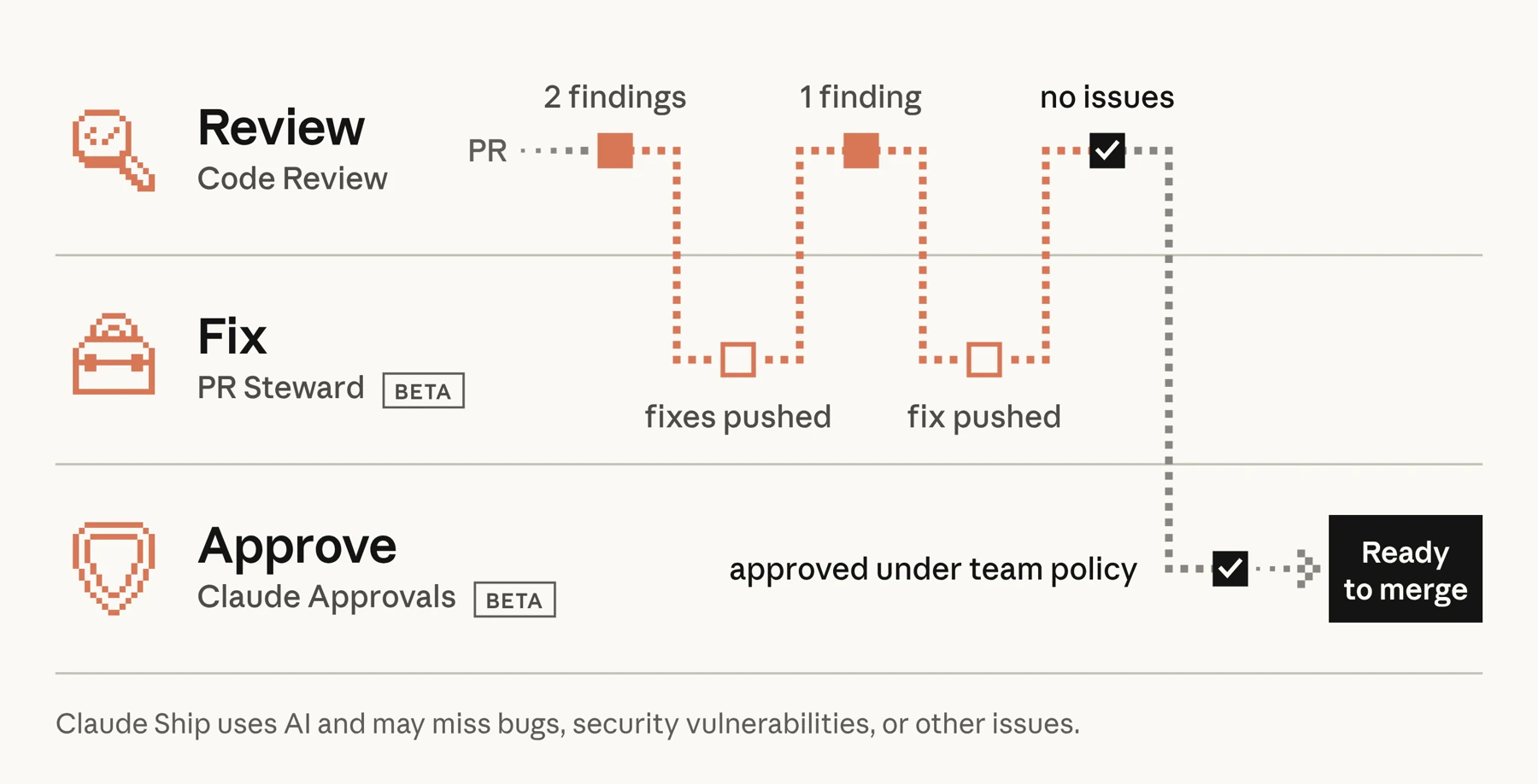
Anthropic introduced Claude Ship on November 23. It combines the already generally available Code Review service with two agents in beta: PR Steward and Claude Approvals. It is a workflow around GitHub pull requests, not a new frontier model.
For a founder with a small engineering team, the appeal is the work after opening a PR. A review identifies a problem, someone makes a correction, checks run again and an approval decision follows. Each handoff competes with whatever the developer started next.
Automating more of that sequence can reduce coordination. It also makes a pull request a moving target. If an agent pushes another fix after someone reviewed the first version, “this PR was reviewed” is incomplete information. Which change did the reviewer actually see?
Find the issue
Code Review reports findings. Its analysis does not run your application.
Change the branch
PR Steward can push corrections. That changes what needs inspection.
Apply the policy
Claude Approvals evaluates requirements. GitHub rules govern the merge.
The Code Review documentation says it reads the diff and surrounding code without building or running it. Findings appear with a summary and check run. A no-findings result is useful evidence about that analysis, not a substitute for tests or confirmation of the intended behavior.
The PR Steward guide describes fixes for failing checks, conflicts and review feedback. It is designed not to approve or merge. Our earlier Claude coverage examined visual outputs; Ship’s new development concerns the review and delivery process around code.
THE PRODUCT IN VIEW
A fix leaves
a new revision behind.
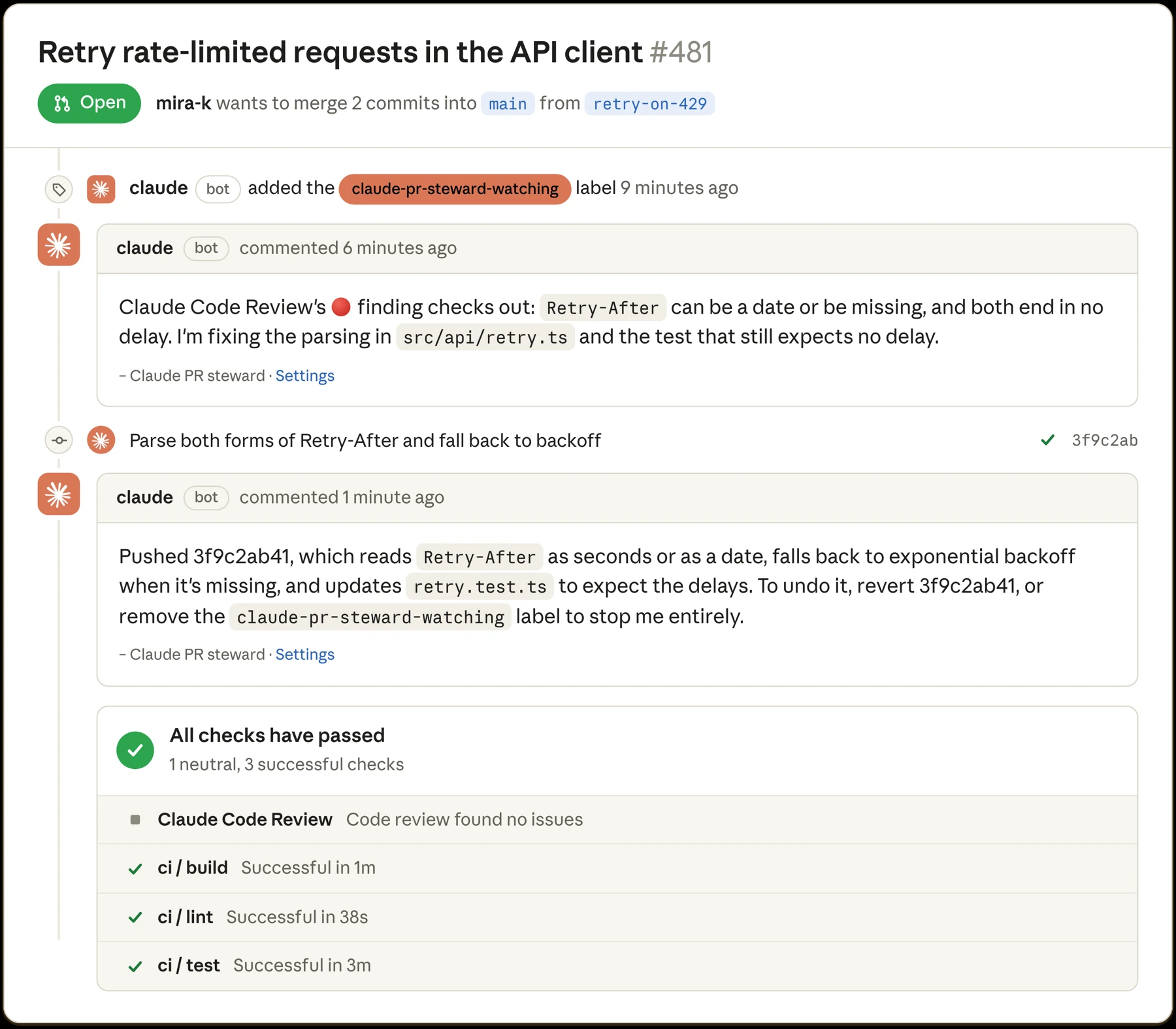
Anthropic’s official PR Steward example shows a finding followed by a pushed correction and an explanation. The useful detail is the relationship between the report and the revision. A comment describing a fix gives you a place to start inspecting; it does not independently establish that the fix is correct.
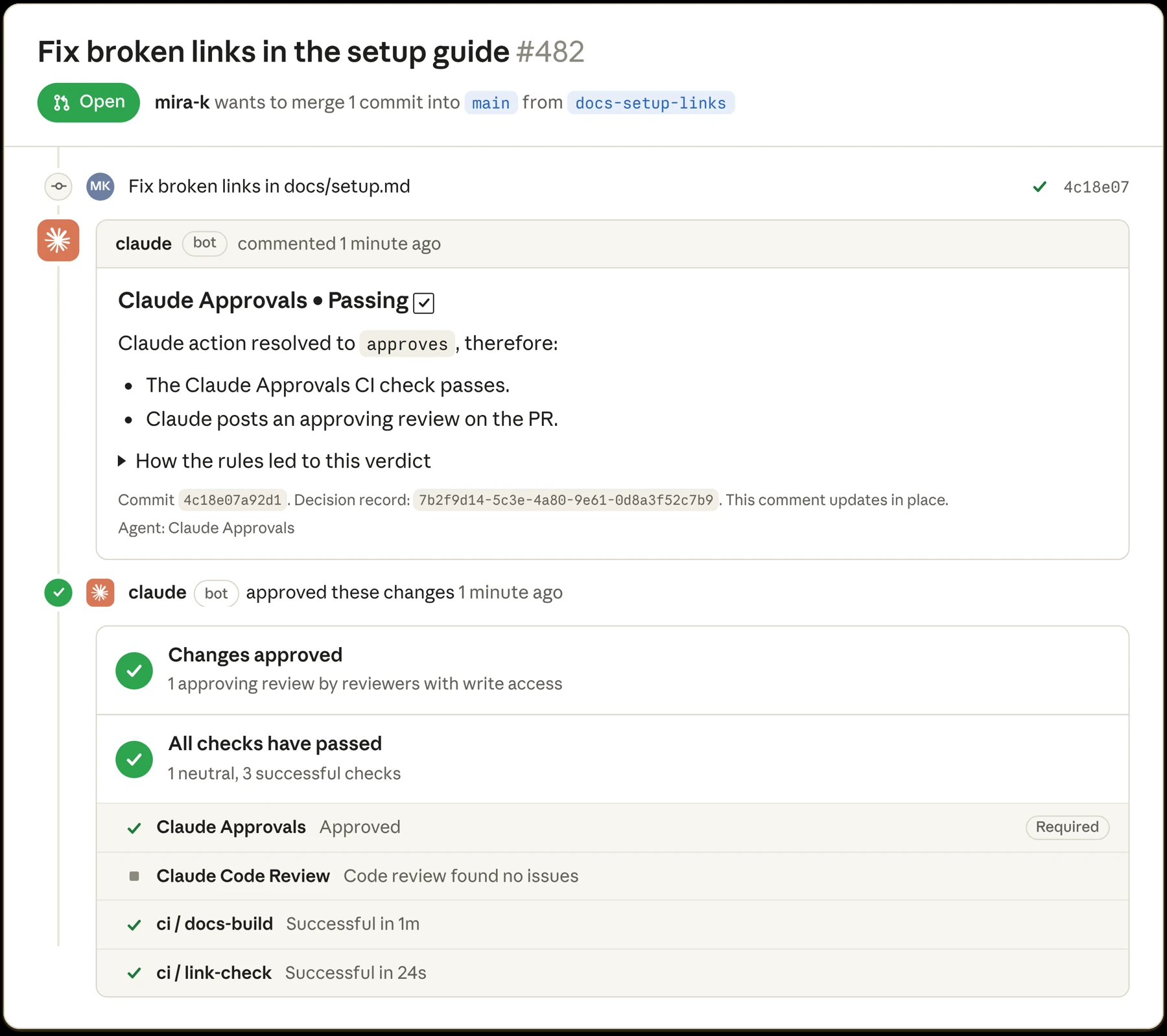
The second official example shows an approval decision on a different PR. It is not the next step of the same demonstrated task. Both are vendor examples, not results measured here.
AN ORIGINAL EDITORIAL LAB
One pull request.
Two different changes.
Imagine a fictional app whose trial-expiry message gives the wrong date. Version A changes the calculation. A reviewer checks it. A later revision, B, fixes a failing test but also changes the display logic. The earlier screenshot and approval may no longer answer the question that matters.
Choose a stage below. These are authored teaching cards, not a GitHub interface, live policy evaluator or Claude Ship output. The commit labels are fictional.
Review and preview recorded against A.
Check which evidence now covers B.
The reviewer inspected revision A.
Evidence: a preview and test output tied to fictional revision A.
That evidence describes the version inspected, not every later version of the PR.
WHAT DOES THE EVIDENCE COVER?
Record the revision with the result.
A PR link alone does not identify the code that produced a screenshot or passing test.
Keep the commit identifier beside the check output and the expected trial-expiry behavior.
This is a proposed review habit, not a claim that Ship invalidates every earlier result automatically. The policy reference includes reuse rules for retaining approvals or classifier answers after a changed diff. A new commit should make you ask what still counts, rather than assume either that everything is stale or that everything survived.
The review guide also allows keeping an earlier result when a push preserves the same added and removed lines under its documented conditions. A new commit identifier and a substantively changed diff are different cases.
A USEFUL FIRST EVALUATION
Follow a correction.
Then follow its evidence.
For an authorized trial, choose a small change with behavior you can check independently. Record the starting revision, review findings and relevant test. After a correction, compare the new diff before trusting the earlier preview. Repeat the affected behavior check against the version you intend to deliver.
The Approvals workflow guide says a push can cause earlier approvals to stop counting. Read the current check title and its explanation after each substantive revision. A historical approval elsewhere in the conversation is not the current decision.
A PROPOSED REVIEW QUESTION
“What changed since the reviewed revision, which checks cover the current version, and what approval does the current policy still require?”
Keep the handoff inspectable.
This local aid records your review. It does not connect to GitHub or evaluate a policy.
0 of 4 checks reviewed.
Download the revision-review worksheet
Do not treat observation as free. The Ship documentation says observe mode is billed, and PR Steward has no spend limit of its own until one is set. Adding an Approvals policy can also change which PRs receive automatic Code Review, even in observe mode. Read those settings before an administrator enables anything.
The GitHub-rules guide explains why approval and merge remain separate: enforcement depends on required checks, while auto-merge or a queue can deliver a policy-approved change without another person acting. CI should remain independently required; an approval policy is not a test runner.
THE USEFUL IN PRACTICE TAKE
Less coordination.
The same need for a clear decision.
Claude Ship deserves a bounded evaluation for an eligible team whose PRs repeatedly wait on routine corrections. Code Review is generally available; Steward and Approvals remain beta. Current documentation lists Team and Enterprise access and excludes several compliance configurations. Check your organization’s eligibility before planning a rollout.
The tradeoff is a more active branch. Faster fixes help only if the team can still tell which findings were addressed, what changed afterward and what evidence covers the current version. This note measures no speed, defect-rate or cost improvement.
Keep the workflow if it reduces handoff effort while making the final revision easier to understand. A green signal is useful when its meaning is clear. Before accepting it, ask which commit it describes.
SOURCES & METHOD
The evidence,
dated.
Published November 26, 2026. Sources accessed that date. Official examples are vendor media. The fictional revision lab and worksheet are original proposed evaluation aids.
- Introducing Claude Ship, November 23, 2026: release and imagery.
- Ship overview, Code Review and PR Steward, current documentation.
- Review results and Approvals workflow, current documentation.
- Policy reference and GitHub rules, current documentation.