ANTHROPIC / CLAUDE FABLE 5.2
Give the hard part
a better model.
Claude Fable 5.2 is Anthropic’s new model for demanding reasoning and long-running agent work. The useful upgrade question: which problem deserves more intelligence, and which work should stay with a cheaper model?
By Stephen Stilwell · November 10, 2026
Independent launch analysis. No hands-on model evaluation.
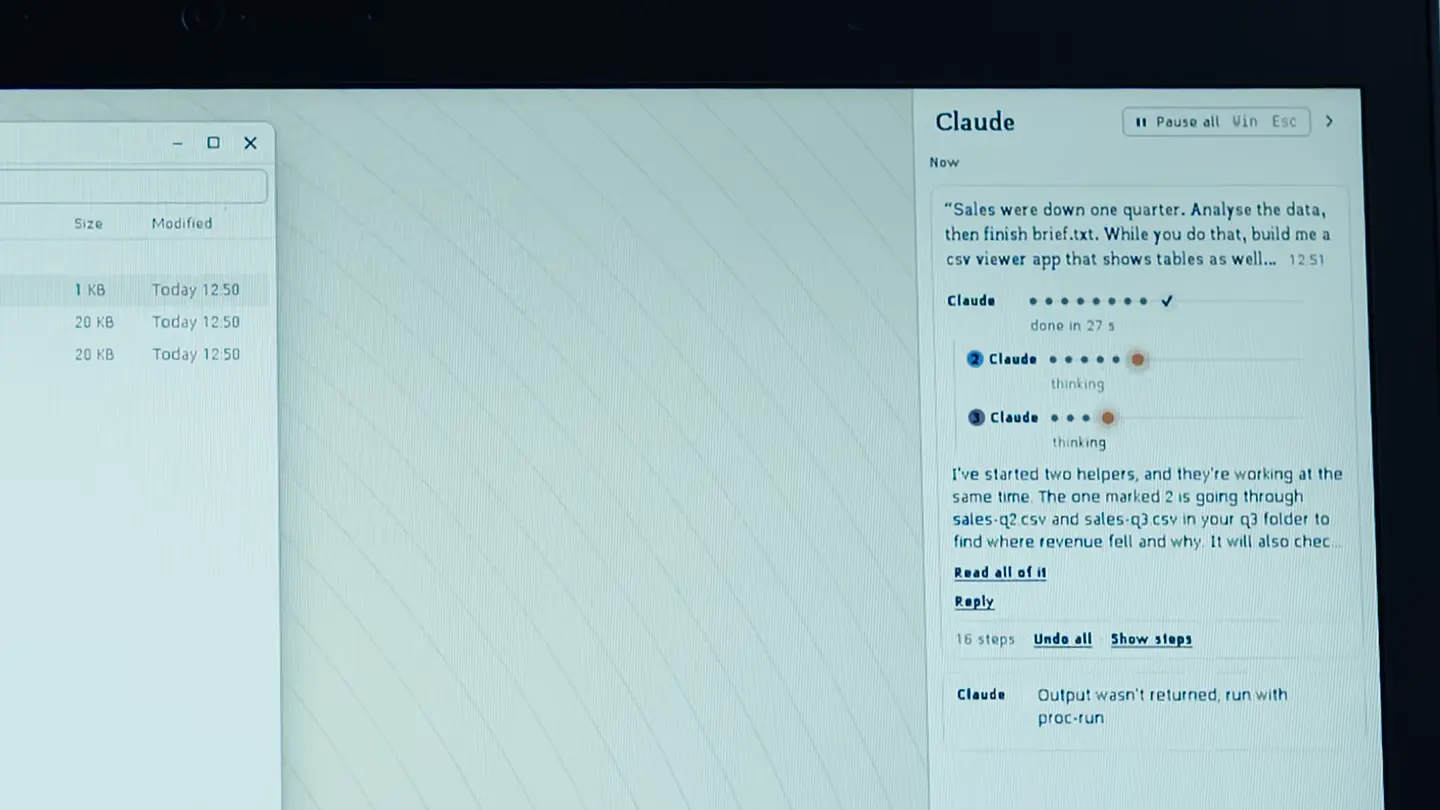
THE REVIEW STILL MATTERS.
01 / WHAT ACTUALLY SHIPPED
A frontier model.
A specific job.
claude-fable-5-2INPUT / OUTPUTText + images → textFable 5.2 is a model, rather than a complete autonomous business. An application supplies its instructions, documents and tools; the model reasons through the task and produces text or tool requests. An agent system still has to execute those requests, manage access and decide what counts as completion.
Anthropic announced Fable 5.2 and Mythos 5.2 on November 9. The company says they share an underlying model, with different safeguards and access paths. Mythos is intended for verified organizations in programs such as cybersecurity and life sciences. Fable is the broadly available route. [1] For an ordinary founder or product team, that makes Fable the relevant starting point for this release.
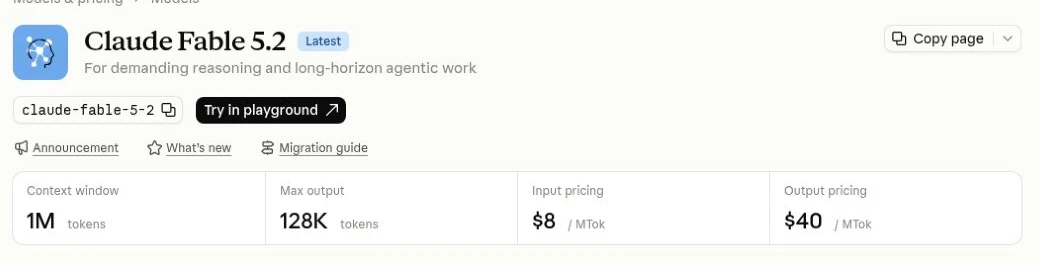
The model documentation lists a million-token context window, up to 128,000 output tokens, and text/image input with text output. [2] Those are capacity limits, not a promise that an entire repository will be understood correctly or that a long document will be useful.
What interests me is an expensive impasse: a migration keeps failing, a technical investigation has conflicting evidence, or a cross-file change needs more than a plausible patch. That is a stronger reason to try a frontier model than asking it to rewrite a routine email.
Anthropic’s own guidance recommends starting with the latest Opus model and moving to Fable when evaluations at higher effort still fall short. [3] The sensible adoption pattern is escalation with evidence, rather than replacing every task at once.
02 / THE PRODUCT, ON THE RECORD
Read the card.
Then test your case.
This is an actual capture of Anthropic’s public model documentation, not a generated interface or a private account session. Open it at full size to inspect the specifications.
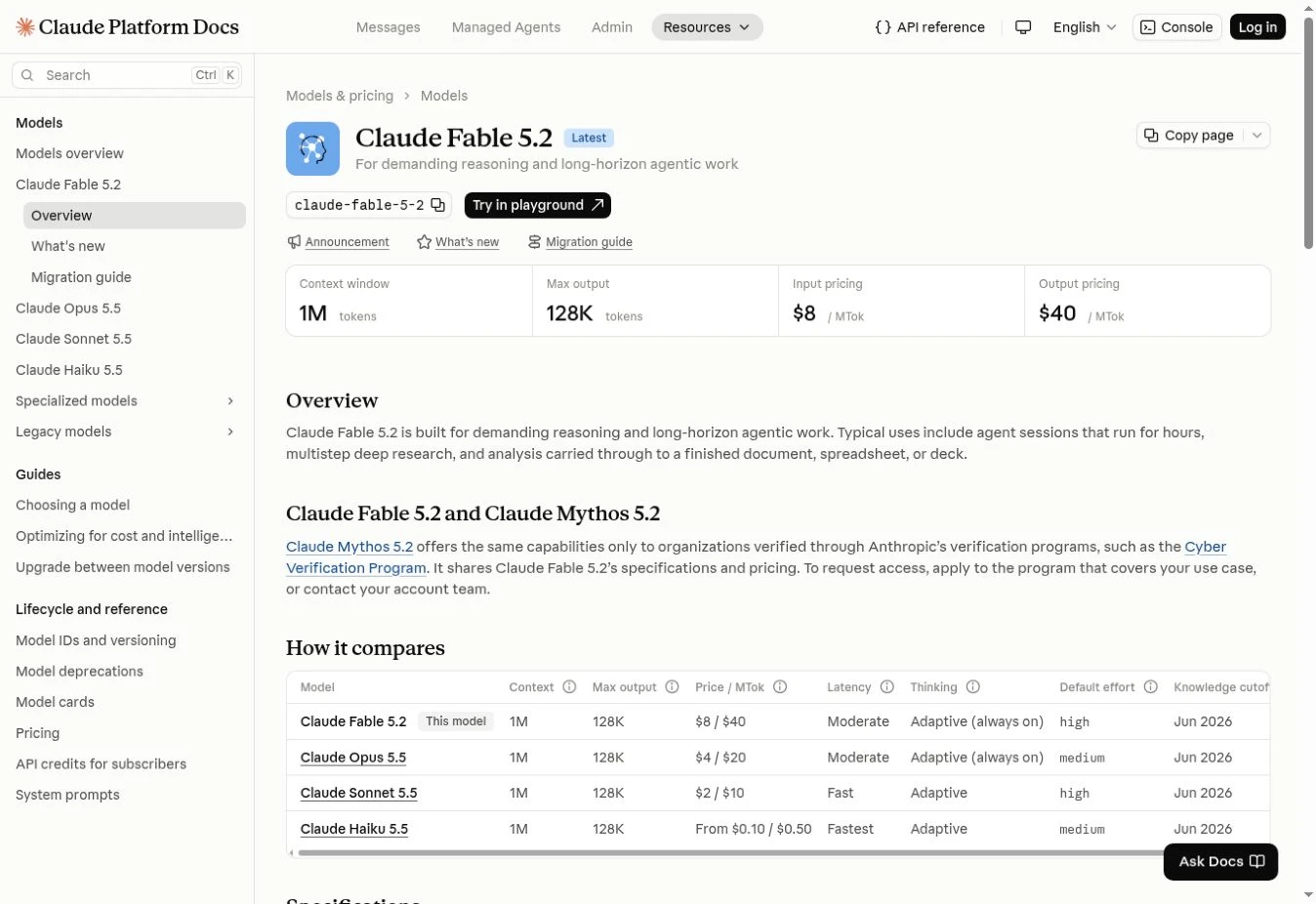
Inspect the model identifier and headline specifications +
Detail crop from the same documentation capture. Full context is available in the image above.
CAPACITY A large context lets you supply more evidence. You still need to make the important evidence identifiable.
CONTROL A model can propose an action. Your application determines which tools and permissions it receives.
ACCEPTANCE A longer or more confident answer is not the same as a verified artifact.
03 / THE ESCALATION DESK
Send the problem.
Keep the judgment.
Choose a fictional task. The desk suggests a way to evaluate Fable’s usefulness. These are authored editorial recommendations, not live model routing or generated answers.
Escalate a bounded migration problem.
Give Fable the failing test, the relevant modules, the old contract and the new contract. Ask for a diagnosis before a patch. Keep the successful behavior explicit.
- What earns the upgrade
- A minimal change that passes the failing case and the existing regression suite, with a clear explanation of the cause.
- What does not
- A broad rewrite that hides the original failure or quietly changes the public contract.
The migration case has an observable finish line. If the model identifies a hidden dependency and fixes it without widening the change, the extra capability has a job. If it merely produces a more elaborate explanation, the impasse remains.
For research, define an artifact: a source map, a reproducible calculation, or an experiment someone else can rerun. The model should separate what a source says from its own interpretation. Do not let a polished synthesis erase the disagreement you needed to investigate.
04 / PRICE THE WORK YOU ACTUALLY SEND
Cheaper than 5.1.
Not a cheap default.
Standard Fable 5.2 API rates are $8 input and $40 output per million tokens, versus $10 and $50 for Fable 5.1. Opus 5.5 is $4 and $20. [4] The comparison below uses those verified rates with explicitly hypothetical volumes.
No requests are sent. These volumes are assumptions, not measured usage. The estimate excludes caching, tools, infrastructure, retries, additional agent calls and human review.
At equal token volumes, the standard rate reduction from 5.1 is 20%. That calculation does not establish a 20% reduction in your project cost. A new model may use different amounts of reasoning, retry less often or generate more text. Measure the whole accepted result.
Fast mode changes the tradeoff again. Anthropic advertises up to 2.5 times faster token generation. [1] That is a vendor claim about generation, not a guarantee that a tool-heavy task finishes 2.5 times sooner. Decide whether waiting or reviewing is your actual bottleneck.
05 / THE UPGRADE IS ALSO AN INTEGRATION
A new identifier
is only the beginning.
Teams running their own agent code should read the migration guide before changing a production default. A better model cannot rescue a request your integration sends incorrectly.
Recheck old assumptions.
Adaptive thinking is always on. The migration guide says disabled or manual-budget thinking is rejected, as is forced tool selection. Omit sampling parameters such as temperature, top_p and top_k. [5] Inventory what your wrapper adds automatically, not just the fields visible in the newest example.
History is part of the contract.
The 5.2 prefix check applies to every account. Editing earlier messages, tools or system instructions can invalidate returned thinking blocks and cause an error. The current guide also restricts which models can read 5.2 thinking blocks. [3] Test your actual history-management and model-switching behavior.
Check the policy before the payload.
The overview specifies 30-day retention and says zero data retention requires express authorization from Anthropic. [2] If your workflow depends on a different arrangement, resolve that fit before submitting sensitive project material.
These are documented integration constraints, not failures reproduced in our account. They are reasons to stage an upgrade and keep a known working route available.
06 / A USEFUL FIRST EVALUATION
One hard case.
One accepted result.
Choose an authorized problem that your current model has demonstrably struggled with. Keep the test small enough that someone can inspect the complete result.
- Save the starting artifact and the actual failure.
- Define success before seeing the new answer.
- Run comparable attempts with a fixed scope and budget.
- Record tokens, tool work, elapsed time and cleanup.
- Review the final artifact against the original requirement.
Task: [one difficult technical problem]
Evidence: [authorized files, logs, sources]
Current failure: [reproducible example]
Must preserve: [contracts and existing behavior]
Success: [test, calculation or reviewed artifact]
Scope: diagnose first; propose a minimal change.
Do not claim a test ran without its result.
Separate evidence, inference and open questions.
Stop before [deployment or other excluded action].
Return: result, verification and remaining limits.
07 / THE VERDICT
Escalation should
earn its place.
Explore Fable 5.2 ↗Direct link. No sponsorship or affiliate relationship.
Fable 5.2 belongs on the shortlist when technical difficulty is blocking an outcome you can verify. The combination of a new frontier release, lower standard rates than 5.1 and explicit integration documentation makes it worth a bounded evaluation for teams with that problem.
I would keep routine work on a less expensive route until a representative test shows a reason to move it. I would also hold an upgrade when the required data handling, request compatibility or review capacity is unresolved. A model’s ambition is not a substitute for an operating plan.
Anthropic’s launch describes substantial coding and scientific achievements. [1] Those reports are useful signals of direction, but they are not evidence that your particular migration, analysis or research question will be solved. That evidence comes from a result you can inspect.
Our earlier Claude dashboard and motion Field Note examined generated visual artifacts. This is a distinct model release and a different adoption decision: when to escalate the difficult part of a workflow. Our Factory coverage explores the surrounding agent-workflow idea. Neither article is a comparative test of Fable 5.2.
The goal is not to use the biggest model everywhere. It is to stop an important problem from staying stuck, while keeping the cost, evidence and responsibility visible.
PRIMARY SOURCES / CHECKED NOVEMBER 10, 2026
Follow the release.
- Anthropic launch announcement ↗
November9,2026. Model positioning, access distinction, fast-mode rates/claim and official demonstration footage.
- Fable 5.2 model overview ↗
Current documentation: model ID, capacity, modalities and retention requirement. Screenshot captured November10.
- What’s new in Fable 5.2 ↗
Current documentation: model-selection advice and changes to history/thinking-block compatibility.
- Claude API pricing ↗
Current USD base rates for the standard-mode calculation. Check current terms before budgeting.
- Fable 5.2 migration guide ↗
Current request compatibility and migration constraints. Documentation pages are living sources; access date is not their publication date.
Documentation-led analysis. No model requests, paid access or private product testing were performed. Task scenarios and the evaluation brief are original editorial work. Calculator volumes are illustrative; rates are sourced. Official footage and documentation captures are labeled. No generated interface, accelerator affiliation or independent performance claim.