Base44 / The Useful Block
I built a Brooklyn block with Base44.
I wanted a personal site you could walk into. Base44 gave the idea a pixel-art street. Its build log shows how it set up the storefronts and a back office for the content.
Walk the block
86th Street, after dark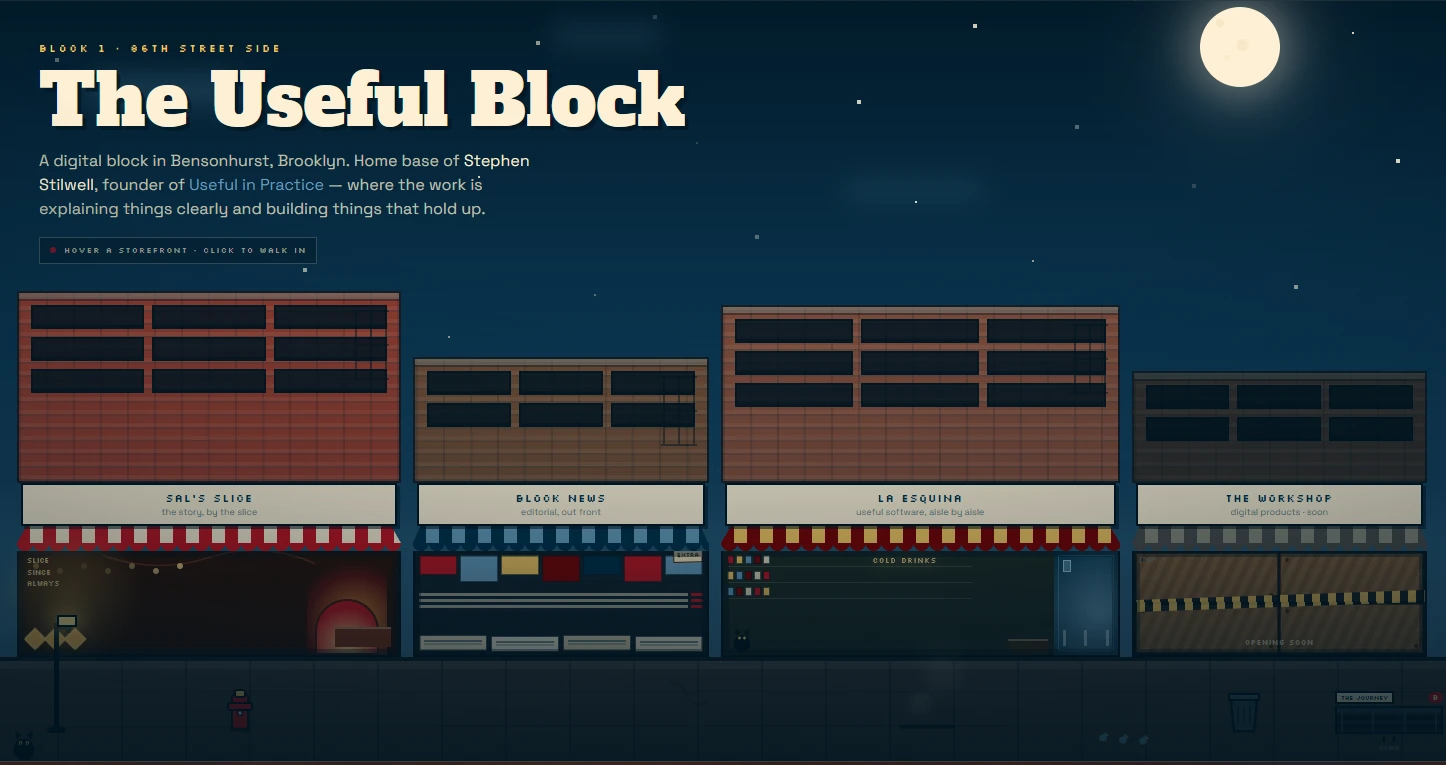
01 / The pizzeria
Sal’s Slice
The pizzeria is where I put my story. The build log lists five starter chapters. The generated copy gave me a structure to work from, and the details and voice are mine to finish.
02 / The newsstand
Block News
A place to browse editorial pieces. The build log lists five starter articles for readers to browse. The newsstand gives the writing its own destination inside the block.
03 / The bodega
La Esquina
Software picks live on shelves. The build log describes ten starter tools, each with a shelf label you can open. A bodega edit also surfaced the persistence issue that made this project interesting.
Original screenshot from my Base44 project. The numbered storefront controls are part of this Field Note.
The idea
Why I started with a street.
I live in Florida, and I have family in Brooklyn and Staten Island. One day I’d like to open a pizzeria or espresso bar in New York. The Useful Block let me start with the digital version, on a fictional street inspired by Bensonhurst.
Base44 is an AI app builder. You describe what the app should do, then refine the result in its editor. Base44 provides managed hosting, a database, and sign-in. For this build, that meant asking for both the street people see and the owner tools I’d use to keep it current. [1]
The brief named five locations and asked for three to work in the first version. The workshop stayed boarded up, and the subway entrance became a tease for a future career journey. Those limits left room for things that make the street feel lived in, like a bodega cat and a hydrant that reacts when you poke it.
From the build transcript
What happened after the prompt.
The builder’s log shows why I’d give an app a visible job and a behind-the-scenes job from the beginning.
01 / Scene
Put the block on screen.
Base44 reported generating the storefronts and scene details first, then correcting an overlap at the subway entrance.
02 / Content
Give each door a job.
The next pass added story chapters, articles, and software entries. The transcript describes an owner-only Manage screen with an editor for each collection. [2]
03 / Persistence
Follow an edit all the way.
A bodega change initially didn’t persist as expected. Base44 reported inspecting the record, cleaning up the test entry, and checking that a saved edit reached the page.
From my original prompt
“Build the first version around an interactive street scene with three functioning locations: the pizzeria, newsstand, and bodega.”
I gave Base44 a place, a palette, and a boundary. I also asked for editable content up front. A visual reference tells the builder how the street should feel. Naming the content and the owner’s job tells it what has to keep working tomorrow.
Try this on your own build
Can you change one shelf label?
A success message in the back office is an intermediate result. The visitor should see the new text after a fresh load, and only the intended account should be able to change it.
Save one recognizable change
Use a disposable item in a test environment. Change its label as the owner, leave the editor, then reopen the record. Compare the text to what you entered.
Follow the same item as a visitor
Open the storefront in a signed-out window and reload it. Check that the updated label is visible and that the public route still works on a narrow screen with touch or keyboard controls.
Check the editing boundary
Confirm the app’s data permissions restrict create, update, and delete access to the intended account or role. Use an ordinary test account to verify editing is unavailable. Remove the disposable record and confirm it disappears from the visitor view. [3]
Base44 documents separate test data and a testing agent. Its testing agent can start signed in, but the vendor says it does not test the login form or verification flow. I’d check those separately. [4]
Where it fits
Would I build with it again?
For another interactive editorial project with a small, editable collection, yes. I’d start with one working destination and one saved edit before adding the rest of the street.
Good first project
A creator portfolio, a niche directory, or an editorial companion where a memorable front end and simple content editing matter. The Block gave me one place to see what those two things look like together.
What I’d check before committing
Budget for iteration against the plan’s credit allowance. If the app needs its own domain or an exit path, check the current tier and try exporting code and records before relying on them. Base44 documents ZIP export and GitHub sync on Builder or higher. A full move also needs a plan for records, authentication, and any hosted services your app uses. [1] [5]
Evidence and sources
What this note is based on.
The supplied screenshot shows the street. The build transcript is the source for the interior content, the back office, and Base44’s reported tests. Live app behavior, permissions, build time, and credit usage are outside the evidence available here. Base44 links are direct.
- Base44’s app-building guide
- Managing app data
- Managing data permissions
- Testing app flows
- Base44 pricing and plan features
Vendor documentation checked November 11, 2026.