
 AGENT 37 / A CLOSER LOOK
Your expertise.
A working
AI product.
You built a workflow that helps. Now someone else needs to use it. Agent 37 is building the infrastructure between those two moments.
useful part
repeatable.Expertise → Skill → Someone’s next step
A useful workflow still needs a front door.
Getting an AI workflow to produce a good answer is a satisfying moment. Delivering that answer to another person, repeatedly, brings a different set of questions. Where does it run? Whose files can it see? How does the customer get back in tomorrow? Who pays when a task takes longer than expected?
I’ve worked across software development, product ownership, and business development. That handoff interests me because the engineering and the customer experience meet there. An excellent workflow buried in someone’s laptop is hard to evaluate, hard to share, and hard to buy.
Agent 37 approaches the handoff from two directions. Its cloud platform gives builders a place to run agents. Its creator product offers a simpler path for packaging a Claude skill as a hosted experience. Understanding which one you need is the first useful decision.
Host an agent.
Or publish a skill.
Different starting points. Different responsibilities.
A persistent home
for the agent.
Agent 37 advertises isolated environments for Hermes, OpenClaw, Claude Code, Codex, and custom harnesses. Files survive restarts; auto-sleep pauses compute; requests can wake the sandbox. App connections and scheduled runs extend it beyond a chat window.
You own the application experience, workflow quality, and customer relationship. Platform overview ↗
Your workflow,
behind a link.
The creator page offers Claude skill uploads, optional MCP configuration, hosted access, free trials, Stripe subscriptions, and an advertised 80% creator payout. Customers can use the link without a Claude account. Creators set prices and ship updates.
A managed creator offer with separate economics from the Cloud API. Creator overview ↗
What changes when it leaves your laptop?
A local agent depends on your machine, its permissions, and its availability. Hosted execution puts that work on a remote computer. Persistence means files can remain for the next session; it does not mean the agent is constantly working or that every task succeeds.
Conceptual architecture. Agent 37’s documentation distinguishes regular sandboxes from full VMs for workloads such as Docker-in-Docker.
See the handoff
for yourself.
Official footage and a real customer implementation.
Provided on the official creator page. The public YC Advisor demo is another entry point; its generated answers have not been evaluated for this article.
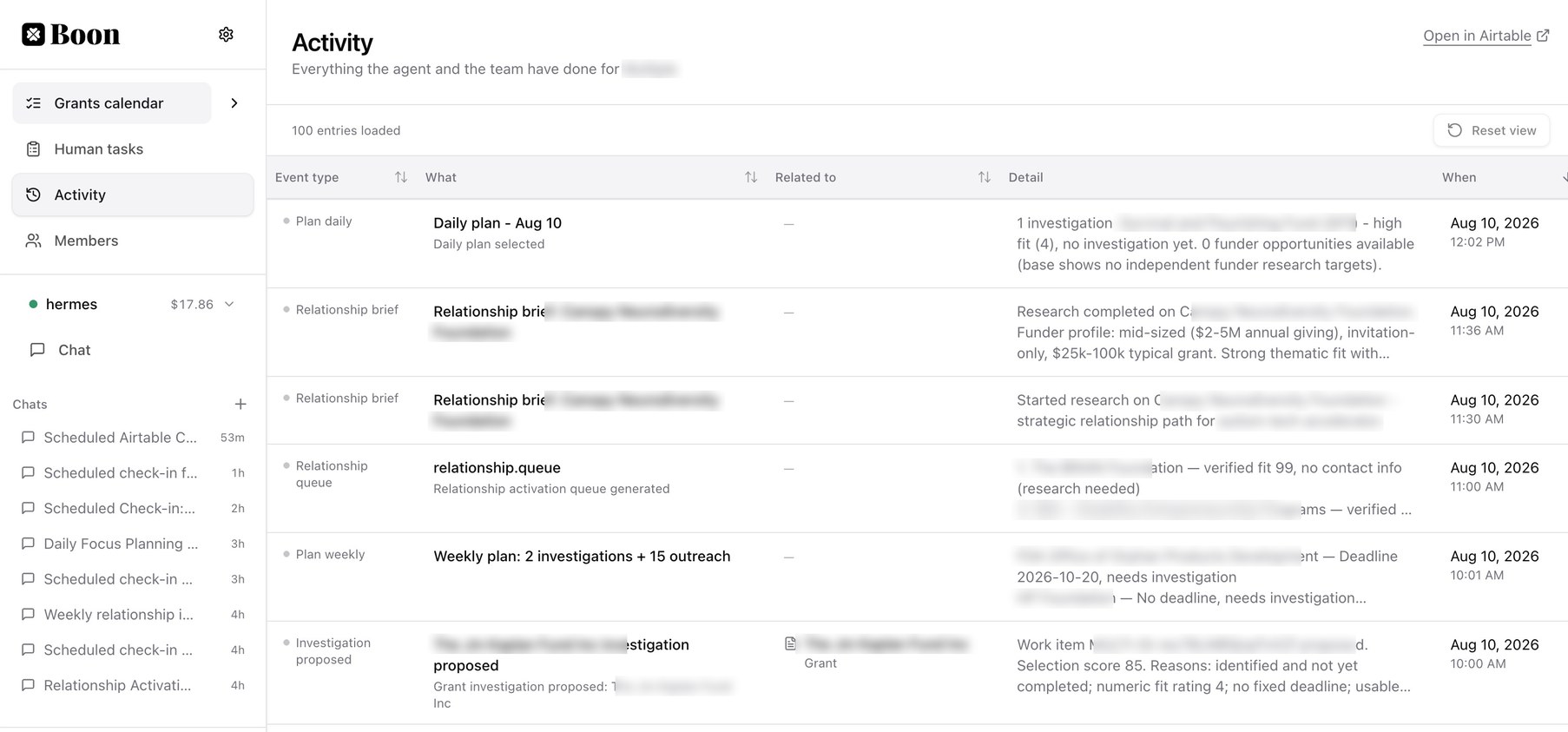
The research worked.
Delivery was the constraint.
In Agent 37’s Boon case study, grant-research skills existed before the hosting was solved. The company describes moving to per-client Hermes agents in three days, with recurring work coordinated by Boon’s own app. A person still approves what reaches the client.
That last detail matters. Infrastructure can remove manual provisioning while leaving editorial judgment exactly where a business needs it.
Company-published customer account, rather than an independently reproduced benchmark. The ETEC+ case study describes a different route: a branded product with its own signup and billing.
 VISHNU KRISHNAPRASAD
FOUNDER / CEO
Less plumbing.
More product.
Y Combinator lists Agent 37 as a New York City company founded in 2026, in its Fall 2026 batch. Founder and CEO Vishnu Krishnaprasad previously worked at Amazon, Quantcast, and ThoughtWorks and studied at Carnegie Mellon.
His launch story is more revealing than the résumé: teams repeatedly built a private computer, persistent files, and a provisioning process for every customer’s agent. That repeated work is the problem Agent 37 wants to absorb.
My read: the opportunity grows when a useful agent has to serve its second, tenth, or hundredth customer. The question shifts from “can it do the task?” to “can we deliver this as a dependable service?”
Company, launch story & portrait source: Y Combinator ↗The AI Skill-to-Product Lab.
You have the expertise. What could you turn it into?
An authored concept planner that runs in your browser. It combines your choices into a brief, without calling an AI model or Agent 37. Inputs stay on this page unless you copy or share them.
Test the method manually. Write and evaluate a skill with sample inputs. Then discuss the managed path with Agent 37’s creator onboarding, or build a custom application with the Cloud documentation. This brief contains no deployable skill or integration.
A smaller, sharper
Useful AI Finder.
I already help readers explore tools through the Useful AI Finder and Workflow Builder. My first hosted experiment would narrow that job: help an independent consultant turn one recurring client task into a practical software workflow.
Ask for the task, existing tools, budget, and constraints. Return a workflow, alternatives, and a first-week setup checklist. Require sources for product claims and flag missing information. I’d begin with a handful of interviews and manually reviewed briefs before adding integrations.
The interesting test is whether someone returns for their next project. A polished first answer gives me something to demonstrate. Repeat use gives me a reason to keep building.
A launch is a beginning.
Make the numbers work.
Creator offer: read the fine print.
The creator page remains public and advertises free onboarding, source privacy, and an 80% share. It also reports 43 paying subscribers for a Story Fruition creator. That is a company-reported example, without independently verified revenue or retention data.
I could not confirm payout geography, settlement timing, refund treatment, or exactly which usage and processing charges the revenue share covers. Confirm those terms, current enrollment, and heavy-user limits before setting a price. A public signup invitation does not establish successful onboarding.
Cloud API: a separate meter.
Published Standard rates are $0.80 per vCPU, $0.70 per GB of RAM, and $0.09 per GB of disk for a 730-hour month. A 2 vCPU / 4 GB RAM / 4 GB disk example totals $4.76 when running all month. Retaining only its disk costs $0.36. Model and tool usage is additional; Performance compute is priced at 4× Standard.
Rates checked October 14, 2026 ↗. These are resource estimates, not an end-to-end product budget. Cloud credit activation requires a card; creator onboarding advertises no card. Terms describe default auto top-up after an initial Cloud top-up.
What makes it worth
coming back for?
Choose a task that recurs. Evaluate ten varied examples, including incomplete and conflicting inputs. Define what a usable output contains and when the agent should ask for help.
Hosted source privacy does not guarantee resistance to prompt extraction. Limit permissions, test adversarial inputs, and require approval for consequential actions. Credentials and customer data need their own handling rules.
Budget for corrections, onboarding questions, model changes, abuse, and cancellation. Track task completion, return use, failure rate, and cost per successful job. Your distribution plan still needs an audience and a reason to try.
Security and privacy: what the documentation actually says
Agent 37 describes gVisor isolation, encrypted storage, restricted network access, and API-key-protected ingress unless a port is made public. These are vendor claims, not findings from a security audit here.
Its privacy policy says it retains account, billing, usage, and operational metadata, with encrypted instance backups, while excluding prompt and response bodies from its own collection. External model and integration providers remain part of the data path. Review their policies too.
The terms put responsibility for agent actions and end-customer obligations on the product builder and make no general uptime promise without a separate agreement. Keep independent copies of important data. Privacy policy · Terms · Trust Center
What could we
build together?
Three proposed collaborations. Start small, learn something useful, then decide what deserves a second round.
AI Product Lab
One narrowly scoped workflow-planning assistant, tested with five volunteer consultants using non-sensitive sample tasks. Useful in Practice contributes research, positioning, workflow design, and distribution; Agent 37 could contribute hosting and onboarding guidance.
First decision: do people return?Review completion, output quality, repeat use, and cost per task before expanding.
The Agent Builder Series
A five-part series: find a recurring job; write a skill; host and share it; test a free trial; improve from usage. Pair one detailed Field Note with short walkthroughs and LinkedIn-native clips for builders, consultants, and solo founders.
First pilot: one complete workflow.Measure whether viewers understand the setup and reach a useful first result.
Creator Launch Campaign
Two authentic product walkthroughs, three short UGC concepts, one practical article, and social edits. Build each around a specific customer task and the real product. Agree on production, distribution, and creative reuse separately.
First test: clearer product education.Negotiate usage rights, paid media permissions, and scope before production.
These are independent proposals. Agent 37 has not commissioned or approved this coverage or these collaborations.
Start with a job
someone wants done.
Agent 37 is interesting because access, persistence, and delivery can consume a surprising amount of the work around an AI product. Its creator path may shorten that distance for a working skill. Its infrastructure gives developers more control over the complete experience.
I’d start with the problem and a few people who have it. Make the result useful, watch where they struggle, and price after understanding the cost to serve them. Hosting makes a workflow accessible. Building a product means giving someone a reason to use it again.
Sources & reporting notes.
Researched October 14, 2026 from public primary sources. This is a documented product analysis, with original concept tools, rather than a hands-on deployment review. Account creation, creator enrollment, payouts, generated demo answers, and production reliability were not tested.
- Agent 37 platform overview and documentation: harnesses, lifecycle, app connections, schedules, and security claims.
- Creator offering: hosted skills, trials, subscriptions, creator share, and reported example. Official Loom demonstration.
- Cloud pricing: unit rates, compute tiers, and storage assumptions. Offers may change.
- Y Combinator profile: company details, founder background, launch narrative, and portrait.
- Company-published Boon and ETEC+ case studies. Dashboard image courtesy of the public Boon case study.
- Privacy, terms, and Trust Center: policies and operational boundaries.
Visual references: official Agent 37 logo; creator-page CSS values #0f0f0f, #262626, #525252, #fafafa, #f5f5f5 and Space Grotesk; homepage sage #819b68. Original editorial compositions and planner interface by Useful in Practice.